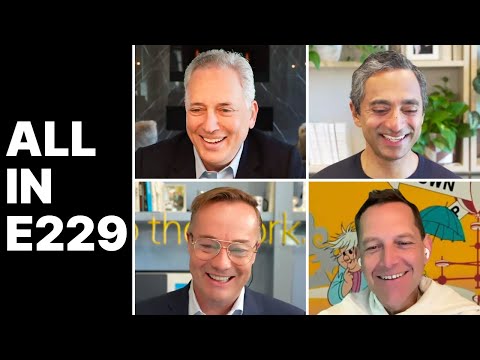
Bond crisis looming? GOP abandons DOGE, Google disrupts Search with AI, OpenAI buys Jony Ive's IO
Jason Calacanis (host), David Sacks (host), Chamath Palihapitiya (host), David Friedberg (host), Jason Calacanis (host), David Sacks (host), Chamath Palihapitiya (host), David Friedberg (host), Jason Calacanis (host)
In this episode of All-In Podcast, featuring Jason Calacanis and David Sacks, Bond crisis looming? GOP abandons DOGE, Google disrupts Search with AI, OpenAI buys Jony Ive's IO explores bond Market Warning, Google’s AI Pivot, OpenAI’s $6.5B Hardware Bet The episode opens with an extended deep dive into a shaky U.S. bond auction, the GOP-backed “Big Beautiful Bill,” and why the hosts see a looming debt and interest-rate spiral exacerbated by political unwillingness to embrace austerity. They argue that higher-for-longer rates could trigger non-linear debt dynamics, crowd out spending, and push investors into gold, Bitcoin, and away from Treasuries, with Japan’s bond market turmoil as an added systemic risk.
Bond Market Warning, Google’s AI Pivot, OpenAI’s $6.5B Hardware Bet
The episode opens with an extended deep dive into a shaky U.S. bond auction, the GOP-backed “Big Beautiful Bill,” and why the hosts see a looming debt and interest-rate spiral exacerbated by political unwillingness to embrace austerity. They argue that higher-for-longer rates could trigger non-linear debt dynamics, crowd out spending, and push investors into gold, Bitcoin, and away from Treasuries, with Japan’s bond market turmoil as an added systemic risk.
They then unpack Google’s I/O announcements, especially AI Mode in Search and a $250/month AI Ultra bundle, framing this as the week Google finally committed to an AI-first business model while still trying to protect its ad cash cow. Parallel to that, they critique OpenAI’s $6.5B acquisition of Jony Ive’s IO, debating whether a new AI hardware device can truly be ‘iPhone-level’ or is overhyped design theater.
The conversation shifts to David Sacks’ Middle East trip and a proposed ‘AI acceleration’ framework: letting Gulf states build massive data centers on U.S. chips in exchange for dollar-for-dollar investment in U.S. AI infrastructure, as a way to box out China and expand the American tech stack globally. They close with a Science Corner segment on a first-of-its-kind, custom CRISPR base-editing treatment for a terminal infant, using it to underscore how biotech, AI, robotics, and—critically—energy abundance could determine whether America grows out of its fiscal crisis.
Across topics, a central throughline emerges: technological revolutions in AI, energy, and biotech can offset dire fiscal math—but only if U.S. political and regulatory systems stop sabotaging power generation, infrastructure, and rational budgeting.
Key Takeaways
Rising Rates + Big Deficits Create a Non-Linear Debt Spiral Risk
Friedberg notes the CBO’s long-run models assume a 3. ...
Get the full analysis with uListen AI
The ‘Big Beautiful Bill’ Trades Debt Discipline for Permanent Tax Cuts
The House bill makes Trump’s 2017 tax cuts permanent, averting what Sacks calls “the largest tax increase in decades” for both the wealthy and middle class, while adding an estimated $3–5T to the national debt over 10 years. ...
Get the full analysis with uListen AI
Energy Policy Is Emerging as the Real Bottleneck for AI and Growth
Chamath and Friedberg argue that all the promise of AI, automation, and biotech hinges on cheap, abundant energy. ...
Get the full analysis with uListen AI
Google Finally Commits to AI-First Search and Subscription Revenue
Google’s I/O announcements introduce an AI Mode in Search that offers synthesized answers alongside the legacy 10-blue-links interface and ads—essentially a Perplexity-like experience integrated into Google. ...
Get the full analysis with uListen AI
OpenAI’s Jony Ive Bet Is Either Genius Option Value or Overhyped Design
OpenAI is acquiring Jony Ive’s hardware startup IO for $6. ...
Get the full analysis with uListen AI
U.S. AI Diplomacy in the Gulf Trades Chips for Capital and Alignment
Sacks describes a new ‘AI acceleration partnership’ framework with Gulf states: for every dollar they invest in local data centers, they must invest a dollar in AI infrastructure in the U. ...
Get the full analysis with uListen AI
CRISPR Base Editing Shows How Tech Could Help ‘Grow Out’ of Debt
In Science Corner, Friedberg explains a case where doctors used custom CRISPR base editing to change a single A→G mutation in a baby’s CPS1 gene, allowing liver cells to produce a crucial urea-cycle enzyme and preventing lethal ammonia buildup. ...
Get the full analysis with uListen AI
Notable Quotes
“There is a non-linear relationship between the deficit and interest rates which drives up the debt problem in a non-linear way and it gets away from you and you can't fix it.”
— David Friedberg
“If DOGE was meant to be a reflection of the American voting population's desire for meaningful reform in government... this is the opposite of that.”
— Chamath Palihapitiya
“This is the moment where we either re-underwrite what we voted for, or we mistakenly pass this Christmas tree concoction... If it passes, forget what any of us think, the bond markets will act decisively and they're gonna go in one direction, and it's away from us.”
— Chamath Palihapitiya
“If we have enough power, the 38 trillion of debt doesn't matter. I'm very, very serious right now.”
— David Friedberg
“The choice is, do we want these countries to be the piggy bank for American AI or for Chinese AI?”
— David Sacks
Questions Answered in This Episode
Friedberg quantified how a 1.5% rate increase adds roughly $5T in interest over a decade—what specific mix of spending cuts or revenue increases would you implement today to neutralize that interest shock without triggering a recession?
The episode opens with an extended deep dive into a shaky U. ...
Get the full analysis with uListen AI
Chamath argued that late-night changes to tax-equity rules will gut near-term private investment in power generation—can you walk through one concrete example (e.g., a solar or storage project) where the new rules make the economics go from ‘go’ to ‘no-go’?
They then unpack Google’s I/O announcements, especially AI Mode in Search and a $250/month AI Ultra bundle, framing this as the week Google finally committed to an AI-first business model while still trying to protect its ad cash cow. ...
Get the full analysis with uListen AI
Sacks’ AI acceleration framework requires Gulf states to invest dollar-for-dollar in U.S. AI infrastructure and keep 80% of chips under U.S. control; what additional safeguards (technical, legal, or governance) would you add to prevent this from becoming a de facto loophole for Chinese influence or access?
The conversation shifts to David Sacks’ Middle East trip and a proposed ‘AI acceleration’ framework: letting Gulf states build massive data centers on U. ...
Get the full analysis with uListen AI
Google is cautiously overlaying AI Mode on top of its classic search UI to protect ad revenue—if you were running Google, at what user-behavior or revenue threshold would you flip AI Mode to the default experience even if it meant a short-term decline in ad dollars?
Across topics, a central throughline emerges: technological revolutions in AI, energy, and biotech can offset dire fiscal math—but only if U. ...
Get the full analysis with uListen AI
The CRISPR base-editing case shows we can custom-build gene therapies within months for ultra-rare mutations—how should regulators, insurers, and hospitals be reorganized so that a middle-class child on public insurance can realistically get that level of personalized treatment without waiting years or facing bankruptcy?
Get the full analysis with uListen AI
Transcript Preview
All right, everybody. Welcome back to the number one podcast in the world, the All-In Podcast. Today, the original squad is back. No guests, just Full Contact Sax is back. We're going to break down a number of topics today including chaos in the bond market as Republicans seemingly have abandoned the Doge agenda. And we're going to debate the Big Beautiful Bill, which is going to add trillions to our national debt. And it's a new era for Google as they release an AI first search product. OpenAI has acquired Johnny Ives company, Ayo, to make some sort of gadget. They've paid over $6 billion. Is this the real deal or not? You're going to find out today. And is energy the solution to every problem we have? One bestie's got a very interesting take. All that and more on the number one podcast in the world. Stick with us. For the fourth year in a row, we're going to do the All-In Summit. If you guys remember, four years ago, I decided, "Hey, let's do a summit," and then these three besties were like, "No, we don't want to do a summit." Now, it's become a big thing and everybody loves it. September 7th to 9th in Los Angeles.
I do give you credit for that, J Cal.
Yeah, after you gave me hell for a year, okay.
Great, great.
That sounds like an apology, but okay, sure.
I'm sorry. You're wonderful and I appreciate what you created.
Thank you very much. Wow, finally some credit. Okay. We all know the goal of the summit is to have the world's most important conversations and this year will be no different. Yada, yada, yada. Allin.com/summit if you would like to apply to come.
Why do you say the most important conversations and then say, "Yada, yada, yada," as a way to dismiss it? Do you think that that-
(sighs)
... increases your salesmanship and effectiveness?
(laughs)
I don't want to make any grand pronouncements here, but these have been important conversations we've had and it's been pretty great, I have to say.
Yada, yada, yada.
(laughs)
No, it's just like, they put like 18 things in the plugs now, and I don't want to do too many plugs.
Well, why don't you do a modicum of work before you get on camera-
(laughs)
... and actually edit it?
Here we go. (laughs) I get one compliment and then here it comes.
That's exactly it. He doesn't do the homework, so he runs out of words. He's like, "We got the biggest names to come to our summit, the Vice President came." He said, "Yada, yada, yada."
Elon Musk showed up in person. "Yada, yada, yada."
(laughs)
There was an astronaut.
(laughs)
Friedberg lost his mind.
"Yada, yada, yada."
"Yada, yada, yada."
(laughs)
Install uListen to search the full transcript and get AI-powered insights
Get Full TranscriptGet more from every podcast
AI summaries, searchable transcripts, and fact-checking. Free forever.
Add to Chrome