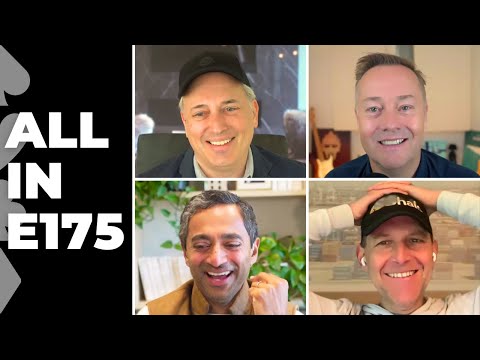
Google fires protestors, NPR chaos, Humane's AI Pin, Startup tax crisis, sports betting scandal
David Sacks (host), Chamath Palihapitiya (host), Jason Calacanis (host), Narrator, David Friedberg (host), David Friedberg (host), David Sacks (host)
In this episode of All-In Podcast, featuring David Sacks and Chamath Palihapitiya, Google fires protestors, NPR chaos, Humane's AI Pin, Startup tax crisis, sports betting scandal explores google Firings, NPR Turmoil, AI Pin Flop, Startup Tax Squeeze, Betting Scandal This All-In Podcast episode ranges from light banter and poker talk to serious debates on tech worker activism, media bias, AI hardware, tax policy, and sports betting ethics.
Google Firings, NPR Turmoil, AI Pin Flop, Startup Tax Squeeze, Betting Scandal
This All-In Podcast episode ranges from light banter and poker talk to serious debates on tech worker activism, media bias, AI hardware, tax policy, and sports betting ethics.
The hosts dissect Google's firing of pro-Palestinian protesters, NPR's escalating culture war controversy, and YouTuber Marques Brownlee's brutal review of Humane's AI Pin.
They highlight a looming R&D tax-change crisis for startups, explore the social consequences of legal sports betting after an NBA betting scandal, and repeatedly return to themes of entitlement, distraction, and how technology is reshaping behavior.
Throughout, they contrast principled protest and innovation with naivete, institutional capture, and unintended consequences from both policy and product design.
Key Takeaways
Workplace protests carry real employment risk, and protesters must own that tradeoff.
The Google sit-in protesters were at-will employees who occupied offices, impeded work, and were promptly fired. ...
Get the full analysis with uListen AI
NPR’s perceived leftward drift, combined with public funding, fuels political backlash.
The panel views the NPR story as unsurprising—NPR has long been left-of-center—but flags a real issue: taxpayer funding for an openly ideological institution. ...
Get the full analysis with uListen AI
Deep-tech and hardware startups are uniquely vulnerable: one bad V1 can burn hundreds of millions.
Humane’s AI Pin, built by ex-Apple executives and backed with ~$250M, illustrates how capital-intensive hardware forces you to sink huge sums before real user feedback. ...
Get the full analysis with uListen AI
Wearables and continuous recording raise profound social and privacy frictions.
The hosts are skeptical of visible, socially intrusive devices like the AI Pin for everyday interaction, predicting pushback similar to Google Glass. ...
Get the full analysis with uListen AI
A little-noticed R&D tax change is a major hidden threat to small innovators.
Due to a 2017 law now in force, US companies must amortize R&D over five years (15 if done abroad), meaning a break-even software or biotech startup can owe tax on phantom ‘profits’. ...
Get the full analysis with uListen AI
Legal sports betting is structurally addictive and now systemically embedded in sports economics.
The Jontay Porter scandal shows how prop bets and real-time data make manipulation both tempting and detectable. ...
Get the full analysis with uListen AI
Chronic distraction and entitlement may signal a deeper lack of meaningful, challenging work.
Across topics—from protest movements to online pile-ons over product reviews—the hosts repeat a theme: overreacting to ‘fake battles’ is often a sign people aren’t truly stretched or mission-focused. ...
Get the full analysis with uListen AI
Notable Quotes
“Groups of people in society in a democracy should have a right to protest… When that stuff impedes the public functioning of society for other people, then I think there is a responsibility for law enforcement to act.”
— Chamath Palihapitiya
“This is what I would call left-on-left violence: left-leaning people creating all of these distractions inside left-leaning organizations for not being left-leaning enough.”
— Chamath Palihapitiya
“Reviewers are gonna review, protesters are gonna protest, and NPR presidents are gonna NPR.”
— David Sacks
“If you get caught up in all of these silly little fake battles, what it really means is that you’re not busy enough and you’re not working on something that matters enough to you.”
— Chamath Palihapitiya
“Adults should be allowed to bet on sporting events… It’s probably not a great thing on a societal basis, but it’s something you allow to happen because of personal freedom.”
— David Sacks
Questions Answered in This Episode
For the fired Google protesters: if your real target was the Gaza war itself rather than Project Nimbus, why choose a narrow corporate contract as the focal point instead of using your visibility to critique the broader policy more directly?
This All-In Podcast episode ranges from light banter and poker talk to serious debates on tech worker activism, media bias, AI hardware, tax policy, and sports betting ethics.
Get the full analysis with uListen AI
To NPR leadership and critics like Uri Berliner: can you articulate a concrete, operational definition of ‘open-minded’ coverage, with measurable guardrails, that would satisfy both internal staff and external skeptics while preserving editorial freedom?
The hosts dissect Google's firing of pro-Palestinian protesters, NPR's escalating culture war controversy, and YouTuber Marques Brownlee's brutal review of Humane's AI Pin.
Get the full analysis with uListen AI
For Humane’s founders and investors: in hindsight, what specific product-scope or go-to-market decisions (e.g., trying to replace the phone, price point, always-on AI UX) would you change, and how will you rebuild trust after a high-profile ‘worst product’ review?
They highlight a looming R&D tax-change crisis for startups, explore the social consequences of legal sports betting after an NBA betting scandal, and repeatedly return to themes of entitlement, distraction, and how technology is reshaping behavior.
Get the full analysis with uListen AI
To members of Congress shaping tax policy: how do you justify maintaining 5–15 year R&D amortization in the US while competitor nations explicitly subsidize R&D, and what empirical thresholds (e.g., startup failures, offshoring trends) would trigger you to reverse course?
Throughout, they contrast principled protest and innovation with naivete, institutional capture, and unintended consequences from both policy and product design.
Get the full analysis with uListen AI
For the NBA and sportsbooks: given the structural incentives and ease of manipulation with player prop bets, should there be tighter limits or outright bans on certain props involving low-minute players to reduce both corruption risk and targeted harassment of fringe athletes?
Get the full analysis with uListen AI
Transcript Preview
Chamath, did you go down to the Breakthrough thing this weekend?
The Breakthrough Prize was amazing. It's like observing exotic animals-
(laughs)
... in their natural habitat.
Well, a friend of mine who you hung out with down there called me (thudding sound) last night to give me the breakdown on all the individuals he saw and what was going on with them.
I mean-
He's like-
... I don't even know how Nat and I keep getting invited to this, but, like, to say we were outclassed is an understatement.
(laughs)
The people at that thing (laughs) were-
What is this, the Breakthrough Awards?
The Breakthrough Prize, yeah.
Yeah, I couldn't make it. I got invited, too. Shout out to Yuri.
It's so incredible.
Yeah.
Okay, first of all, shout out to Yuri and Julia. It is incredible. There were two moments where I cried. This woman goes up on stage to give an award to the people that had made this advancement in cystic fibrosis.
Yeah.
And she says, "My child was born with cystic fibrosis, and then my second child was born with cystic fibrosis, and then my second child died." She said that. I just burst into tears. And then you present an award to the person that actually is helping them stamp out the disease. We celebrated the people that found the gene that caused Parkinson's, and then... Yeah, I mean, the, the people at that... It's pretty incredible.
It's in LA, right? They did it in Los Angeles?
Yeah, I mean, like, look, Yuri Milner and Julia Milner, Zuck and Priscilla Chan, and Anne Wojcicki, and Sergey Brin, those six people are the ones that organizes Breakthrough Prize, and I think it's just a modern version of the Nobel which tries to really shine a spotlight on people doing really groundbreaking work in physics and math and life sciences. And so you get people that have just done things that are just very practical and are very real, and I think what they do is they make, frankly, these kinds of achievements much more high level in the sense that you're bringing together people from Hollywood and people from Silicon Valley, and the awareness is up, and it's just incredibly well-produced, and... Yeah, it's really a cool thing to be a part of. But, I mean, seeing some of these people ver- are very intimidating. I sat beside Vin Diesel.
(laughs)
Oh, really?
That was super cool. He is a super nice guy, and on the other side of me was someone that actually Sachs knows, Toby Emmerich, who's a, was the chairman of Warner Brothers. So just talking to these guys was super cool.
Moving it to Los Angeles was a great move. And it's ju-
Great idea.
Yeah, it's just I was invited. I couldn't make it, so sorry, and thank you to Julia and Yuri for inviting us again. But it, it's really great that they're giving it the celebration it deserves and making it, you know, like, dare I say, sexy and cool and hip to be a scientist and solve the world's biggest problems. I, I think it's just so awesome. And you're right, Sergey Brin, Anne Wojcicki, Zuck, and Priscilla and Julia and Yuri are the founders of the Breakthrough Prize.
Install uListen to search the full transcript and get AI-powered insights
Get Full TranscriptGet more from every podcast
AI summaries, searchable transcripts, and fact-checking. Free forever.
Add to Chrome