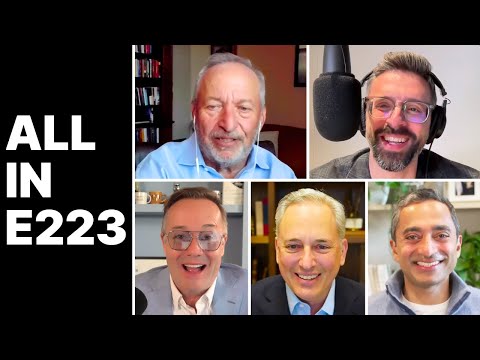
The Great Tariff Debate with David Sacks, Larry Summers, and Ezra Klein
Larry Summers (guest), Ezra Klein (guest), Chamath Palihapitiya (host), Jason Calacanis (host), Nikki (producer / crypto czar) (guest), David Friedberg (host), David Sacks (host)
In this episode of All-In Podcast, featuring Larry Summers and Ezra Klein, The Great Tariff Debate with David Sacks, Larry Summers, and Ezra Klein explores trump’s Tariff Shock: Summers, Sacks, Klein Clash Over Strategy This episode of the All-In Podcast stages a combative, in-depth debate on Trump’s new tariff regime and broader economic strategy, featuring David Sacks (now in the administration), economist Larry Summers, and journalist Ezra Klein. The panel dissects whether the sudden 10% global tariff plus a 125% China tariff are strategic leverage or reckless economic vandalism. They argue over the legacy of bringing China into the WTO, re‑industrialization, supply-chain resilience, and the meaning of market turmoil following “Liberation Day.”
Trump’s Tariff Shock: Summers, Sacks, Klein Clash Over Strategy
This episode of the All-In Podcast stages a combative, in-depth debate on Trump’s new tariff regime and broader economic strategy, featuring David Sacks (now in the administration), economist Larry Summers, and journalist Ezra Klein. The panel dissects whether the sudden 10% global tariff plus a 125% China tariff are strategic leverage or reckless economic vandalism. They argue over the legacy of bringing China into the WTO, re‑industrialization, supply-chain resilience, and the meaning of market turmoil following “Liberation Day.”
Klein repeatedly presses Sacks and Chamath Palihapitiya for clear goals and measurable success metrics, while Summers warns the U.S. is drifting toward a Peron-style, cronyist ‘emerging market’ model. The second half broadens into a discussion of state capacity, DOGE’s aggressive budget-cutting, Democratic governance failures, and how to actually build an “abundance agenda” in practice. The episode closes with reflections on political realignment, administrative competence, and whether disruptive figures like Trump and Musk are necessary—or dangerous—for reform.
Key Takeaways
Trump’s tariff shock introduced major economic volatility and raised recession fears.
Trump imposed a 10% across-the-board tariff plus a 125% China tariff, then abruptly paused most non-China tariffs for 90 days. ...
Get the full analysis with uListen AI
Summers argues tariffs are an inflationary shock that push the U.S. toward ‘emerging market’ status.
Summers contends large tariffs will mostly be passed through to consumers, raising prices and effectively making households poorer, which dampens demand and raises unemployment. ...
Get the full analysis with uListen AI
Sacks and Palihapitiya see tariffs as hard-nosed leverage to reset trade and re‑industrialize.
Sacks frames the tariffs as a deliberate move to establish U. ...
Get the full analysis with uListen AI
There is rare cross-ideological agreement on the need for resilience in four strategic domains.
Chamath outlines four ‘sacrosanct’ areas where the U. ...
Get the full analysis with uListen AI
Ezra Klein’s central critique: big moves are being made without clear goals or success metrics.
Klein repeatedly asks Sacks and Chamath to specify how they would judge success in two years—what metrics (manufacturing jobs, specific sectors, GDP growth, trade balances) would show the tariffs were worth the upheaval. ...
Get the full analysis with uListen AI
The China-WTO debate exposes deep disagreement over both history and counterfactuals.
Sacks blames China’s WTO accession and PNTR for millions of lost U. ...
Get the full analysis with uListen AI
Klein’s ‘abundance agenda’ and DOGE’s cuts highlight a shared diagnosis but divergent solutions on state capacity.
Klein’s new book argues Democrats routinely subsidize demand (e. ...
Get the full analysis with uListen AI
Notable Quotes
“This is dangerous work with a sledgehammer on a pretty sensitive machine, which is the global economy.”
— Larry Summers
“We are trading like an emerging market country right now... we have changed the zeitgeist surrounding America to the kind of zeitgeist that surrounded Juan Perón’s Argentina.”
— Larry Summers
“If I had told you eight days ago that Trump would find a way to get the entire world to eagerly embrace a 10% tariff on the American market... you would have said that would be an April Fool’s joke.”
— David Sacks
“Knowing what you are trying to achieve is the first part of achieving it.”
— Ezra Klein
“The paradox of all of this is what they’re describing, in some ways, is what Trump and Elon are doing. But it’s a bit too hot.”
— Chamath Palihapitiya
Questions Answered in This Episode
For David Sacks and Chamath: if in two years U.S. semiconductor, AI, energy, critical minerals, and pharma-API supply chains are only marginally less dependent on China, but GDP growth has slowed and inflation is higher, would you judge this tariff strategy a failure?
This episode of the All-In Podcast stages a combative, in-depth debate on Trump’s new tariff regime and broader economic strategy, featuring David Sacks (now in the administration), economist Larry Summers, and journalist Ezra Klein. ...
Get the full analysis with uListen AI
For Larry Summers: you argue PNTR didn’t ‘open’ U.S. markets because MFN was already in place—how do you quantify the additional impact of expectations and investment flows that Sacks says were unlocked by making that status permanent?
Klein repeatedly presses Sacks and Chamath Palihapitiya for clear goals and measurable success metrics, while Summers warns the U. ...
Get the full analysis with uListen AI
For Ezra Klein: your abundance agenda and DOGE’s cuts both target bureaucratic bloat, yet you see DOGE as destroying capacity—where exactly would you draw the line between acceptable, high-speed deregulation and reckless dismantling of crucial functions like tax enforcement or foreign aid?
Get the full analysis with uListen AI
For all guests: if you were designing a narrow, resilience-focused tariff or industrial policy regime from scratch, which specific products or HS codes would you target first, and what sunset or review mechanisms would you build in to prevent permanent, rent-seeking protectionism?
Get the full analysis with uListen AI
For Chamath: your ‘Mar-a-Lago Accords’ vision imagines countries trading tariff relief for shifting big contracts (planes, energy, imports) toward the U.S.—how do you prevent that from devolving into pure patronage and shakedowns, especially when combined with the highly personalized, leader-to-leader deal-making style you praise?
Get the full analysis with uListen AI
Transcript Preview
Looking forward to our thing in a few weeks.
Yeah, I don't know if I'll end up being there but I'm hoping to. I'm hoping to.
Oh.
It's been-
What, do you guy- you guys have, like, a liberal cuddle party or what are you doing?
Yeah, yeah. L- Larry takes a bunch of MDMA and we all sort of go into the, the corner and hang out together.
God, that sounds incredible.
(laughs) Liberalism is wonderful, man. You should come try it.
That's not liberalism. It's called something else, Ezra.
(laughs)
Sorry, Niki, is our crypto czar joining us or no?
He's, uh, I'm talking to (beep) now. It looks like he is...
Oh, zing! This is gonna be great.
This will be like ratings bonanza.
All right. We do have David Sacks here.
All right.
David, make sure you have your quick time on.
Look at Sacksy-poo, looking so presidential.
He looks thin, doesn't he?
Oh, he looks fabulous.
I'm going all in. 50s are back in town. All right, here we go. Let your winners ride.
Rain man, David Sacks.
I'm going all in.
And I said-
We open sourced it to the fans and they've just gone crazy with it.
Love you, Wesley.
I mean, queen of kin wow.
I'm going all in. All right, everybody. Welcome back to the number one podcast in the world. I'm your host, Jason Calacanis, with my bestie, Chamath Palihapitiya, our chairman dictator, and live from, well, the administration, Mr. David Sacks, our czar for AI and crypto, and amazingly, two fantastic guests this week. We have, uh, New York Times writer and host of the Ezra Klein podcast. He's got a new book with Derek Thompson, Abundance, and he co-founded Vox in 2014, and he's our guest here today before Trump ships him to El Salvador. Please welcome, E- Ezra Klein. I'll let you start.
(laughs) Glad to be here in my final hours of freedom.
Okay, great. Good to be here. Sorry, Sacks. Uh, uh, and, uh, with us, of course, Larry Summers, economist, former Treasury Secretary under Clinton, former Director of the National Economic Council under Obama, and the President of Harvard from 2001 to 2006. Thanks for coming, Larry.
Good to be with you.
Okay, we have, uh, a lot to get to here so we, uh, might as well talk about the big news of tariffs. It's day 80 of the Trump presidency, eh, a second presidency, his second term, and Trump tweeted that he paused tariffs for everyone but China on Wednesday. Basically, let me just cue up the details, Larry, and then we'll get your take on all of this. Just one week after Liberation Day, Trump announced on Truth Social that, in effect, he was raising tariffs against China, 125%, based on their "lack of respect," quote unquote, instead of negotiating, and that he was pausing reciprocal tariffs on all other countries for 90 days, and markets ripped 10% after he posted this. And today, Thursday, when we tape, there's been a massive selloff on Wall Street so the rollercoaster ride continues. What it will be on Friday when you consume this podcast is anyone's guess. S&P is down 5% today. For context, the S&P was at 5700 pre-Liberation Day, so about a 9% drop after these wild swings. And, uh, in fact, this has been historic volatility. Here are the top selloffs in history. As you can see, three of them came during Black Monday in 1987, three of them came during the financial crisis, three of them came during COVID, and, uh, coming in 11th is Trump's tariffs. Also, in the gainers, uh, you have these big rebounds. Wednesday's 9.5% recovery was number three. The administration says this was all part of a master plan, we'll hear more about that later, and that they laid a trap for China. They laid a trap. Bessent has been the spokesperson during this retreat, or whatever we're gonna call the, uh, pause, and quote, "This was driven by the President's strategy... He and I had a long talk on Sunday, and this was his strategy all along." I don't think we need to play the clip. Uh, that's the gist of it. The White House account then tweeted in all caps, my favorite way to tweet, "DO NOT RETALIATE AND YOU WILL BE REWARDED." Wall Street Journal, on the other side, posted a story about why Trump blinked. They chronicled the decision as, uh, being affected by Jamie Dimon, who went on Fox to express fears of recession while saying the tariffs were valid and that he knew the Trump and cabinet would be watching him on Fox. Other banking executives, who felt they didn't have a lot of influence in this administration, according to the Wall Street Journal, started lobbying Republican lawmakers that the Trump tariff plan would tank the economy. The White House Chief of Staff, Suze Wiel, started receiving calls from executives and lobbyists expressing concerns and, uh, the Wall Street Journal reports that Trump was influenced heavily by Bessent. They were flooded with worried calls from Wall Street and that the president was, uh, lobbied to find an off-ramp. Trump ultimately relied on his instincts, according to the administration. Larry, is this 4D chess or is this something else? What are your thoughts?
Install uListen to search the full transcript and get AI-powered insights
Get Full TranscriptGet more from every podcast
AI summaries, searchable transcripts, and fact-checking. Free forever.
Add to Chrome