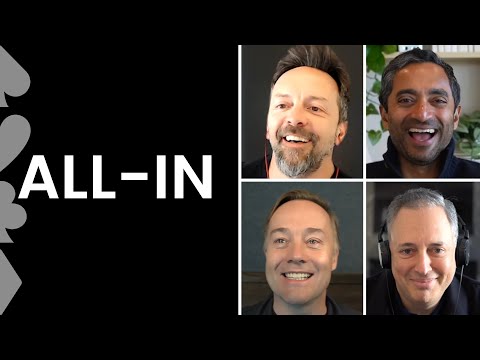
E73: Late-stage VC markdowns and mistakes, market strategy, Ukraine/Russia update with Brad Gerstner
Jason Calacanis (host), David Sacks (host), Brad Gerstner (guest), Chamath Palihapitiya (host), David Sacks (host), David Friedberg (host), Narrator
In this episode of All-In Podcast, featuring Jason Calacanis and David Sacks, E73: Late-stage VC markdowns and mistakes, market strategy, Ukraine/Russia update with Brad Gerstner explores vC valuations reset, startup survival, and Ukraine war’s economic shock The episode features Brad Gerstner joining the All-In hosts to unpack the sharp repricing of tech and SaaS stocks, arguing it’s a painful but necessary normalization after the zero-interest-rate, stimulus-fueled bubble of 2020–2021.
VC valuations reset, startup survival, and Ukraine war’s economic shock
The episode features Brad Gerstner joining the All-In hosts to unpack the sharp repricing of tech and SaaS stocks, arguing it’s a painful but necessary normalization after the zero-interest-rate, stimulus-fueled bubble of 2020–2021.
They explain how rising rates mechanically compress revenue multiples, why late-stage venture is essentially “closed” without real price discovery, and what this means for unicorns, down-round IPOs, and founder playbooks.
The conversation shifts to the Ukraine–Russia war, where Sacks and Gerstner argue U.S. policy appears focused on using overwhelming economic sanctions to weaken Russia—potentially at the risk of recession, famine, and escalation—rather than prioritizing a rapid ceasefire.
They close by noting global demand destruction (energy prices, no more stimulus, higher mortgages), China’s move to stimulate its economy, and the need for investors and founders to re-focus on quality, efficient growth, and realistic outcomes.
Key Takeaways
Rising rates mechanically compress growth valuations by 15–20% per 100 bps.
Chamath summarizes Brad’s framework: when rates go from 0% to ~2. ...
Get the full analysis with uListen AI
Late-stage venture is mispriced and effectively “closed” until reality hits.
Gerstenr says most late-stage unicorns still reflect 2021 fantasy multiples; real price discovery will only occur when they must raise or IPO, likely at 40–60% lower valuations and many down-round IPOs.
Get the full analysis with uListen AI
Founders must manage to runway, efficiency, and profitability—not just growth.
Sacks pushes burn multiple as a critical metric (aim ≤2, ≤1 is excellent), and the group stresses that healthy gross margins, contribution margins, and a clear path to EBITDA-positive within ~2 years are now survival requirements.
Get the full analysis with uListen AI
“Nth player” startups in crowded, capital-intensive markets are in serious danger.
Delivery apps, neobanks, and low-end SaaS relying on paid acquisition face rising CAC and intense competition from public incumbents; many will be forced into brutal down rounds or fail outright.
Get the full analysis with uListen AI
VC behavior and weak governance amplified the bubble and will amplify the bust.
They criticize late-stage investors for chasing logos, stripping protections, overpaying with no ratchets, prioritizing velocity of deals over judgment, and ignoring unit economics—leaving employees and founders holding the bag.
Get the full analysis with uListen AI
Quality and concentration matter more than ever for investors.
Gerstner advocates shrinking portfolios to a handful of “must-own” durable winners (e. ...
Get the full analysis with uListen AI
The Ukraine war plus sanctions create major tail risks and economic drag.
Sacks warns U. ...
Get the full analysis with uListen AI
Notable Quotes
““Multiple expansion hides many sins, and now the opposite is happening in a dramatic and historic way.””
— Brad Gerstner
““In an up market the three things that matter are growth, growth, and growth. In a down market, the three things that matter are growth, burn, and margins.””
— Chamath Palihapitiya
““You couldn’t pry a late-stage dollar out of my hand right now because I don’t think we have real price discovery going on.””
— Brad Gerstner
““Clapping is not a strategy. Clapping is something people do at the blackjack table—it doesn’t influence the cards.””
— Chamath Palihapitiya
““We should be pushing for lead, not bleed—lead the way to a ceasefire, not to inflict maximum damage on the Russian regime.””
— David Sacks
Questions Answered in This Episode
How should late-stage founders practically adjust hiring, spend, and growth targets to avoid a down round in this new multiple regime?
The episode features Brad Gerstner joining the All-In hosts to unpack the sharp repricing of tech and SaaS stocks, arguing it’s a painful but necessary normalization after the zero-interest-rate, stimulus-fueled bubble of 2020–2021.
Get the full analysis with uListen AI
What specific signals should investors watch to distinguish “must-own” durable software companies from the long tail that may never recover their prior valuations?
They explain how rising rates mechanically compress revenue multiples, why late-stage venture is essentially “closed” without real price discovery, and what this means for unicorns, down-round IPOs, and founder playbooks.
Get the full analysis with uListen AI
Where is the line between using sanctions as a legitimate deterrent and overreach that destabilizes the global economy or escalates conflict?
The conversation shifts to the Ukraine–Russia war, where Sacks and Gerstner argue U. ...
Get the full analysis with uListen AI
How can boards and founders redesign governance and funding practices to avoid the kind of mispricing and “logo chasing” behavior described in 2020–2021?
They close by noting global demand destruction (energy prices, no more stimulus, higher mortgages), China’s move to stimulate its economy, and the need for investors and founders to re-focus on quality, efficient growth, and realistic outcomes.
Get the full analysis with uListen AI
Given China’s stimulus and signs of demand destruction in the West, how should investors update their recession vs. inflation outlook for the next 12–24 months?
Get the full analysis with uListen AI
Transcript Preview
Hey, everybody. Hey, everybody. Welcome to another episode of the All-In Podcast. We have a new bestie-yesti filling in for the Prince of Panic Attacks.
(laughs)
(laughs)
The Queen of Quinoa. The Sultan of Science can't make it this week-
Ugh.
(laughs)
... I think. After his incredible performance last week, and him trending on TikTok with his incredible, uh, insights over, uh, sadly the, the potential famine that could come after this Ukraine war, uh, he decided he would take a week off. I think it's just a little too much attention for him. So we have a bestie-guestie today. Yes, the Shaman of Stocks is with us.
(laughs)
He brings the equanimity to equities. You know him. He'll bring that namaste to your payday. His predictions are the anti-Galloway. Brad Gerstner, welcome back to the program.
Thanks for having me.
Namaste. Uh, and also with us, of course, the Rain Man- Man himself, he's bitter on Twitter, he's brawling on calling-
(laughs)
... he's the Bill of Rights from Pack Heights.
(laughs)
David Sacks.
Boy, you've really outdone yourself today.
Wow.
And the Prince of Palo Alto, the Overlord of the Overton Window-
(laughs)
... Chamath Palihapitiya.
Jake L, are you the stinker of stonks?
Oh, God, relax. Y- you know, leave the comedy to me.
(laughs)
(laughs)
All right.
I'm going all in.
To let your winners ride.
Don't you stop.
Rain Man, David Sacks.
I'm going all in.
As I said, we open sourced it to the fans and they've just gone crazy with it.
Love you,
Queen of Quinoa. I'm going all in.
It's been a pretty, pretty crazy couple of weeks here. Uh, we are not a political show here, but obviously when world affairs become acute, as they have, we cannot ignore, uh, the war, uh, that is occurring in Ukraine. Uh, we're gonna talk a little bit about markets. I think we'll start with those, uh, with Brad Gerstner here. Uh, the SaaS market and the index, uh, why don't you walk us through this chart here because everybody's wondering what's happening with the markets given the war, given interest rate hikes, uh, and the repricing of stocks. I don't know how you would look at what happened in November, December, January, Brad. How do you contextualize?
Well, certainly a repricing. There's certainly a repricing, but I, I, I think of it more as normalization.
Okay.
Right? Chamath was saying it in November, I was, I was on CNBC talking about the fact that when, when we got to a post-COVID world, rates were gonna normalize, go back to where they were in January 2020, that was around 2%. And the growth multiples would have to come off of this historic red bull high that we were on during most of 2020 and 2021. So, we were 30% to 50%, depending upon the index, above the five-year average growth multiple pre-COVID. So that just needed to happen. Like, we should be celebrating in one sense that that happened, because that means that we overcame a global pandemic. The downside is we couldn't play with artificial money, 0% rates, trillions of dollars, you know, of, of, of congressional and Fed injection in order to prop up valuations. And when it happened, in and of itself, that was gonna be extraordinarily painful. What I didn't anticipate, and what most people didn't anticipate, is that on top of that, we're gonna have increasing fears of hyperinflation, not just getting back to normal rates, and that we were going to find ourselves in the middle of an incredibly devastating war in Ukraine. Those two things added to the uncertainty, the risk premiums, um, added to uncertainty around future inflation. The dot plot exploded higher and expectations of forward rates went higher. Now, why the hell does this matter? It matters because when you take, you know, if you're looking at that chart, the five-year average, the 10-year was 2.5%. Like, we all got comfortable investing in this period of time. The markets hate uncertainty. We had a predictable way for us to estimate where we thought our wax should be in our discounted cash flow models. All of a sudden, that was thrown into, uh, thrown into the air. Oh my God, look what we got going on.
Install uListen to search the full transcript and get AI-powered insights
Get Full TranscriptGet more from every podcast
AI summaries, searchable transcripts, and fact-checking. Free forever.
Add to Chrome