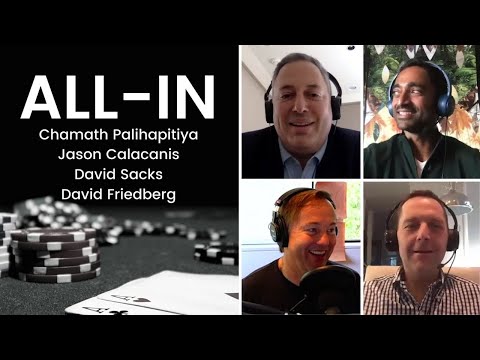
E8: TikTok + Oracle, how privacy loss will impact society, economy & COVID outlooks for 2021
Jason Calacanis (host), David Friedberg (host), David Sacks (host), Chamath Palihapitiya (host), David Friedberg (host), Narrator
In this episode of All-In Podcast, featuring Jason Calacanis and David Friedberg, E8: TikTok + Oracle, how privacy loss will impact society, economy & COVID outlooks for 2021 explores tikTok, data privacy, COVID futures, climate tech, and cancel culture collide This episode of the All-In Podcast ranges from the U.S. push to constrain TikTok and Chinese tech influence, to the broader crisis of digital privacy and surveillance. The besties debate COVID policy, long‑term economic effects, and how rapid testing and vaccines may reset behavior by 2021–22. They then shift to climate change, arguing technology and market incentives—rather than austerity—will drive decarbonization, and touch on nuclear and bioengineering solutions. The show closes on cancel culture, arguing that overreach by extremes on both left and right could fuel another Trump victory and ultimately fracture the two-party system.
TikTok, data privacy, COVID futures, climate tech, and cancel culture collide
This episode of the All-In Podcast ranges from the U.S. push to constrain TikTok and Chinese tech influence, to the broader crisis of digital privacy and surveillance. The besties debate COVID policy, long‑term economic effects, and how rapid testing and vaccines may reset behavior by 2021–22. They then shift to climate change, arguing technology and market incentives—rather than austerity—will drive decarbonization, and touch on nuclear and bioengineering solutions. The show closes on cancel culture, arguing that overreach by extremes on both left and right could fuel another Trump victory and ultimately fracture the two-party system.
Key Takeaways
The TikTok crackdown is as much about leverage with China as it is about security.
The hosts view Trump’s TikTok actions as a power play that accidentally lands on a reasonable end state: pushing reciprocity after decades of asymmetric access where U. ...
Get the full analysis with uListen AI
Foreign data access plus ubiquitous sensors make privacy the next premium consumer feature.
With TikTok, WeChat, smart speakers, connected TVs, and packet sniffing all harvesting data, they argue consumers will increasingly pay for encryption, anonymity, and ‘SCIF‑like’ homes—creating major business opportunities in privacy‑first products and services.
Get the full analysis with uListen AI
COVID should have been handled with targeted protection and masks, not broad lockdowns.
They argue we now know COVID is extremely dangerous mainly for the elderly and those with comorbidities, so shutting the entire economy was overkill; future policy should focus on shielding at‑risk groups, ubiquitous rapid testing, and keeping society open.
Get the full analysis with uListen AI
Rapid antigen tests and vaccines could normalize life by mid‑2021, but psychology will lag.
Friedberg and Sacks expect widespread cheap testing (and eventually vaccines) to make events, offices, and travel workable again, though they note habits like remote work and lingering fear will persist, much like post‑9/11 security theater.
Get the full analysis with uListen AI
Decarbonization is primarily a technology and incentive design problem, not a sacrifice narrative.
They contend we already have the scientific tools—renewables, bioengineering, synthetic meats, carbon‑sequestering seaweed—so the real gaps are capital, engineering scale‑up, and market creation via carbon pricing or subsidies, rather than shaming consumption.
Get the full analysis with uListen AI
Consumer preferences are already shifting toward sustainable products, even at a price premium.
Citing the unexpected success of plant‑based meats and EVs, they argue the market is beginning to reward climate‑friendly options, and expect the 2020s to see commodity markets (food, materials) disrupted by cheaper, bio‑manufactured, low‑carbon alternatives.
Get the full analysis with uListen AI
Cancel culture and ‘safetyism’ may backfire by driving swing voters toward Trump.
They argue that expansive claims of harm, contamination‑by‑association, and institutional overreactions alienate the large middle; Trump’s ‘uncancelability’ makes him a symbolic shield against this, and overreach by extremes on both sides could entrench his support.
Get the full analysis with uListen AI
Notable Quotes
“Privacy is the killer feature of the 2020s.”
— Chamath Palihapitiya
“The solution to climate change is ultimately going to be technology companies… not making people feel bad for consuming and being alive.”
— David Sacks
“I think COVID’s going to be a distant memory by next summer.”
— David Sacks
“Happiness doesn’t come from absolute standards of living. It comes from relative progress over time.”
— David Friedberg
“If Trump wins in November, it’ll be because this whole thing [cancel culture] just gets too much for too many people.”
— Chamath Palihapitiya
Questions Answered in This Episode
How should democratic societies balance openness to foreign tech platforms with national security and data‑sovereignty concerns?
This episode of the All-In Podcast ranges from the U. ...
Get the full analysis with uListen AI
What concrete product and business models could turn privacy into a mainstream, monetizable consumer feature rather than a niche concern?
Get the full analysis with uListen AI
If rapid testing and vaccines arrive, which COVID‑era behaviors (remote work, telehealth, travel avoidance) will persist structurally, and which will snap back?
Get the full analysis with uListen AI
What is the most politically feasible way to price carbon or structure incentives so that decarbonizing technologies can scale without triggering economic backlash?
Get the full analysis with uListen AI
Where is the line between legitimate calls for safety and accountability and a cancel‑culture overreach that chills open debate and drives political polarization?
Get the full analysis with uListen AI
Transcript Preview
Hey, everybody. Hey, everybody. Welcome to another episode of All-In: The Podcast, Episode 8. Besties are here to talk about tech, economy, politics, the election, and our lives in Silicon Valley. Uh, welcome back to the pod, David Friedberg, the Queen of Quinoa is here from an undisclosed location.
Thanks, J Cal. Always a- always a joy.
Yes, and-
Undisclosed location, somewhere in the Midwest.
You- you bailed on SF after the smoke. You- you lasted how many days into the barbecue, into the orange cloud?
I left on the Wednesday of the orange cloud, and, uh, took... It was crazy. Took my kiddos and we're, uh, we're waiting it out the fires in the, uh, in the Midwest.
Well, it's beautiful the last two days here. Uh, also from an undisclosed bestie location, David Sacks back on the program. Rain Man is here.
Yep.
Definitely here.
Good to be here.
All right. Well, there you go.
Yeah.
A man of many words.
(laughs)
And speaking of a man of many words-
(laughs)
... hot off of seven keynotes this week, talking about SPACS, the, uh, prince of SPACS, Chamath Palihapitiya back on the pod.
How are you, besties?
Well, we had a little bestie reunion, which I think we can talk about. Chamath invited us over to have an outdoor bestie reunion.
Yeah, and you gave one of them gonorrhea and you gave the other two... (laughs)
(laughs)
Well, we- it- it's crazy to say, but I literally had to call Chamath, uh, two or three days after he hosted-
Uh, a so- a socially... By the way, a socially-distanced dinner outdoors.
Socially-distanced dinner outdoors, wonderful.
Yeah.
We had some great rib eye, fantastic. Uh, cracked open a nice bottle or- or two of wine and the port.
And but- but then, what did you do?
Well, then a family member of mine, who shall remain nameless-
(laughs)
... decided to go to a party-
(laughs)
... uh, in San Francisco and-
(laughs)
... possibly got the 'rona and he tested positive. And then I had to get everybody in my house tested twice. Everybody came back negative, but I had to call Chamath and tell him, "Listen, I- I wasn't exposed, but some members of my family were, therefore I might have secondhand exposure." I took two tests, came back negative two times in a row.
Can- can I just say though, it's really crazy, like you- we have to develop all these new social norms and you're not sure what to say and you're not- you're not sure how to react. And it's like, it's- it- it must have been like when, you know, you got a call and it's like, "Hey, listen, uh," you know, your girlfriend's like, uh, "I may be pregnant." Or like, you know, somebody's like, "Hey, listen, I have an STD." Like, you're just like, "What is going on?"
Install uListen to search the full transcript and get AI-powered insights
Get Full TranscriptGet more from every podcast
AI summaries, searchable transcripts, and fact-checking. Free forever.
Add to Chrome