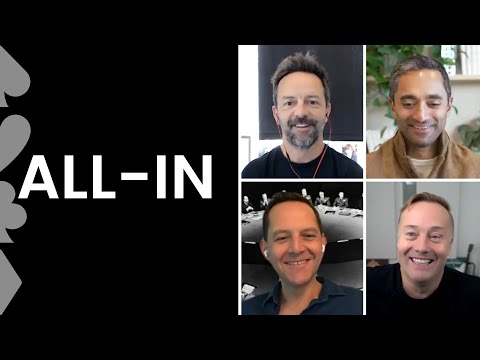
E101: Ye acquires Parler, Snap drops 30%, macro outlook, VC metrics, valuing stocks & more
Jason Calacanis (host), Brad Gerstner (guest), Chamath Palihapitiya (host), David Friedberg (host), Narrator, Jason Calacanis (host), Chamath Palihapitiya (host), Brad Gerstner (guest), David Friedberg (host), Narrator
In this episode of All-In Podcast, featuring Jason Calacanis and Brad Gerstner, E101: Ye acquires Parler, Snap drops 30%, macro outlook, VC metrics, valuing stocks & more explores kanye, Parler, social media shakeout, venture math, and stock sanity The episode opens with Kanye West’s planned acquisition of Parler and a broader debate about mental health, media ethics, and the fragmentation of social media platforms. The conversation shifts to Snap’s stock collapse, Apple’s ad privacy changes, and what they reveal about social media business models, governance, and overstaffing in big tech. The besties and guest Brad Gerstner then dig into macroeconomics, interest rates, and why the next decade will reward true operating discipline and cash generation. In the back half, they unpack venture capital returns, fund construction, and why most stock pickers and many VCs will underperform simple indexes in a higher-rate world.
Kanye, Parler, social media shakeout, venture math, and stock sanity
The episode opens with Kanye West’s planned acquisition of Parler and a broader debate about mental health, media ethics, and the fragmentation of social media platforms. The conversation shifts to Snap’s stock collapse, Apple’s ad privacy changes, and what they reveal about social media business models, governance, and overstaffing in big tech. The besties and guest Brad Gerstner then dig into macroeconomics, interest rates, and why the next decade will reward true operating discipline and cash generation. In the back half, they unpack venture capital returns, fund construction, and why most stock pickers and many VCs will underperform simple indexes in a higher-rate world.
Key Takeaways
Media platforms should treat clearly manic public figures with restraint, not as ratings bait.
The hosts argue it’s unethical to feature someone in an acute mental health crisis for long-form interviews, both out of compassion for the person and to limit the spread of harmful antisemitic rhetoric that could inspire real-world violence.
Get the full analysis with uListen AI
Social networks are less monopolies and more editorialized, replaceable app layers.
Friedberg frames Elon buying Twitter and Kanye buying Parler as evidence that users self-select into platforms with specific speech norms, and capital will continue to fund alternatives when groups feel “edited out” of mainstream networks.
Get the full analysis with uListen AI
User metrics are strong; monetization and Apple’s privacy moves are the real pain points.
Snap, Twitter, and Meta still show sticky daily usage, but Apple’s IDFA changes have slashed ad targeting efficiency and ARPU, exposing how dependent these businesses are on precise tracking and how vulnerable their ad pricing is.
Get the full analysis with uListen AI
Zero interest rates masked bad governance, bloated headcount, and weak leadership.
The panel stresses that a decade of free capital let tech companies overhire, tolerate poor cost discipline, and indulge dual-class control; higher rates are now forcing layoffs, return-of-capital strategies, and a reset in what governance investors accept.
Get the full analysis with uListen AI
A huge chunk of recent venture “paper returns” will likely be marked down.
Gersten’s TVPI vs DPI analysis suggests that 2011–2020 vintages are massively over-marked; as funds age, he expects their ultimate cash returns to revert toward long-run averages, implying hundreds of billions in forthcoming write-downs.
Get the full analysis with uListen AI
Portfolio construction and differentiation matter as much as picking hot deals.
Chamath shows that funds with highly overlapping portfolios will suffer more when markets correct, because the same crowded, momentum names get repriced together, while uncorrelated portfolios are less exposed to the “VC index trade.”
Get the full analysis with uListen AI
Most investors—retail and professional—should default to low-cost index funds.
Friedberg warns that narrative-driven stock picking without financial statement fluency or valuation discipline leads to underperformance; citing Buffett’s long-term S&P 500 bet, they argue indexing plus modest, educational stock experiments is a better path.
Get the full analysis with uListen AI
Notable Quotes
“I find it abhorrent to interview somebody when they're in a manic episode like this. I wouldn't do it.”
— Jason Calacanis
“It's not forgiving what they say, but it is having maybe a little bit more compassion in that moment to get them back to their true self.”
— Chamath Palihapitiya
“Not all good companies are good investments. Price of entry matters.”
— Brad Gerstner
“We've gone through an entire decade of under-training an entire generation of people in Silicon Valley.”
— Unnamed ‘star’ investor summarized by Chamath Palihapitiya
“Everyone learns this lesson over time and everyone gets bonked on the head at some point... which is why nearly every stock picker underperforms the index over time.”
— David Friedberg
Questions Answered in This Episode
Where should media outlets draw the ethical line between free expression and exploiting someone’s mental health crisis for attention?
The episode opens with Kanye West’s planned acquisition of Parler and a broader debate about mental health, media ethics, and the fragmentation of social media platforms. ...
Get the full analysis with uListen AI
If alternative platforms like Parler and Rumble grow, how will that change the balance between content moderation, radicalization risk, and true competition in social media?
Get the full analysis with uListen AI
Given Apple’s power over mobile advertising, what realistic strategies do Snap, Meta, and others have to rebuild monetization without compromising user privacy?
Get the full analysis with uListen AI
How can LPs and founders better detect when venture returns are just inflated marks rather than real, distributable value—and adjust behavior before the write-downs arrive?
Get the full analysis with uListen AI
For an individual investor today, what specific skills and processes are truly required to justify picking stocks instead of just owning a global or S&P 500 index?
Get the full analysis with uListen AI
Transcript Preview
Welcome everybody to episode 101. David Sacks is on vacation. Sitting in, Brad Gerstner from Altimeter Group. Welcome back to the pod. Brad, how you doing?
It's good to be back.
Good to be back.
I mean, first- first you guys, uh, you know, tilted Friedberg and now a little bit on, uh, Sacks is-
Yeah.
... is getting attacked on Twitter and so you roll me back in when-
Yeah, absolutely.
... when you've got a little problem.
Whenever the Brigadoons come out, Brad Gerstner comes on.
(laughs)
(laughs)
Brigadoons. I love that term.
I think Sacks will be okay. But shout out to Sacks.
You know who probably hates the term Brigadoons? The nitwits that are in the Brigadoons.
(laughs) Brigadoons.
Oh, the Brigadoons.
It's all going to end at some point because I think-
The Brigadoons.
... new ownership at Twitter is going to change, like, the whole span thing.
That's a Rodgers and Hammerstein musical, right? Brigadoon?
Brigadoon, yeah, yeah.
Brigadoon. (laughs)
Yeah.
Yeah, yeah. But I think- I think Brigadoons could stick. I don't know, I've never heard anybody use that for the verbatims.
Yeah, calling- calling the Twitter mob the Brigadoons is a good new thing. I like it.
Yeah.
It's pejorative, it's funny, it'll- it'll- It softens everything a little bit, tones it down. I like it.
It feels goofy.
It completely-
Yeah.
... disempowers them. They really want to be taken seriously, but they're just a Brigadoon.
(laughs)
Brigadoon.
I mean, to be a Brigadoon though-
(laughs)
... you have to have four or more accounts and you have to reply-
(laughs)
... to each of those accounts as if it's an actual conversation.
No, you don't.
Can you be a solo Brigadoon?
Jakell, when you- Yeah, when you retweet something as a social justice warrior, as an example, you're trying to join the Brigadoon.
Oh, got it.
It's just a different Brigadoon.
It's a Brigadoon. (laughs)
Jakell, uh, you're sometimes a Brigadoon, right?
Uh.
You're part of Brigadoons, Jakell?
No, I'm not part of any Brigadoon. I- I-
You totally Brigadoon, come on.
I do not, no.
Brigadoon. (laughs)
(laughs)
I never- I've never even Briga-done.
(laughs)
(laughs)
I've never Briga-done.
(laughs)
(laughs)
I mean, I may have Briga-done once or twice from my burner account, but that's it. I mean...
We're going all in. Don't let your winners ride. Rain man, David Sacks. We're going all in. As I said, we open sourced it to the fans and they have just gone crazy with it.
Love you, West.
Queen of quinoa.
We're going all in.
Well, anyway. Uh, Kanye West can't leave, uh, an amazing career alone and he is going to buy Parler, which apparently Candace Owens' husband, George Farmer, had created. So, he's going to buy his own social network. If you don't remember, Parler is like a sh- really shitty version of Twitter that never seems to have worked or been stable. It crashed the first 10 times I used it. Miraculously, this steaming pile of garbage had raised $56 million in funding, and Kanye's on a social media/media tour saying horrific antisemitic stuff. He seems to be having a mental breakdown again. Uh, there's a big discussion now, I guess, should people be platforming them to the point, um, that he's doing three, four, five hour interviews with people, and it does seem like it's acute mental illness/breakdown. I don't wanna, like, diagnose anybody, uh, from afar here, and I'm not qualified to do that now.
Install uListen to search the full transcript and get AI-powered insights
Get Full TranscriptGet more from every podcast
AI summaries, searchable transcripts, and fact-checking. Free forever.
Add to Chrome