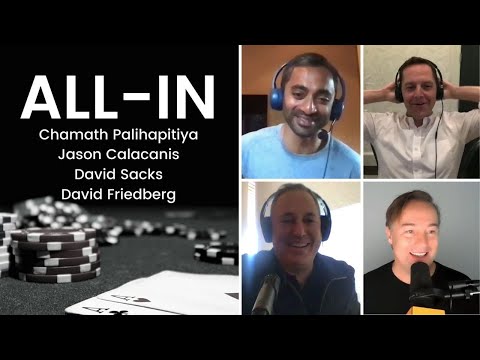
E13: SPACsgiving Special! Vaccine news, innovation vs regulation, fixing higher ed, challenge trials
Jason Calacanis (host), David Friedberg (host), Chamath Palihapitiya (host), David Sacks (host)
In this episode of All-In Podcast, featuring Jason Calacanis and David Friedberg, E13: SPACsgiving Special! Vaccine news, innovation vs regulation, fixing higher ed, challenge trials explores sPAC success, vaccine breakthroughs, and reimagining regulation, education, risk The hosts open by celebrating David Friedberg’s Metromile SPAC and use it to discuss usage-based insurance, machine learning, and the SPAC/PIPE financing structure.
SPAC success, vaccine breakthroughs, and reimagining regulation, education, risk
The hosts open by celebrating David Friedberg’s Metromile SPAC and use it to discuss usage-based insurance, machine learning, and the SPAC/PIPE financing structure.
They then pivot to COVID-19 vaccine breakthroughs, explaining mRNA technology, Operation Warp Speed, and when herd immunity and normal life might realistically return.
A large portion of the conversation critiques how regulation slows innovation in drugs, challenge trials, tech, and education, contrasting it with permissive risk in gambling, drugs, and everyday life.
They close with a deep dive on higher education, income share agreements, regulatory capture, and a more personal reflection on what the pandemic has taught them about family, mental health, and character.
Key Takeaways
Usage-based insurance plus real-world data can build powerful moats.
Metromile charges per mile using telematics data, heavily weighting miles driven (70% of risk) over fine-grained driving behavior; as autonomous features spread, dynamic pricing tied to who/what is driving will further differentiate data-rich insurers.
Get the full analysis with uListen AI
Operation Warp Speed quietly executed a highly effective, parallelized vaccine strategy.
The U. ...
Get the full analysis with uListen AI
mRNA platforms can radically compress vaccine development timelines.
By sending RNA instructions so your own cells print viral proteins, mRNA vaccines can be designed within days of sequencing a pathogen; in future pandemics, the bottleneck will be human trials and regulation, not the underlying vaccine design.
Get the full analysis with uListen AI
Challenge trials and multi-path regulatory routes could vastly speed lifesaving drugs.
The group argues that informed adults should be allowed to assume medical risk—much as we permit extreme sports, war service, and hard drug use—and that regulators should enable challenge trials and alternative approval paths, especially in crises.
Get the full analysis with uListen AI
Regulatory capture often protects incumbents while hurting consumers and innovators.
Examples from clinical trials, drug development, cosmetology licensing, and gambling show how rules can be shaped to entrench existing business models, slowing R&D, raising barriers for the poor, and misaligning risk protection with actual public benefit.
Get the full analysis with uListen AI
Income Share Agreements could unbundle college and realign incentives toward outcomes.
When schools get paid only if students’ earnings rise, they become highly selective about who they admit, what they teach, and how hard they work on placement—potentially stripping traditional universities of many practical, high-ROI programs.
Get the full analysis with uListen AI
The pandemic is accelerating a cultural reset around work, mental health, and character.
Remote work has increased family time and self-reflection for the hosts, surfacing personal habits to change and normalizing conversations about depression, anxiety, and the value of close relationships alongside financial and career success.
Get the full analysis with uListen AI
Notable Quotes
“The most incredible dividend of climate change is peace.”
— Chamath Palihapitiya
“The reason why innovation has happened so fast on the internet is because of one word: permissionless.”
— David Sacks
“In theory, in the future, you could take any virus, read its DNA in an hour, code RNA for it, and produce an immune response.”
— David Friedberg
“It does not make sense that you can drink yourself to death, smoke yourself to death, gamble away your money, or openly do illicit drugs, but you can’t participate in a thoughtful trial backed by scientific research.”
— Chamath Palihapitiya
“We need to celebrate vocational capability, because this mythical bachelor’s degree just means nothing.”
— David Friedberg
Questions Answered in This Episode
How far should individual freedom to assume risk extend when it comes to medical experimentation and challenge trials?
The hosts open by celebrating David Friedberg’s Metromile SPAC and use it to discuss usage-based insurance, machine learning, and the SPAC/PIPE financing structure.
Get the full analysis with uListen AI
What specific regulatory reforms would meaningfully speed drug development without repeating past public health disasters?
They then pivot to COVID-19 vaccine breakthroughs, explaining mRNA technology, Operation Warp Speed, and when herd immunity and normal life might realistically return.
Get the full analysis with uListen AI
If ISAs and trade-focused schools scale, what should the role of traditional four-year colleges be in society?
A large portion of the conversation critiques how regulation slows innovation in drugs, challenge trials, tech, and education, contrasting it with permissive risk in gambling, drugs, and everyday life.
Get the full analysis with uListen AI
How can policymakers prevent regulatory capture while still protecting vulnerable populations from predatory contracts and scams?
They close with a deep dive on higher education, income share agreements, regulatory capture, and a more personal reflection on what the pandemic has taught them about family, mental health, and character.
Get the full analysis with uListen AI
In hindsight, what aspects of Operation Warp Speed should become permanent features of our pandemic preparedness playbook?
Get the full analysis with uListen AI
Transcript Preview
Hey, everybody, welcome back. Besties are back and it's a bestie SPACs-giving.
(laughs)
Congratulations to...
(laughs)
... the queen of quinoa.
(laughs)
His second company. David Freiberg announces today, hours before the taping of this special Thanksgiving pod, that he is taking Metro Mile public through a SPAC and that bestie see, and here is the quote, that as only Chamath can tweet, "Buffett had Geico. I pick Metro Mile."
(laughs)
(laughs)
(laughs)
Unbelievable. I would just like to say-
That's how you move markets. Yeah.
LeBron James (laughs) has three rings. (laughs) Uh, Freiberg, tell us what is Metro Mile, uh, and, um...
Well, this isn't a self-promoting podcast, is it? I mean, like-
No, no, but I think it's just... You know, it's your second company.
I s- I started the- I started the company in 2011 when I was running Climate, when I was the CEO there, and, um, you know, s- we were just, Climate was offering insurance at the time. We learnt a lot about the insurance markets and figured like, hey, you know, telematics or connecting cars to the internet is going to be a big deal and we're gonna be able to completely change the auto insurance industry. So we set up this company. I was the chairman from the founding, uh, in 2011 and, uh, you know, been, uh, been chairman and I've been an active investor in the business in every round since then. Um, so the business has built some, uh, you know, really compelling, uh, value proposition for customers and, you know, it's got really good unit economics and it's, um, you know, needed its last round of capital to get profitable and turns out, you know, as we were thinking about that this summer, that a SPAC was, uh, a really good path for the business given the inflection point it's at. Um, and so-
And the basic premise of the business is instead of paying for insurance by month or time period-
Yeah.
... the innovation here is you pay per mile.
Yeah. Insurance today is like, you know, you fill out a form and you get a price for insurance and you pay that rate for six months of coverage. But, you know, depending on when you're driving and how much you're driving, you should be paying a different price, right? So we s- we kind of changed the model to a rate per mile. And so if you don't drive, you save. You know, so the average customer doesn't drive a lot with Metro Mile. They save 47% over what they were paying with like Geico or Progressive reinsurance. Uh-
And you do that with that ODB port? It's like ODB port-
Yeah, the little plug-in device and increasingly-
Yeah.
... we're actually doing it directly by connecting to cars, uh, direct through, uh, Ford and a couple other big automotive OEMs now have this ability to send the data directly out of the car because they're all internet connected now. So, um, so that allows us to just basically f- you know, see how many miles you're driving and the rate per mile is what we bill you each month times the number of miles you drove on your, on your car.
Install uListen to search the full transcript and get AI-powered insights
Get Full TranscriptGet more from every podcast
AI summaries, searchable transcripts, and fact-checking. Free forever.
Add to Chrome