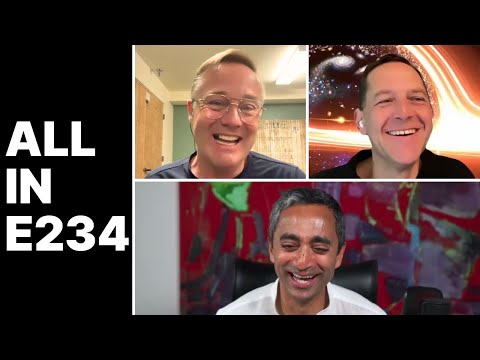
Big Beautiful Bill, Elon/Trump, Dollar Down Big, Harvard's Money Problems, Figma IPO
Jason Calacanis (host), Chamath Palihapitiya (host), David Friedberg (host), David Sacks (host), Narrator
In this episode of All-In Podcast, featuring Jason Calacanis and Chamath Palihapitiya, Big Beautiful Bill, Elon/Trump, Dollar Down Big, Harvard's Money Problems, Figma IPO explores aI Rules, Dollar Slides, Harvard Squeezed: Tech’s Power Realignment Begins The episode centers on the “Big Beautiful Bill” (BBB) moving through Congress, with the hosts dissecting its implications for AI regulation, U.S. energy policy, federal spending, and elite institutions like Harvard. A major flashpoint is the removal of federal preemption for AI, which Friedberg and Chamath argue will create a crippling state-by-state regulatory patchwork that advantages incumbents and harms startups and U.S. competitiveness.
AI Rules, Dollar Slides, Harvard Squeezed: Tech’s Power Realignment Begins
The episode centers on the “Big Beautiful Bill” (BBB) moving through Congress, with the hosts dissecting its implications for AI regulation, U.S. energy policy, federal spending, and elite institutions like Harvard. A major flashpoint is the removal of federal preemption for AI, which Friedberg and Chamath argue will create a crippling state-by-state regulatory patchwork that advantages incumbents and harms startups and U.S. competitiveness.
They connect America’s soaring debt and spending to the weakening dollar, inflationary pressures, and the political shift toward socialism, while stressing that GDP growth—especially driven by AI—is likely the only realistic path out of the fiscal trap. The conversation also explores how changes in energy subsidies, tariffs, and nuclear policy intersect with AI and data center build‑outs.
The hosts unpack the public clash between Elon Musk and Donald Trump over the bill and the deficit, arguing that tech and MAGA are now structurally interdependent and will ultimately find alignment despite rhetorical skirmishes. They then pivot to Harvard’s financial and political bind under the Trump administration, using it to illustrate how AI and the internet may structurally erode the traditional university model.
Finally, they discuss the Figma IPO, Grammarly’s acquisition of Superhuman, and the broader AI-driven reshaping of software economics, questioning how durable non-core AI software revenues will be once foundational models become central to both work and leisure.
Key Takeaways
AI regulation should be centralized at the federal level to avoid a crippling state patchwork.
Friedberg argues that AI affects interstate and international commerce and thus must be regulated federally, not by individual states (around 430–540 seconds). ...
Get the full analysis with uListen AI
Fragmented state AI rules will favor entrenched incumbents and slow down startups.
Chamath calls AI a national security issue and likens state-level AI regulation to states fielding their own armies (around 640–770 seconds). ...
Get the full analysis with uListen AI
U.S. energy policy must prioritize massive, technology‑agnostic electricity expansion, not just green subsidies.
Friedberg notes the old rationale for solar/wind subsidies (decarbonization) is now colliding with a more urgent need: rapidly scaling total electricity production for AI, data centers, and industrial growth (around 1180–1700 seconds). ...
Get the full analysis with uListen AI
America is in a structural fiscal bind; realistic escape depends on sustained GDP growth, not austerity.
Friedberg details how Congress’s incentives favor ever‑higher spending and how mandatory vs discretionary spending and tax cuts are being used to argue the BBB is fiscally responsible (around 2600–3300 seconds). ...
Get the full analysis with uListen AI
Dollar devaluation is both a long‑running trend and an inflationary political accelerant.
The dollar is down ~11% in 2025 against major currencies, the worst start in 50+ years (around 3560–3850 seconds). ...
Get the full analysis with uListen AI
Elite universities like Harvard face a structural reckoning as AI and politics hit their funding models.
Chamath argues Harvard is “cooked” financially (around 4480–4920 seconds) if Trump follows through on cutting research funding, imposing an endowment excise tax, and challenging its nonprofit status. ...
Get the full analysis with uListen AI
AI may compress enterprise org charts and challenge the durability of many SaaS revenues.
Discussing Figma’s IPO (around 6100–6750 seconds), Chamath praises the business but raises a systemic concern: as foundational AI models become central to both work and leisure, they may absorb adjacent functionality and reduce the need for vertically specialized tools. ...
Get the full analysis with uListen AI
Notable Quotes
“Not governing AI at the federal level makes as much sense for states to legislate AI as it would make sense for states to have competitive armies.”
— Chamath Palihapitiya
“Having a patchwork of regulations on AI this early would be a huge detriment to consumers and a huge detriment to the job market.”
— David Friedberg
“I’m not a huge fan of being dependent on government-subsidized energy at all… you want an engine for creating new energy production on a continuous basis so we climb non-linearly the energy production curve.”
— David Friedberg
“I don’t think MAGA can exist successfully without the tech alignment. I don’t think tech can exist without MAGA because of the government alignment.”
— David Friedberg
“Harvard’s cooked, and I think this is really good for America.”
— Chamath Palihapitiya
Questions Answered in This Episode
If state-by-state AI regulation proceeds without federal preemption, what concrete scenarios do you envision where startups are forced to shut down or relocate, and how soon could that start to bite?
The episode centers on the “Big Beautiful Bill” (BBB) moving through Congress, with the hosts dissecting its implications for AI regulation, U. ...
Get the full analysis with uListen AI
You’ve argued that removing green subsidies could catalyze a nuclear boom; what specific policy or financing structures would actually make 10-year nuclear projects investable in time to meet AI’s power needs?
They connect America’s soaring debt and spending to the weakening dollar, inflationary pressures, and the political shift toward socialism, while stressing that GDP growth—especially driven by AI—is likely the only realistic path out of the fiscal trap. ...
Get the full analysis with uListen AI
You framed MAGA and tech as structurally codependent—what happens, practically, if Elon doubles down on a separate ‘America PAC’ platform that occasionally conflicts with a future Trump or Vance White House?
The hosts unpack the public clash between Elon Musk and Donald Trump over the bill and the deficit, arguing that tech and MAGA are now structurally interdependent and will ultimately find alignment despite rhetorical skirmishes. ...
Get the full analysis with uListen AI
On Harvard and higher ed, how do you see employers’ hiring filters evolving over the next decade, and what might replace the ‘Harvard/Stanford’ logo as a scalable proxy for talent at global volume?
Finally, they discuss the Figma IPO, Grammarly’s acquisition of Superhuman, and the broader AI-driven reshaping of software economics, questioning how durable non-core AI software revenues will be once foundational models become central to both work and leisure.
Get the full analysis with uListen AI
Given your concerns that foundational AI models may absorb large chunks of the software stack, what characteristics should investors and founders look for in SaaS businesses today to ensure their revenue remains durable in a 5–10 year AI-dominated environment?
Get the full analysis with uListen AI
Transcript Preview
All right. Welcome to the show, everybody. The number one podcast in the world and, uh, man, gonna be really exciting come September. September 7th, 8th, and 9th, The All In Summit in its fourth year. This week, um, doing Friedberg's job for him because he's been a little bit busy.
No, you're not.
Lockdown (beep) is in. Uh, looks like (beep) -
No, Jason, what are you doing?
... from (beep) is in.
Why are you doing this?
You can bleep it.
Nick, cut. Nick, beep. (laughs)
And, uh-
Every year, (beep) you pre-announce a bunch of people who don't show up. It's literally... You literally pick people who won't show up.
Ha! What are you talking about?
Like, yeah.
I got Elon to come three out of three years. I have gotten a couple of trillion dollars in market cap for you, Friedberg, um, and more to come.
Don't worry about it. Don't worry about it.
More to come.
This year is gonna be better than ever. Don't worry about it.
Better than ever. Allin.com/summit. And lots of exciting news around the tequila, boys.
Friedberg, did you see MSN covered me sending a case of the tequila to Bezos? (laughs)
(laughs) I didn't see that.
We're going all in. Let your winners ride. Rain Man, David Sacks. We're going all in. And I said, "We open source it to the fans," and they've just gone crazy with it. Love you guys. Queen of Quinoa. Going all in.
We've, uh, been crushed with orders. Apologies if we're taking a little bit of time with customer support, uh, but you can go to tequila.allin.com. Deliveries begin in late summer, right around the time, I think, of the, uh, summit.
Friedberg and I were in Las Vegas this past weekend. It was a blast as always. We had a really good time. We had 20 of our besties or so with us. No?
Great, great time.
It was great.
Good time.
I wish I could have been there, but I was on the Snake River doing a little-
You didn't invite me?
I was invi... What are you talking about?
(laughs)
I was getting lobbied, like, "Cancel your family trip, white water rafting, to come to Vegas." I was like, "Yeah."
I don't remember inviting you. Friedberg, do you remember?
(laughs) Trust me. People, when you go to Vegas, you want J Cal. J Cal is a good time in Vegas, but I did-
That is true. That is true.
I got a lot of invites, but I... Uh, Nick, pull up the picture. I was on the Snake River there. I was doing my white water rafting trip. And so, if you're ever interested in, um, doing a fun trip with your family, you can do these-
Install uListen to search the full transcript and get AI-powered insights
Get Full TranscriptGet more from every podcast
AI summaries, searchable transcripts, and fact-checking. Free forever.
Add to Chrome