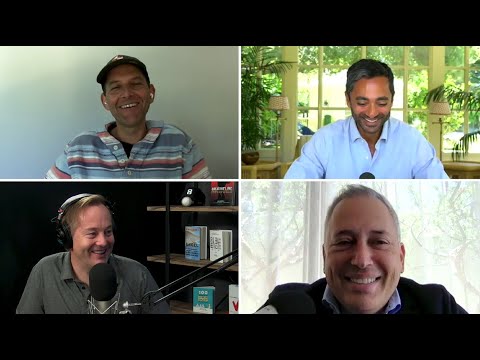
E4: Politicizing the pandemic, Police reform, Twitter vs Facebook with David Sacks & David Friedberg
Jason Calacanis (host), Chamath Palihapitiya (host), David Sacks (host), Jason Calacanis (host), David Friedberg (host), Chamath Palihapitiya (host)
In this episode of All-In Podcast, featuring Jason Calacanis and Chamath Palihapitiya, E4: Politicizing the pandemic, Police reform, Twitter vs Facebook with David Sacks & David Friedberg explores pandemic politics, police reform, and free-speech battles online collide The hosts discuss how their personal COVID risk behaviors have evolved and argue that outdoor activity and masks are underused, depoliticized tools that could have replaced broad lockdowns. They then pivot to policing, criticizing militarization, unions, training, and the handling of cases like Rayshard Brooks, while exploring alternative models involving social workers and ‘Jedi’ cops. A major segment dissects cancel culture, free speech, and the divergent approaches of Twitter and Facebook toward Trump and political content, tying this to broader generational and cultural shifts. They close by handicapping the 2020 election, debating Trump’s odds, Biden’s cognition, and floating an Oprah Winfrey vice-presidential pick as a potential game‑changer.
Pandemic politics, police reform, and free-speech battles online collide
The hosts discuss how their personal COVID risk behaviors have evolved and argue that outdoor activity and masks are underused, depoliticized tools that could have replaced broad lockdowns. They then pivot to policing, criticizing militarization, unions, training, and the handling of cases like Rayshard Brooks, while exploring alternative models involving social workers and ‘Jedi’ cops. A major segment dissects cancel culture, free speech, and the divergent approaches of Twitter and Facebook toward Trump and political content, tying this to broader generational and cultural shifts. They close by handicapping the 2020 election, debating Trump’s odds, Biden’s cognition, and floating an Oprah Winfrey vice-presidential pick as a potential game‑changer.
Key Takeaways
Outdoor activity is far safer than indoor gatherings for COVID spread.
Friedberg cites data that ~97% of traced transmissions occurred indoors; sun and wind degrade viral particles, making masked indoor time and short supermarket trips the main risk to manage, not hiking or pool hangs.
Get the full analysis with uListen AI
Masks could have replaced prolonged nationwide lockdowns.
Sacks argues that countries like Japan, South Korea, and the Czech Republic controlled COVID with early, universal mask usage, suggesting the U. ...
Get the full analysis with uListen AI
Public health measures in the U.S. are fatally politicized.
Chamath notes that everything from masks to wearables gets framed as a partisan issue or government overreach, undermining adoption of low-cost, high-impact tools like temperature-tracking devices or mask rules.
Get the full analysis with uListen AI
Police incentives, training, and militarization drive excessive force.
The group criticizes qualified immunity, combat-style gear, and minimal training, arguing cops are incentivized to project power rather than de-escalate; they propose de-arming or delaying guns for rookies and building a parallel force of well-paid social workers for mental health calls.
Get the full analysis with uListen AI
Unions help block both school and police reform.
Sacks and Chamath tie teachers’ and police unions together as entrenched interests that protect bad actors and resist common-sense changes, with both parties reluctant to challenge them for political reasons.
Get the full analysis with uListen AI
Cancel culture and online mobs can destroy innocent people.
The hosts highlight cases where internet sleuths misidentified suspects (e. ...
Get the full analysis with uListen AI
Free speech norms are shifting from protecting offense to enforcing comfort.
They argue younger cohorts and some institutions (e. ...
Get the full analysis with uListen AI
Notable Quotes
“We have managed to find a way to politicize absolutely everything.”
— Chamath Palihapitiya
“The way you deal with bad speech is more speech.”
— David Sacks
“The job is too complicated. They clearly can't do it, they're poorly trained, and then you arm them on top of all that and you have the shit show that we have today.”
— Chamath Palihapitiya
“We're starting to shift towards valuing comfort over freedom of expression.”
— David Friedberg
“Biden–Winfrey. It's a slam dunk. She would win every state.”
— Chamath Palihapitiya
Questions Answered in This Episode
If masks are so effective and low-cost, what structural or cultural changes would be required for the U.S. to adopt a permanent ‘mask norm’ in pandemics without it becoming partisan?
The hosts discuss how their personal COVID risk behaviors have evolved and argue that outdoor activity and masks are underused, depoliticized tools that could have replaced broad lockdowns. ...
Get the full analysis with uListen AI
What concrete, step-by-step reforms to policing—training hours, equipment, use-of-force rules, mental health responder units—would most quickly reduce wrongful deaths while maintaining public safety?
Get the full analysis with uListen AI
How should societies balance the real-time accountability enabled by the internet with protections against mob justice and mistaken identity?
Get the full analysis with uListen AI
What product or design changes could Twitter, Facebook, and others implement to support more nuanced debate and ‘more speech’ without sliding into either censorship or pure outrage amplification?
Get the full analysis with uListen AI
Given the generational shift toward prioritizing emotional safety, how can institutions re-teach and defend the value of tolerating offensive but legal speech as a cornerstone of liberal democracy?
Get the full analysis with uListen AI
Transcript Preview
All right, everybody. Welcome back to the All In Podcast. We're here with Chamath Palihapitiya, David Friedberg, and David Sacks. Our usual, usual foursome as we, uh, chop up the business news, uh, and what's going on. (smacks lips) And, uh, just as a point of order, the frequency of this show is, uh... Well, don't, don't ask-
As we feel like it.
As we feel like it, correct. Uh, so do not ask me to advertise on the podcast 'cause Chamath banned advertising, and do not ask me when the next one is. The next one is when Chamath decides he wants to go on a rant. Um, but what, how, how are you holding up, uh, Bestie C?
Uh, Bestie C is doing pretty well.
Yeah. Uh, uh, and the family, everything? A- ar- have you come out of quarantine in any way? This is the first question I have for people is, has your behavior changed now as we go into, I think what most people are calling phase two? Any change in what you're doing and the risk you're willing to take? Chamath.
Um, that's a really good question. Um, you know, I, I, I, I've kind of ventured out a little bit, um, but, uh, I just kind of put on a mask. The only place I don't wear a mask is when I walk around my house, um, just because it's, uh, you know, I live in the suburbs and so there's just so much space between people that you don't really run into anybody. Um, but if I have to go to Walgreens or CVS or whatever, I always bring a mask and gloves. Um, uh, so I've got, I ventured out a little bit, but, you know, nothing, nothing meaningful to be quite honest.
Um, and Sacks, uh, you're still out of the country in an undisclosed location. Uh, how are you feeling about what risks you're willing to take? Uh, you know, small groups of people, are you going out to a restaurant? Are you seeing other people? How, how do you look at the risk you're willing to take personally?
I've, I've adjusted my risk profile, I think, um, quite a bit. Um, so I mean, the, the learning over the past, uh, few months was just that relatively, that, that the fatality rate for, say, relatively healthy people under 50 without risk factors is, you know, 50 times lower than, um, say, you know, someone under, over 60 or someone who has risk factors. And so, um, I'm not being reckless, but, um, I'm willing to kind of re-engage in social behavior among, um, groups of friends. And, um, on the theory that, you know, all of my friends have been locked down. Um, I was, I was in total lockdown for two months, um, so were my friends. And so, you know-
I, I have several questions. The first is, um, uh-
Install uListen to search the full transcript and get AI-powered insights
Get Full TranscriptGet more from every podcast
AI summaries, searchable transcripts, and fact-checking. Free forever.
Add to Chrome