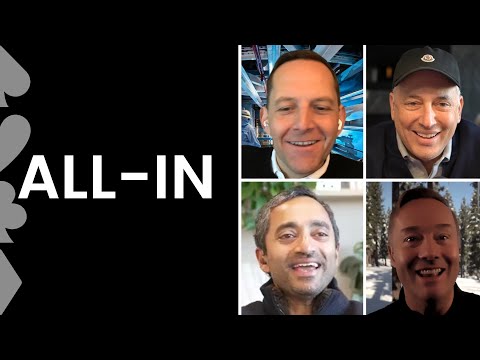
E108: Doxing debate, Nuclear fusion breakthrough, state of the markets & more
Jason Calacanis (host), Chamath Palihapitiya (host), David Sacks (host), Narrator, David Friedberg (host), Jason Calacanis (host), Chamath Palihapitiya (host), David Friedberg (host), Narrator, Narrator
In this episode of All-In Podcast, featuring Jason Calacanis and Chamath Palihapitiya, E108: Doxing debate, Nuclear fusion breakthrough, state of the markets & more explores elon’s Twitter Doxing Dilemma, Fusion Milestone, and Market Reset Showdown The episode centers on Elon Musk’s controversial Twitter moderation around real-time location tracking (“doxing”), exposing tensions between free speech absolutism, personal safety, and the difficulty of content moderation at scale.
Elon’s Twitter Doxing Dilemma, Fusion Milestone, and Market Reset Showdown
The episode centers on Elon Musk’s controversial Twitter moderation around real-time location tracking (“doxing”), exposing tensions between free speech absolutism, personal safety, and the difficulty of content moderation at scale.
The besties then dive into the U.S. government’s recent nuclear fusion “ignition” breakthrough, debating its technical significance, timelines, and whether fusion is a worthy investment versus already-cheap renewables like solar.
They pivot to the state of markets: how private equity will feast on overfunded SaaS companies, what new valuation realities mean for founders, and how profligate spending plus rising rates are driving a coming wave of PE-led takeovers and layoffs.
Throughout, they weave in geopolitical implications of abundant energy, the power law in venture returns, and a cultural critique of tech, comedy, and media narratives around speech and censorship.
Key Takeaways
Real-time, persistent location tracking is being reframed as a new kind of doxing.
The hosts distinguish between one-off public sightings and continuous, precise GPS tracking feeds of individuals’ movements, arguing the latter is effectively stalking and poses real security risks in an era of precision-guided weapons.
Get the full analysis with uListen AI
Elon Musk is discovering there’s no “canonically right” answer in content moderation.
They note Musk promised maximal free speech but quickly faced edge cases that forced him into the same subjective, emotionally charged tradeoffs as prior regimes, undermining claims that moderation can ever be purely principled and apolitical.
Get the full analysis with uListen AI
The fusion “ignition” result is a real physics milestone but not grid-ready power.
Freeberg explains that the experiment produced more fusion energy than delivered to the fuel pellet, yet the total system still consumed vastly more energy than it produced; meaningful grid-scale fusion is likely decades away, not years.
Get the full analysis with uListen AI
Solar is already incredibly cheap, so fusion must justify itself on scalability, not novelty.
Chamath argues that grid-level solar plus storage is heading toward ~1. ...
Get the full analysis with uListen AI
Abundant, software-like energy tilts geopolitical power toward innovation hubs like the U.S.
Sacks notes that if energy becomes an innovation problem instead of a natural resource problem, the ‘resource curse’ weakens and countries strong in software, talent, and R&D—especially the U. ...
Get the full analysis with uListen AI
Private equity is poised to buy distressed SaaS firms, slash headcount, and capture upside.
With public SaaS multiples compressed and many companies bloated, PE firms can finance buyouts on recurring revenue, cut 50%+ of costs, and turn today’s 20x EBITDA deal into a de facto 10x deal by aggressively improving efficiency.
Get the full analysis with uListen AI
Founders must accept brutal valuation resets and prioritize survival over hypergrowth.
Cooley data show late-stage valuations down 45–85%; the hosts argue founders should treat last year’s capital as incredibly expensive, slow their growth targets, cut burn, and plan for 4–6 quarters of demand contraction rather than chase old multiples.
Get the full analysis with uListen AI
Notable Quotes
“There is no canonically right decision ever in this space. There’s only a decision where some percentage will support it and some percentage will always be against.”
— Chamath Palihapitiya
“Fusion energy exists today. It’s called the sun. We actually know how to capture it at virtually no cost right now.”
— Chamath Palihapitiya
“What we’re seeing with fusion today is similar to what we saw with the ENIAC computer in the 1950s… a demonstration that fusion is possible.”
— David Friedberg
“If you don’t start acting in a more capital-efficient way and preserve your cash, your company’s ultimately going to be owned by a private equity firm and they’re going to make all the money.”
— David Sacks
“The age of excess is over. If you’re not working 50, 60, 70 hours a week, you’re not gonna cut it in Silicon Valley.”
— Jason Calacanis
Questions Answered in This Episode
Where should the line be drawn between protected speech and harmful real-time tracking in an increasingly sensor- and data-rich world?
The episode centers on Elon Musk’s controversial Twitter moderation around real-time location tracking (“doxing”), exposing tensions between free speech absolutism, personal safety, and the difficulty of content moderation at scale.
Get the full analysis with uListen AI
Is it realistic or desirable to expect any social platform owner—including Elon Musk—to apply content rules without personal bias when personally targeted?
The besties then dive into the U. ...
Get the full analysis with uListen AI
Given current solar and storage cost trends, under what scenarios does fusion become economically compelling rather than just scientifically exciting?
They pivot to the state of markets: how private equity will feast on overfunded SaaS companies, what new valuation realities mean for founders, and how profligate spending plus rising rates are driving a coming wave of PE-led takeovers and layoffs.
Get the full analysis with uListen AI
How should founders balance responsible austerity with maintaining a competitive growth rate when investors and boards still pressure them for aggressive expansion?
Throughout, they weave in geopolitical implications of abundant energy, the power law in venture returns, and a cultural critique of tech, comedy, and media narratives around speech and censorship.
Get the full analysis with uListen AI
If ultra-cheap, abundant energy materializes, which existing industries and countries are most at risk of disruption, and who stands to benefit the most?
Get the full analysis with uListen AI
Transcript Preview
Captain Calacanis is here-
(laughs)
... reporting for duty.
Wait, is that a Spirit Airlines cap?
Absolutely. (laughs) Spirit Airlines. I just wanted to say, All-In Podcast now sponsored by Moncler and Spirit Airlines.
Or now sponsored by the Village People.
(laughs) (singing) YMCA.
Now, are you a pilot or a flight attendant, J Cal?
He's a flight attendant.
(laughs)
I don't think he's thin enough to be a flight attendant.
Are you fat shaming me?
(laughs)
Are you body shaming me?
Ooh, can't do that nowadays. That'll get me canceled.
(laughs)
Getting sacks, canceled at this point, like fat shaming would be number 72 on the list.
He can't get canceled because all the libs have left Twitter. There's nobody to- (laughs)
There's no hall monitors left. (laughs)
There's no hall monitors.
That's not true. They all pretend.
No, they quit every week. (laughs)
Yeah, it's like all the libs that said they'd move to Canada when Trump got elected.
What you saying?
Yeah, Canada immigration.
Whoa, we're going all in.
Go ahead.
What you saying? Don't let your winners ride. Whoa, we're going all in.
Rain Man, David Sacks.
What you saying? Whoa, we're going all in.
And I said-
... we open source it to the fans and they've just gone crazy with it.
Love you Betsies.
Whoa, we're going all in.
I'm getting queen of quinoa.
Whoa, we're going all in.
A hacker figured out a way to take all this data and track, you know, people's yachts, people's planes. Obviously one of those people was Elon. Elon had a security issue. This is all public information. So, the larger issue at stake here is the fact that the law allows for people to, uh, do this persistent tracking of planes, which then becomes persistent tracking of a person. And what really is at stake here is how we define the term doxing. For people who don't know the term doxing, it means giving a person's location. That could be your home. That could also be you're at a location for some period of time. You're- you're at a hotel, you know, for a basketball game. Uh, and it's pretty clear. You could take a picture of a celebrity and say, "There's a celebrity here. Oh, Lady Gaga is at the farmer's market." What I object to here, uh, we all understand doxing is dangerous, and it, uh, in fact is against the law to just give people's addresses and stuff like that. Um, the issue here is a new type of doxing, which I- I'll call, you know, persistent coordinated doxing, where dozens of times a month you're giving a person's location. It- it may not be against the f- the First Amendment. Sachs, I think you would agree. But we have to ask ourselves, do we want to live in a world where whether a person is on an electric bicycle or an airplane or any device in between, somebody should be releasing dozens of times a month a specific dedicated feed of their location? It is terrorizing as a parent when this happens. I've had doxing. People on the call here have had various security concerns. We don't want to live in a world with de facto doxing. What these sites were doing was de facto doxing.
Install uListen to search the full transcript and get AI-powered insights
Get Full TranscriptGet more from every podcast
AI summaries, searchable transcripts, and fact-checking. Free forever.
Add to Chrome