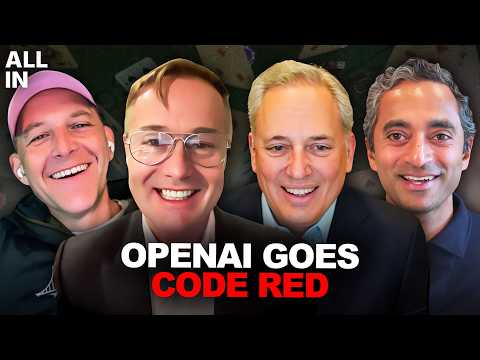
OpenAI's Code Red, Sacks vs New York Times, New Poverty Line?
Jason Calacanis (host), Chamath Palihapitiya (host), David Friedberg (host), David Sacks (host), Narrator
In this episode of All-In Podcast, featuring Jason Calacanis and Chamath Palihapitiya, OpenAI's Code Red, Sacks vs New York Times, New Poverty Line? explores openAI’s Code Red, NYT vs. Sacks, And Rethinking Poverty Economics The hosts dissect Sam Altman’s internal “code red” at OpenAI as a response to intensifying AI competition from Google’s Gemini, Anthropic’s Claude, xAI’s Grok, and Meta, arguing the market will fragment into several specialty winners rather than one dominant player.
OpenAI’s Code Red, NYT vs. Sacks, And Rethinking Poverty Economics
The hosts dissect Sam Altman’s internal “code red” at OpenAI as a response to intensifying AI competition from Google’s Gemini, Anthropic’s Claude, xAI’s Grok, and Meta, arguing the market will fragment into several specialty winners rather than one dominant player.
They praise Google’s recent AI resurgence, contrast risk-taking vs. risk-averse product postures, and predict a shift from single-chatbot dominance to a multi-model, multi-modal AI world where chat is just the starting point.
The episode then turns to a New York Times piece portraying David Sacks as conflicted in his White House advisory role; the group frames it as a politically motivated hit designed to deter experienced private‑sector experts from public service, and Sacks details substantial divestments he made to avoid conflicts.
Finally, they debate claims that America’s poverty line is dramatically understated, explore childcare and housing as core cost drivers, and warn that expanding welfare-plus-rising taxes can trigger a “socialist spiral” and wealth flight, unless housing, healthcare, and education are structurally fixed.
Key Takeaways
AI leadership is fragmenting into specialties rather than converging to one winner.
OpenAI still leads consumer chat, but Gemini is gaining via distribution, Anthropic leads with coding and enterprise, Grok excels on real-time/current events, and users increasingly mix and match tools for images, research, code, and conversation.
Get the full analysis with uListen AI
Relentless focus and ‘code red’ mobilizations are powerful but costly tools.
Altman’s directive to halt side projects and double down on core ChatGPT mirrors earlier Google and NASA ‘code red’ moments, using perceived existential threats to cut entropy, concentrate talent, and accelerate product improvement.
Get the full analysis with uListen AI
Risk aversion and over-safety tuning can quietly ruin AI product value.
The hosts argue ChatGPT’s recent hedgy, over-cautious behavior—especially in voice and numerical answers—reflects an incumbent, media-fearful posture, while Google’s willingness to take more product risk has made Gemini feel more useful.
Get the full analysis with uListen AI
Big tech cash piles will likely subsidize ‘free’ frontier AI, crushing subscription models.
They predict Google and Meta will offer top-tier AI models for free, funded by ads and balance-sheet cash, undermining OpenAI’s $20/month consumer subscription revenue much like free browsers and search once killed paid Netscape.
Get the full analysis with uListen AI
Media hit pieces may deter capable operators from serving in government.
Sacks recounts divesting hundreds of millions in private holdings at steep discounts per ethics guidance, contending the NYT framed him as self-dealing despite those sacrifices; the group sees this as a warning shot to other successful professionals considering public roles.
Get the full analysis with uListen AI
Childcare and housing, not food, now drive real household economic stress.
They note that the original US poverty formula (food ×3) is outdated because food has shrunk to ~5–6% of household budgets while childcare (often $1–3K/month) and housing dominate, creating a ‘stagnation zone’ for families in the roughly $45–63K income band.
Get the full analysis with uListen AI
Aggressive wealth and payroll taxes risk triggering capital and talent flight.
Examples from California, Washington, Oregon, and Norway illustrate how rising taxation to fund growing benefits can push companies and high earners to relocate, shrinking the tax base and deepening fiscal problems — a pattern they associate with a slow slide toward socialism.
Get the full analysis with uListen AI
Notable Quotes
“It’s ChatGPT versus the world, and I think the world wins two-thirds.”
— Jason Calacanis
“Not only is this job not benefiting me, it’s actually cost me a lot of money to serve.”
— David Sacks
“The whole point was the headline… to intimidate those kinds of people to say, ‘Wow, this is not worth it.’”
— Chamath Palihapitiya
“ChatGPT is now acting like an incumbent, fearful of losing market share and fearful of getting attacked in the media, and that posture has fundamentally damaged the product.”
— David Friedberg
“We have a problem in this country: too much progress too fast has led to a distribution of capital that is so asymmetric that the mechanism for restoration becomes these measures — these wealth and billionaire taxes.”
— David Friedberg
Questions Answered in This Episode
If big tech succeeds in making frontier AI models free, what sustainable business models—beyond ads—will remain for independent AI providers like OpenAI and Anthropic?
The hosts dissect Sam Altman’s internal “code red” at OpenAI as a response to intensifying AI competition from Google’s Gemini, Anthropic’s Claude, xAI’s Grok, and Meta, arguing the market will fragment into several specialty winners rather than one dominant player.
Get the full analysis with uListen AI
How should AI companies practically balance safety and alignment with responsiveness and usefulness, especially when media and regulators punish mistakes but users punish over-cautiousness?
They praise Google’s recent AI resurgence, contrast risk-taking vs. ...
Get the full analysis with uListen AI
What ethical framework should govern wealthy private-sector experts entering government: how much divestment is enough, and how do we distinguish genuine conflicts from politically weaponized narratives?
The episode then turns to a New York Times piece portraying David Sacks as conflicted in his White House advisory role; the group frames it as a politically motivated hit designed to deter experienced private‑sector experts from public service, and Sacks details substantial divestments he made to avoid conflicts.
Get the full analysis with uListen AI
Given that childcare and housing now dwarf food in household budgets, what would a modern, evidence-based poverty line and benefit structure look like in the US?
Finally, they debate claims that America’s poverty line is dramatically understated, explore childcare and housing as core cost drivers, and warn that expanding welfare-plus-rising taxes can trigger a “socialist spiral” and wealth flight, unless housing, healthcare, and education are structurally fixed.
Get the full analysis with uListen AI
At what point do higher wealth and payroll taxes in states like California and Washington start to irreversibly hollow out their innovation ecosystems, and what alternative fiscal strategies could avoid that spiral?
Get the full analysis with uListen AI
Transcript Preview
All right, everybody. Welcome back to the number one podcast in the world, the All-In Podcast. In the news, in your feed, we're ready to go. We've got the original quartet here. The band's back together. All right, first up on the docket, a code red has been called by Sam Altman. He sent a memo on Monday, told employees to stop working on side quests, you know, like ads, et cetera, and focus on the core, ChatGPT. The core experience, make it faster, make it better. And, uh, I think we all know why, because Gemini and Grok and Claude from Anthropic have been crushing it. ChatGPT-5, let's call it what it is, was a bit of a flop. It didn't por- perform to expectations. We discussed that a couple of weeks ago, or months ago. Anthropic is beating OpenAI in enterprise revenue starting this summer, and I talked about how, you know, previous episodes on the streets, I'm seeing more startups want to use Anthropic's API, uh, and also Google, Gemini's API, and, and they don't essentially trust OpenAI to not steal their business. So it's big changes right now. Here is, uh, a chart based on data from July. Most of Anthropic's revenue here is corporate. Most of OpenAI's, as everybody knows, is consumer. And here's another chart, OpenAI's new infrastructure deals versus revenue, and this is just for 2025 alone. A lot of deals being made, but competition is fierce. Chamath, your thoughts here on the game on the field. Code red for people who don't know in our industry is when everybody reports to the office and gets focused on one thing, and, uh, that's apparently what Sam's doing. How do you interpret it?
Look, I think that there are two things. Let's do the strategic lens and then the tactical lens. The strategic lens is that this is, uh, an incredibly vibrant and dynamic market, and I think it's too difficult and too early to pick winners, other than at the silicon layer, where largely that die has been cast. I think that it's going to grow, so we can talk about how there'll be more competition, but it's roughly NVIDIA plus AMD plus Google plus a bunch of inference silicon. So that's sort of that market, but above it at the model market, it reminds me, frankly, a lot of when we were building Facebook. I remember sitting around our senior executive team, six of us, looking at Myspace, who was an order of magnitude bigger than us, and at some point, we were like, "You know what? Our product is just fundamentally better than theirs." And they had 100 million plus users, and we had sort of 15, but we knew that we were eventually gonna beat them. Nobody else knew. And I feel like this market is similarly evolving, which is that you have these early winners, but there's still so much work to do. There's still so many consumer expectations to define that it's too early to know who's gonna win. And ultimately, what we are learning, especially as all these markets converge, is that distribution still matters a ton, which favors Google. It favors Meta, although Meta's quite behind, and now it will still favor OpenAI because they have 800 million monthly actives. So then the tactical thing is, what do you do knowing that this dynamic is set up to have a lot of competition? And I think what you have to do is streamline the focus and try to make a crisis out of every opportunity, because look, the companies tend to just grow. This positive entropy tends to cause people to hire at every level, and you look around, and there's thousands of people that you didn't know even six months ago. And so I think if Sam can use different points in time to tighten the core focus, they'll be better off, and I think that is what Google did a while back. If you remember the whole black George Washington thing, they were able to use that as a rallying cry to streamline the organization and to focus and to get their best and smartest people to work on the most highly leveraged tasks, and what you see now is an incredible overperformance from where they were. I've said this before, but Gemini is, is incredible. So I think that that's what's happening. Too early to call. It's a three or four horse race, and Sam needs to batten down the hatches, and I think he used this opportunity to stop a bunch of peripheral activities.
Install uListen to search the full transcript and get AI-powered insights
Get Full TranscriptGet more from every podcast
AI summaries, searchable transcripts, and fact-checking. Free forever.
Add to Chrome