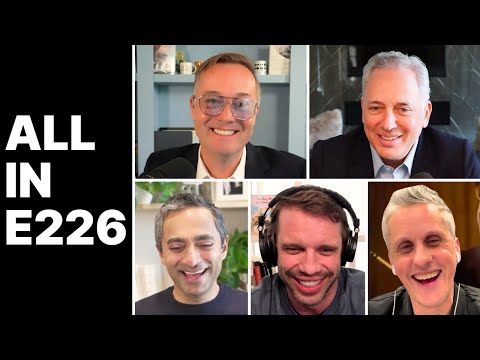
Trump's First 100 Days, Tariffs Impact Trade, AI Agents, Amazon Backs Down
Jason Calacanis (host), Chamath Palihapitiya (host), Ryan Petersen (guest), David Sacks (host), David Friedberg (host), Aaron Levie (guest), Jason Calacanis (host), Chamath Palihapitiya (host), Aaron Levie (guest), Narrator, David Friedberg (host), Chamath Palihapitiya (host)
In this episode of All-In Podcast, featuring Jason Calacanis and Chamath Palihapitiya, Trump's First 100 Days, Tariffs Impact Trade, AI Agents, Amazon Backs Down explores trump’s Tariffs, Trade Shock, AI Agents, And Elite Politics Collide This episode of the All-In Podcast dissects Trump’s first 100 days in office, the aggressive new tariff regime with China, and its cascading impact on supply chains, small businesses, and big tech. The besties and guests Ryan Petersen (Flexport) and Aaron Levie (Box) debate whether Trump’s shock-and-awe tariff strategy is necessary realpolitik or reckless ‘chaos monkey’ economics, and how poorly communicated policy is amplifying uncertainty.
Trump’s Tariffs, Trade Shock, AI Agents, And Elite Politics Collide
This episode of the All-In Podcast dissects Trump’s first 100 days in office, the aggressive new tariff regime with China, and its cascading impact on supply chains, small businesses, and big tech. The besties and guests Ryan Petersen (Flexport) and Aaron Levie (Box) debate whether Trump’s shock-and-awe tariff strategy is necessary realpolitik or reckless ‘chaos monkey’ economics, and how poorly communicated policy is amplifying uncertainty.
They also explore the rapid rise of AI agents, how agentic systems will change enterprise software, labor, and business models, and the technical/compliance hurdles enterprises face as they move from toy demos to production systems. The conversation repeatedly returns to media distortion, political tribalism, and the tension between free-market instincts and national-security-driven industrial policy.
Overall, the panel sees big wins on border security, AI and crypto policy, and a cultural shift away from DEI, but deep disagreement remains over tariffs, execution quality, communication, and the risks of economic dislocation during a high-velocity policy reset.
Key Takeaways
Trump’s first 100 days: strong marks on border, investment, culture; mixed on process
Chamath and Sacks give Trump roughly a B+/A- for the first 100 days, citing an A+ on sealing the border, attracting ~$1T in foreign direct investment, and rapidly dismantling DEI/woke frameworks in government and culture. ...
Get the full analysis with uListen AI
Tariffs created a 60% collapse in China–US ocean freight bookings and huge uncertainty
Ryan Petersen reports a roughly 60% drop in ocean freight bookings from China to the US after Trump’s reciprocal tariffs escalated from an initially signaled 54% to roughly 154% on Chinese imports, far exceeding expectations. ...
Get the full analysis with uListen AI
There’s a core strategic case for tariffs—but execution and communication have been rough
Chamath and Sacks argue tariffs are exposing dangerous US dependencies on China for rare earths, batteries, pharma APIs, and critical manufacturing capacity—dependencies that could cripple US options in a China–Taiwan or China–India conflict. ...
Get the full analysis with uListen AI
Amazon, Chinese sellers, and unfair competition are now front-and-center policy issues
Tariffs have thrown a spotlight on Amazon’s marketplace dynamics. ...
Get the full analysis with uListen AI
AI agents are shifting software from ‘tools’ to ‘workers’ and going after labor spend
Sacks and Levie describe AI agents as long-running, multi-step systems that can operate across many SaaS apps—searching, browsing, editing documents, running code terminals, and executing workflows. ...
Get the full analysis with uListen AI
Enterprise AI is hitting a ‘trough of disillusionment’ on production use, not on potential
Chamath sees large enterprises encountering a hard reality: moving from flashy POCs to production systems in regulated industries (healthcare, finance, life sciences) is blocked by error tolerance and liability. ...
Get the full analysis with uListen AI
Under the hood, AI capabilities are compounding exponentially across models, chips, and compute
Sacks emphasizes that while adoption and governance are messy, the underlying AI stack is improving at roughly 3–4x per year in three dimensions: (1) algorithms/models are evolving from simple chatbots to reasoning models and now to agents; (2) hardware is leaping from H100 to H200 to GB200 and beyond, with each generation several times more powerful; and (3) total deployed compute is exploding as data centers scale from 100MW to 300MW to planned gigawatt facilities, and clusters go from ~100k GPUs to projections of millions. ...
Get the full analysis with uListen AI
Notable Quotes
“I think the tariffs have been an A, because it has uncovered how beholden we are to a brittle supply chain and specifically to China, who is a friend but also an enemy.”
— Chamath Palihapitiya
“We can totally chaos monkey the economy and just see what breaks. That’s great if you’re in theory-land; it’s not great if you’re the small business owner with 30 employees who has no idea what they’re going to do next month.”
— Aaron Levie
“All the people who suddenly know what the perfect plan is and how to perfectly execute it… had nothing to say about this topic for 25 years.”
— David Sacks
“The big breakthrough is starting to think through these things as full agentic systems that operate on any amount of data, any amount of tools, for as long as you want, to complete any task that you want.”
— Aaron Levie
“In the world of AI, QA will end up being the most talented job. ‘Improvement engineering’ is really the skill that translates toy apps and vibe coding into something that’s very practical and real.”
— Chamath Palihapitiya
Questions Answered in This Episode
For Ryan: If the 154% China tariffs persist for 12–18 months, which specific categories of small and mid-sized importers do you expect to fail first, and what leading indicators in Flexport’s data would tell us that a true ‘small business extinction event’ is underway versus a temporary reset?
This episode of the All-In Podcast dissects Trump’s first 100 days in office, the aggressive new tariff regime with China, and its cascading impact on supply chains, small businesses, and big tech. ...
Get the full analysis with uListen AI
For Aaron: You outlined an alternative, ‘zero shock-and-awe’ path using carrots like 5% factory tax rates and deregulation for strategic sectors. If you were given 90 days in the Trump White House, what exact three executive actions and one piece of legislation would you prioritize to implement that plan without abandoning leverage on China?
They also explore the rapid rise of AI agents, how agentic systems will change enterprise software, labor, and business models, and the technical/compliance hurdles enterprises face as they move from toy demos to production systems. ...
Get the full analysis with uListen AI
For Chamath and Sacks: You both frame the collapse of DEI and wokeism as an unequivocal win. How do you distinguish between dismantling harmful quota engineering and simply abandoning efforts to address real, persistent discrimination—and what concrete guardrails, if any, do you think should remain inside federal agencies and universities?
Overall, the panel sees big wins on border security, AI and crypto policy, and a cultural shift away from DEI, but deep disagreement remains over tariffs, execution quality, communication, and the risks of economic dislocation during a high-velocity policy reset.
Get the full analysis with uListen AI
For all: Given the exponential trajectory Sacks described (models, chips, compute) but the stubborn error rates in Aaron’s evals and the compliance concerns Chamath raised, what is your realistic estimate of when AI agents will be trusted to fully own a high-stakes, regulated workflow—like end-to-end KYC or claims adjudication—without mandatory human approval on every case?
Get the full analysis with uListen AI
For policymakers: You argued Trump’s tariffs finally forced America to confront strategic dependencies in rare earths, batteries, and pharma APIs. If in five years we still haven’t stood up robust domestic or allied capacity in those four areas, at what point does the ‘strategic shock’ thesis fail, and what accountability should there be for the economic disruption imposed in the meantime?
Get the full analysis with uListen AI
Transcript Preview
I got to wrap, guys. I got to catch a flight to Miami. Let me do a closing here. If you want to keep going, you're welcome. Two, three, two.
Well, if the plane just waits, just text the pilot and just tell him you're a ʻall in.'
(laughs)
All right, listen. I'm not burning all the, uh, All In-
I'm just kidding.
... credits, so to speak, and all of our tokens.
I'm kidding. I'm kidding. I'm kidding.
I'm not like Freyberg who's flying private to everything-
Wait, you're worried about missing a flight?
(laughs)
... and then putting it on the All In budget, and the rest of us are flying Southwest-
(laughs)
... for your chairman dictator, Chamath Palihapitiya.
Yeah, miss a flight? That's a strange concept.
Yeah. David Sacks, uh, h- what does that mean? Dave, when's the last time you flew commercial? Clinton.
I haven't missed a flight in about 15 years.
(laughs)
(laughs)
We're going all in. Don't let your winners ride.
Rainman, David Sacks.
I'm going all in. And I said- We open sourced it to the fans, and they've just gone crazy with it.
WSI.
Queen of quinoa.
I'm going all in.
All right, everybody. Welcome back to the number one podcast in the world. We're back. We're back, and what an amazing panel we have today. With us, Ryan Petersen, friend of the pod, is back on the show. He's the CEO of Flexport. How are you doing, Ryan? Did you get any skiing in this year? I know you like to ski in the deep powder like we do.
I tried, man, but it was a, uh, busy year for work, and I got two little kids. I w- I did a few days.
Okay. So, you're... Oh, yes. We all forgot. You gave control of your company to somebody. It got a little, uh, shaky, got a little contentious, and then you took the reins back. How has it been being back in the pilot seat?
Uh, that was a year and a half ago, so it's a distant-
Yeah.
... memory for... In, in Flexport time, that's like a decade. We've, uh, yeah, really had an amazing run, although these tariffs... I mean, I guess that's why you guys invited me on. These tariffs have kind of, uh, made a lot of, created a lot of new uncertainty in the Flexports world.
Okay.
Uh-
So we'll definitely get into that, and of course, fan favorite, back for his fourth appearance on the pod.
I, I, I was... So, first of all, I saw the comment.
Unbelievable.
I s- I saw the comments last time I was on. I'm, I'm officially not a fan favorite, but, uh, glad to be back on, and I will be-
Install uListen to search the full transcript and get AI-powered insights
Get Full TranscriptGet more from every podcast
AI summaries, searchable transcripts, and fact-checking. Free forever.
Add to Chrome