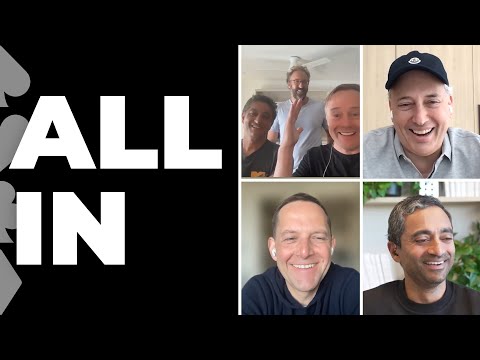
E125: SpaceX launch, Fox News settlement, "Zombie-corn" exodus to AI, late-stage implosion
Jason Calacanis (host), David Friedberg (host), Gavin Baker (guest), Antonio Gracias (guest), Chamath Palihapitiya (host), Antonio Gracias (guest), David Sacks (host), Narrator
In this episode of All-In Podcast, featuring Jason Calacanis and David Friedberg, E125: SpaceX launch, Fox News settlement, "Zombie-corn" exodus to AI, late-stage implosion explores spaceX’s Starship milestone, media spin, AI gold rush, venture reset The episode opens with SpaceX board member Antonio Gracias and investor Gavin Baker describing the Starship test as a historic breakthrough for making humanity multi-planetary, emphasizing technical success beyond media narratives of “explosion” and failure.
SpaceX’s Starship milestone, media spin, AI gold rush, venture reset
The episode opens with SpaceX board member Antonio Gracias and investor Gavin Baker describing the Starship test as a historic breakthrough for making humanity multi-planetary, emphasizing technical success beyond media narratives of “explosion” and failure.
They outline how Starship’s step‑change in payload and launch costs could transform everything from Mars colonization to global logistics, Starlink deployment, and downstream entrepreneurial innovation in space.
The conversation then pivots to Fox News’ $787M Dominion settlement, broader media dishonesty, and how legal and financial pressures may reshape news behavior—just as AI threatens to replace much of traditional media and knowledge work.
The hosts close by unpacking an AI-driven venture capital reset: “zombiecorns” starved of growth capital, talent and money rushing to tiny AI-native startups, and investors grappling with how to invest amid extreme uncertainty, while crypto faces an aggressive US regulatory clampdown.
Key Takeaways
Starship’s partial failure was actually a historic success for reusable rocketry.
Despite not reaching orbit, Starship cleared max-Q, flew for four minutes, and generated vital data—proving core structural and propulsion concepts for a vehicle intended to make Mars transport feasible.
Get the full analysis with uListen AI
Starship radically changes the unit economics of space and communications.
Moving from ~17 tons to ~100+ tons per launch while cutting variable launch cost from ~$15M to under ~$2M implies roughly a 50x improvement, enabling cheaper Starlink deployment and entirely new space-based businesses.
Get the full analysis with uListen AI
Ultra-cheap heavy lift will ripple through terrestrial logistics and travel.
High-frequency Starship fleets could replace many transoceanic cargo flights and dramatically shorten global travel times, turning New York–Tokyo into a matter of hours via suborbital hops.
Get the full analysis with uListen AI
Media incentives distort public understanding of complex technical milestones.
The hosts argue mainstream outlets framed the Starship test as a failure (“explodes”) because of hostility toward Elon Musk, ignoring standard test-flight risk and the significance of passing key thresholds like max-Q.
Get the full analysis with uListen AI
Legal and financial pressure may push media toward stronger correction standards.
Using the Fox–Dominion settlement and Alex Jones judgments as examples, they propose reforms where outlets must issue corrections with equal prominence to original errors or face substantial liability.
Get the full analysis with uListen AI
AI is triggering a massive reallocation of talent and capital while collapsing cost structures.
AutoGPT-like agents and foundation models allow 2–3 person teams to do the work of 20–30, so founders need far less capital, late-stage growth rounds are collapsing, and many richly valued “zombiecorns” now trade below their preference stacks.
Get the full analysis with uListen AI
Regulatory overreach risks pushing entire innovation fronts offshore.
They see the SEC’s aggressive posture toward Coinbase and US crypto broadly as effectively banning compliant players while undermining America’s role in blockchain innovation—just as similar dynamics could mis-shape future AI regulation.
Get the full analysis with uListen AI
Notable Quotes
“Today is the day that all of the hardworking people at SpaceX accomplished a goal of making the human race space‑faring.”
— Antonio Gracias
“When we look back in history, I believe this will be the day when we mark the technological development that we broke through and built a vehicle that could actually go to Mars.”
— Antonio Gracias
“You are lifting more than five times the mass to orbit and you’re doing it at 10 to 15 percent of the cost… roughly a 50x change.”
— Gavin Baker
“It’s the moment where I have the least sense of how to do my job… I don’t know whether I should be writing $200 million checks or $200,000 checks.”
— Chamath Palihapitiya
“Crypto’s dead in America… the United States authorities have firmly pointed their guns at crypto.”
— Chamath Palihapitiya
Questions Answered in This Episode
If Starship achieves full reusability and $2M-per-100-tons economics, which specific industries beyond Starlink and cargo aviation will be disrupted first?
The episode opens with SpaceX board member Antonio Gracias and investor Gavin Baker describing the Starship test as a historic breakthrough for making humanity multi-planetary, emphasizing technical success beyond media narratives of “explosion” and failure.
Get the full analysis with uListen AI
How should the public evaluate “failures” in experimental systems like rockets or AI models when headlines and on-the-ground technical perspectives diverge so sharply?
They outline how Starship’s step‑change in payload and launch costs could transform everything from Mars colonization to global logistics, Starlink deployment, and downstream entrepreneurial innovation in space.
Get the full analysis with uListen AI
What would a realistic, enforceable framework for media corrections look like that balances free speech with accountability for reputational harm?
The conversation then pivots to Fox News’ $787M Dominion settlement, broader media dishonesty, and how legal and financial pressures may reshape news behavior—just as AI threatens to replace much of traditional media and knowledge work.
Get the full analysis with uListen AI
In an AI world where tiny, highly-leveraged teams can build serious products, how should venture capital reconfigure fund sizes, check sizes, and support models?
The hosts close by unpacking an AI-driven venture capital reset: “zombiecorns” starved of growth capital, talent and money rushing to tiny AI-native startups, and investors grappling with how to invest amid extreme uncertainty, while crypto faces an aggressive US regulatory clampdown.
Get the full analysis with uListen AI
What are the long-term consequences for US technological leadership if crypto and potentially parts of AI innovation are driven offshore by regulation rather than shaped by clear domestic rules?
Get the full analysis with uListen AI
Transcript Preview
Hey, everybody. Welcome to Episode 125 of the All-In Podcast. On a historic day, we're taping 4/20. Really excited that SpaceX was able to launch Starship, and it made it off the launch pad. An incredibly successful today... day today. We have, of course, with us the Rain Man, David Sachs, the Sultan of Science, David Freiberg, and of course, the Dictator, Chamath Palihapitiya. But two special guests are here.
Special guests.
Gavin Baker from Etreides. How do you pronounce it?
Etreides.
Etreides.
House of Etreides.
House of Etreides, if you know Dune. And then SpaceX board member, Antonio Gracias, one of the first investors in SpaceX. Antonio, a big day for you. Maybe you could just tell the audience what happened today, why that is so important in the history of this company.
Well, first, I wanna thank you guys for letting me, uh, come on and have a little chat with you about this. Today was extraordinarily important for, for SpaceX, I think for America, and for humanity. And the Starship is the realization of, of the vision had- Elon had 20 years ago, 25 years ago, even as a child, really, to, to go to Mars. And the engineers here at, at SpaceX, and on the entire team working extremely hard, are really just to get this, this, uh, vehicle off the pad, as, as Elon had said, right? The, the... This is a brand new vehicle. Everything about it is new. So the engines, the material science, the structure, the design, all of it new. And the most important thing here was to get off the pad so we can collect data. And this technology platform is the platform that'll allow us to go to Mars. So from a non-engineer's standpoint, why this is important is that what we've proven with this flight, we got past a, um, point called Max-Q, which is the point at which the vehicle takes maximum stress. That's how I think about it. I'm sure engineers would tell you there's a, a lot more, uh, description to it, or David Freiberg give you a better description to it. But it's the most amount of stress in the vehicle, which means that this vehicle will get to orbit. And this is the vehicle that's gonna take us to Mars. So today is the day that all of the hardworking people at SpaceX accomplished a, a goal of making the human race space-faring. When we look back in history, I believe this will be the day when we mark the, the technological development that we broke through and built a vehicle that could actually go to Mars.
Now, when we look at it, uh, obviously it didn't make it to orbit. Maybe you can give some context into what is the typical life cycle of a new rocket ship coming out. The Falcon, the original one, has done, I think, 224 missions, 222 of them successful. I think 160 or so actually landed themselves.
Install uListen to search the full transcript and get AI-powered insights
Get Full TranscriptGet more from every podcast
AI summaries, searchable transcripts, and fact-checking. Free forever.
Add to Chrome