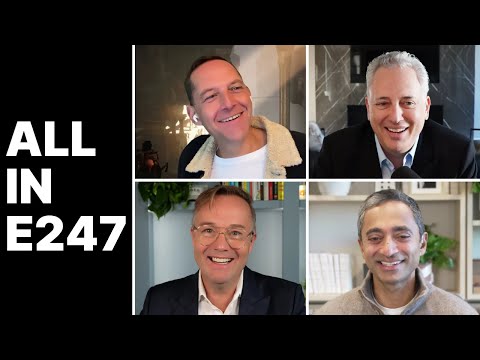
Trump: Send National Guard to SF, China Rare Earths Trade War, AI's PR Crisis
Jason Calacanis (host), Chamath Palihapitiya (host), David Sacks (host), David Friedberg (host), Jason Calacanis (host), Guest (guest), Chamath Palihapitiya (host), Guest (guest), David Friedberg (host)
In this episode of All-In Podcast, featuring Jason Calacanis and Chamath Palihapitiya, Trump: Send National Guard to SF, China Rare Earths Trade War, AI's PR Crisis explores trump, China, And AI: National Guard, Rare Earths, And Backlash The episode opens with banter from Dreamforce in San Francisco, then pivots into a serious debate about crime, homelessness, and whether Trump’s proposed National Guard deployment to San Francisco is warranted given recent improvements. The discussion then moves to China’s new export controls on rare earth minerals, U.S. dependence on Chinese supply chains, and how price floors, deregulation, and strategic reserves might rebuild domestic capability. The hosts zoom out to the larger U.S.–China rivalry, tracing how WTO policy and corporate incentives helped create today’s dependency and multipolar world. Finally, they examine AI’s emerging PR crisis: data-center backlash over power and water, fears of job loss, and how to communicate AI’s benefits while addressing real local and economic concerns.
Trump, China, And AI: National Guard, Rare Earths, And Backlash
The episode opens with banter from Dreamforce in San Francisco, then pivots into a serious debate about crime, homelessness, and whether Trump’s proposed National Guard deployment to San Francisco is warranted given recent improvements. The discussion then moves to China’s new export controls on rare earth minerals, U.S. dependence on Chinese supply chains, and how price floors, deregulation, and strategic reserves might rebuild domestic capability. The hosts zoom out to the larger U.S.–China rivalry, tracing how WTO policy and corporate incentives helped create today’s dependency and multipolar world. Finally, they examine AI’s emerging PR crisis: data-center backlash over power and water, fears of job loss, and how to communicate AI’s benefits while addressing real local and economic concerns.
Key Takeaways
San Francisco is statistically improving, but a blighted downtown core fuels calls for federal intervention.
Friedberg cites city data showing crime down ~30% citywide and ~40% downtown, homicides at a 70-year low, tents largely removed, car break-ins at a 25-year low, and net police hiring for the first time in seven years. ...
Get the full analysis with uListen AI
Homelessness in San Francisco is heavily subsidized, creating perverse incentives and a regional magnet for addiction.
The hosts claim San Francisco spends roughly $700–800M annually on homelessness—around $52,000 per homeless person—largely via NGOs paid per “client,” which they argue incentivizes maintaining rather than solving addiction and homelessness. ...
Get the full analysis with uListen AI
China’s rare earth dominance is the product of decades of strategic mercantilism, not a free market outcome.
China identified rare earths, EVs, batteries, and pharma APIs as strategic sectors in the 1990s, then used subsidies, provincial balance sheets, and quasi‑state entities to undercut global prices, drive competitors like Molycorp out of business, and build a near‑monopoly in mining, processing, and magnet casting. ...
Get the full analysis with uListen AI
The hosts endorse a more activist U.S. industrial policy: strategic reserves and limited price guarantees in critical inputs.
While Friedberg is wary of permanent price floors and prefers deregulation and tax incentives, Sacks and Chamath argue that in strategic materials like rare earths, pure market logic can’t overcome China’s ability to dump supply and crash prices. ...
Get the full analysis with uListen AI
U.S.–China relations are shifting from naive integration to managed rivalry between competing international orders.
Sacks argues that U. ...
Get the full analysis with uListen AI
AI faces a growing PR and political backlash driven by local costs and sensational narratives.
Chamath highlights three canceled hyperscaler data center projects (Google in Indianapolis, Microsoft in Wisconsin, Amazon near Tucson) amid resident concerns about higher electricity prices, water use, and noise. ...
Get the full analysis with uListen AI
The hosts see AI as a major growth engine with manageable job shifts, not mass unemployment—if transition is handled well.
Sacks notes Q2 U. ...
Get the full analysis with uListen AI
Notable Quotes
“We don’t have to live in San Francisco with our main street, Market Street, basically being an open-air drug market.”
— David Sacks
“You get as much homelessness as you’re willing to pay for.”
— David Sacks (quoting Thomas Sowell)
“China is not a rising power; China is a re‑ascending power… from 1500 to now, China had the world’s largest GDP 70% of those years.”
— Chamath Palihapitiya
“AI is the difference between having great GDP growth, say around 4%, and modest GDP growth around 2%.”
— David Sacks
“Humans are end-to-end; AI is middle-to-middle.”
— David Sacks (attributing to Balaji Srinivasan)
Questions Answered in This Episode
If San Francisco’s crime and homelessness metrics are genuinely improving, what specific, measurable threshold would justify bringing in federal forces like the National Guard—and who should have the authority to decide that?
The episode opens with banter from Dreamforce in San Francisco, then pivots into a serious debate about crime, homelessness, and whether Trump’s proposed National Guard deployment to San Francisco is warranted given recent improvements. ...
Get the full analysis with uListen AI
Given your criticism of the existing homelessness NGO ecosystem in San Francisco, what concrete accountability framework or funding model would you implement to ensure providers are rewarded for exits from homelessness and addiction, not caseload growth?
Get the full analysis with uListen AI
For rare earths and other strategic inputs, where exactly would you draw the line between acceptable industrial policy (price guarantees, strategic reserves) and dangerous long-term market distortion—and how would you sunset those interventions once U.S. capacity is rebuilt?
Get the full analysis with uListen AI
On AI data centers: if you were negotiating with a skeptical Midwestern town that fears higher power bills and water depletion, what specific package of local benefits (e.g., bill credits, microgrids, job guarantees) would you put on the table to win a democratic vote in favor?
Get the full analysis with uListen AI
Your optimism about AI-driven job transitions leans heavily on past industrial revolutions; what leading indicators would you watch over the next 3–5 years (e.g., wage growth by quartile, youth unemployment, retraining take-up) to falsify your current view and trigger a policy course correction?
Get the full analysis with uListen AI
Transcript Preview
All right. You guys were, uh, talking about the fun shenanigans you were having in San Francisco and at Marc Benioff's Dreamforce.
Did you see Brian Johnson was at Benioff's CEO dinner?
Oh, I didn't see him.
Yeah.
Matthew McConaughey was at our table at dinner.
All right, all right, all right.
Right, all right.
David Sacks. McConaughey's fabulous. He is funny.
Did you see where I was sitting at that dinner?
Yeah.
Yeah, table one.
Right next to the king himself.
The king himself, exactly.
The king who? The king in I? Benioff is a king?
(laughs) Well, he's the king of San Francisco.
At his party. Yeah.
He's not-
He's the king of San Francisco. (laughs)
He's... Yeah. I mean, obviously, he has to bend the knee to the king of kings, which is Trump, but...
(laughs)
(laughs)
(laughs)
I was sitting next to-
Ew.
... Benioff there.
It got weird.
It got a little weird. No, well, what happened was... Did you see that SF Standard? Yeah. I don't even know how they can write a headline like this, so...
Well, it's The San Francisco Standard.
Yeah.
Yeah, so Benioff interviewed me at Dreamforce, and somehow this was, like, headline-worthy for SF Standard. And they said that Marc Benioff dodges political questions then fawns over David Sacks on Dreamforce day one. That was just referring to the interview we did. So we trolled them by taking that photo.
That's, um... Yeah, it's a little weird.
(laughs)
I thought the fireside chat you guys did was great.
It was great, yeah.
Hmm.
It was just an interview.
It was really good, actually. He's a very good interviewer.
Mm-hmm.
Hmm.
Yeah, totally. But apparently, to SF Standard, it's like some sort of transgression that I was even interviewed.
They didn't get the memo that cancel culture is over.
Yeah.
They can't-
I know. That's what it feels like, right?
They can't cancel. It's like...
Where they're, like, trying to-
Yeah.
They're trying to gin up some sort of brouhaha over the fact that I was speaking.
Yeah. "Oh, you can't talk to David Sacks."
Right.
"He's in the Trump administration. Not allowed to talk to him."
(laughs) He's literally-
I get about a hundred people a week who say that. (laughs)
(laughs)
Literally, the AI guy and the AI CEO-
Right.
... shouldn't talk to him. It's like...
(laughs)
You know, like what the (beep) ?
Yeah, makes sense.
Oh, I'm an AI company.
Sure.
I should not talk to the government's-
Makes sense.
... AI person.
Right. By the way, did you see that there was one other, uh, very important conference in town at the same time as Dreamforce?
Install uListen to search the full transcript and get AI-powered insights
Get Full TranscriptGet more from every podcast
AI summaries, searchable transcripts, and fact-checking. Free forever.
Add to Chrome