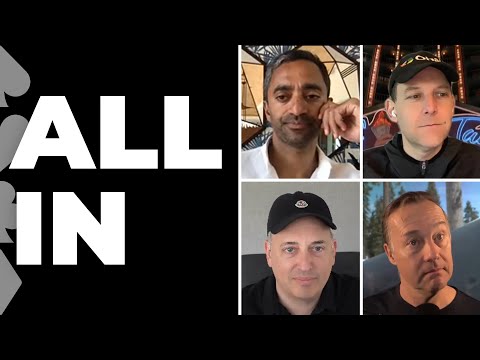
E123: Trump indictment, de-dollarization, should VCs back Chinese AI? RIP Bob Lee
Jason Calacanis (host), David Friedberg (host), Chamath Palihapitiya (host), Narrator, David Sacks (host), Chamath Palihapitiya (host), David Friedberg (host), Jason Calacanis (host), Narrator, Narrator, Narrator, Narrator
In this episode of All-In Podcast, featuring Jason Calacanis and David Friedberg, E123: Trump indictment, de-dollarization, should VCs back Chinese AI? RIP Bob Lee explores trump indictment, dollar dominance, China AI, and San Francisco’s decline The hosts open with banter before diving into the New York indictment of Donald Trump, largely criticizing the case as weak, politicized, and counterproductive even for anti‑Trump advocates. They then examine fears around global de‑dollarization, arguing the dollar’s dominance is not immediately threatened but warning that US debt, unfunded liabilities, and weaponization of the dollar are long‑term risks. The conversation shifts to geopolitical strategy: whether US VCs should take capital from allies like Saudi Arabia and whether they should be allowed to fund Chinese AI companies, with consensus that backing adversarial AI should be restricted. They close with the stabbing of Bob Lee in San Francisco, using it to highlight perceived policy failures on crime, homelessness, and “decaceration,” and calling for political change or exit from failing cities.
Trump indictment, dollar dominance, China AI, and San Francisco’s decline
The hosts open with banter before diving into the New York indictment of Donald Trump, largely criticizing the case as weak, politicized, and counterproductive even for anti‑Trump advocates. They then examine fears around global de‑dollarization, arguing the dollar’s dominance is not immediately threatened but warning that US debt, unfunded liabilities, and weaponization of the dollar are long‑term risks. The conversation shifts to geopolitical strategy: whether US VCs should take capital from allies like Saudi Arabia and whether they should be allowed to fund Chinese AI companies, with consensus that backing adversarial AI should be restricted. They close with the stabbing of Bob Lee in San Francisco, using it to highlight perceived policy failures on crime, homelessness, and “decaceration,” and calling for political change or exit from failing cities.
Key Takeaways
The Trump hush‑money case is seen as legally thin and politically risky.
Sacks and Chamath argue the underlying conduct (a private settlement with personal funds) is typically legal, the statute of limitations is stretched, and using state law to bootstrap federal campaign violations is dubious—potentially undermining more serious future cases against Trump by making them all look partisan.
Get the full analysis with uListen AI
De‑dollarization is more a long‑term risk than a present reality.
Chamath notes that China’s yuan is pegged to the dollar, so bilateral yuan trade still effectively rides on the dollar, while Sacks and Friedberg emphasize that US over‑indebtedness and weaponizing dollar reserves/sanctions gradually incentivize countries to hedge away from dollar exposure.
Get the full analysis with uListen AI
Unfunded pensions and government promises are a massive, under‑priced liability.
Using Chicago as an example—80% of property taxes going to pensions that are only ~25% funded—the hosts tie state and city pension holes to federal backstops, arguing that Social Security, municipal pensions, and commercial real‑estate losses will ultimately force higher taxes and/or money printing.
Get the full analysis with uListen AI
Escaping the debt trap will likely require an unpopular mix of higher taxes and spending restraint.
Friedberg predicts materially higher top tax rates (possibly approaching 70%) plus some eventual austerity, while Sacks argues growth‑oriented tax reform and entrepreneurship are crucial; Chamath is more fatalistic, expecting debt‑to‑GDP to drift higher for the US and everyone else without a hard break in our lifetimes.
Get the full analysis with uListen AI
Gulf sovereign wealth funds are stepping in as Western LPs retrench.
With US endowments and institutions “closed for business” after misallocation and losses, Chamath frames Saudi’s PIF publication of its VC relationships as smart marketing that positions them as the new go‑to LP for top global venture firms.
Get the full analysis with uListen AI
US capital funding Chinese AI companies should likely be restricted.
Chamath argues that just as CFIUS polices foreign money entering sensitive US sectors (rockets, chips), there should be comparable scrutiny on US money seeding advanced AI in strategic rival nations; Sacks suggests a simple rule—take capital only from allies, not declared adversaries.
Get the full analysis with uListen AI
San Francisco’s public‑safety crisis is blamed on policy choices and ‘upside‑down’ power dynamics.
Using Bob Lee’s stabbing and rampant property crime as examples, Friedberg and Sacks contend that non‑prosecution of low‑level crime, decarceration, and a focus on offenders over victims have made the city unsafe, arguing that meaningful change requires regime change at the local level or residents “voting with their feet.”
Get the full analysis with uListen AI
Notable Quotes
““This is ripping the country apart for no reason and such a stupid case.””
— Chamath Palihapitiya (on the Trump indictment)
““As bad as the dollar is, it is the worst‑affected leper in the leper colony.””
— David Sacks (on the dollar’s relative strength despite structural issues)
““I still think we’ll end up seeing 70% tax rates on the wealthiest people in this country.””
— David Friedberg (on how the US will fill fiscal gaps)
““It should not be allowed… I don’t think we want US fingerprints on this stuff being perfected outside of US borders.””
— Chamath Palihapitiya (on US VCs backing Chinese AI companies)
““San Francisco has become an upside‑down town… If you want to deal drugs in the open air, nothing will happen to you. But if you have a car and you park at a parking meter for more than 10 minutes, you get a ticket.””
— David Friedberg (on perceived misaligned enforcement priorities in SF)
Questions Answered in This Episode
If the Trump hush‑money case is as weak as argued, what reforms—if any—should be made to prevent local prosecutors from bringing politically explosive but thin cases against national candidates?
The hosts open with banter before diving into the New York indictment of Donald Trump, largely criticizing the case as weak, politicized, and counterproductive even for anti‑Trump advocates. ...
Get the full analysis with uListen AI
At what concrete indicators (e.g., share of reserves, commodity contracts) would you personally conclude that de‑dollarization has moved from ‘theoretical risk’ to ‘active regime change’ in global finance?
Get the full analysis with uListen AI
How should policymakers balance the long‑term risks of debt and unfunded pensions against the near‑term political and social backlash from austerity and higher taxes?
Get the full analysis with uListen AI
Where should the line be drawn between legitimate global capital flows and strategically dangerous ones—especially around AI, semiconductors, and other dual‑use technologies?
Get the full analysis with uListen AI
What specific criminal‑justice or homelessness policies would you implement in a city like San Francisco to improve safety without abandoning concerns about fairness and social justice?
Get the full analysis with uListen AI
Transcript Preview
I can't see what's on your hat. What does it say? Super Gut?
One of my most exciting companies. It's called Ohalo.
Oh, Mahalo. I still have mahalo.com.
No, not Mahalo. Unrelated.
Ah.
Completely unrelated, nothing whatsoever to do with Mahalo. I remember Mahalo, great product. Sorry it didn't become like a-
I went up against, you know, we were making $10 million in revenue, uh, at the peak.
Yeah.
Had a hundred people writing, like, human curated search result pages.
I remember that.
And it was doing so well-
Look at ChatGPT, you're, you're a great guy to reference the ChatGPT thing coming out of that.
Well, then what happened was, they did the Panda update and we went from 10 million down to, uh, 500,000 in revenue overnight.
What was the Panda update?
They looked at who the top sites were, eHow, Mahalo-
Yeah, yeah.
... et cetera, and they just said, "Nobody can get any more than this amount of traffic." And they literally throttled the number of unique users they would send to you. And, uh, that was it. Game over. And, um, then everybody I knew at Google wouldn't return my emails and they were like, "We don't have partnerships with anybody." That's what Matt Cutts told me.
Are you saying that Mahalo's lack of success had nothing to do with the poor product and (beep) execution? It was Google's malfeasance?
It got really rave reviews. It was backed by Sequoia then, um-
So did the movie (beep) but it sucked (beep) .
You know, when you build a company that gets to 10 million in revenue in 18 months, you can talk, Chamath. But basically, looking at your resume here, I see that you've created nothing in your entire career.
(laughs)
When you get in the arena, the arena, and you actually build a product, then you can talk to me. I had the number one blog in the world, one of the top five tech magazines in the world.
Ugh.
And this is the number one tech and business podcast in the world.
This is so good. I touched a soft spot. I got to the warm underbelly there. (laughs)
Jake Hellis so rarely goes after Chamath. When he does, it's just gold. It's like-
Oh, it's, uh, it's incredible.
You're talking to three founders here, Chamath. You're the odd person out.
Mm, I like that.
So when you wanna talk about product, then make one. Okay?
That's so gross. And yet I'm the richest. That's so tilting. It must tilt you.
Totally fine. So is Kim Jong Un, so is Putin. Okay? There's a lot of rich people in the world.
Oh, my God.
But the- these are three product. Okay, dictator?
(laughs)
There's your (beep) cold open. Let's go.
Install uListen to search the full transcript and get AI-powered insights
Get Full TranscriptGet more from every podcast
AI summaries, searchable transcripts, and fact-checking. Free forever.
Add to Chrome