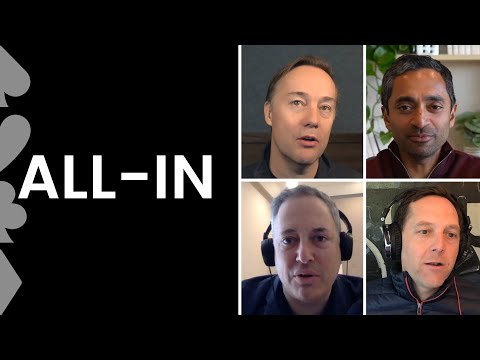
E72: Impact of sanctions, deglobalization, food shortage risks, macroeconomic outlook and more
Jason Calacanis (host), David Sacks (host), Chamath Palihapitiya (host), Narrator, David Friedberg (host), Jason Calacanis (host), Narrator
In this episode of All-In Podcast, featuring Jason Calacanis and David Sacks, E72: Impact of sanctions, deglobalization, food shortage risks, macroeconomic outlook and more explores war, sanctions, and food shocks reshape global markets and geopolitics The hosts discuss the Russia-Ukraine war’s military trajectory, the emerging contours of a possible peace deal, and the role of U.S. diplomacy versus European mediators. They argue sanctions on Russia are historically severe, potentially effective in forcing compromise, but also likely to trigger major second-order effects, including recession risks and a tighter Russia–China alignment.
War, sanctions, and food shocks reshape global markets and geopolitics
The hosts discuss the Russia-Ukraine war’s military trajectory, the emerging contours of a possible peace deal, and the role of U.S. diplomacy versus European mediators. They argue sanctions on Russia are historically severe, potentially effective in forcing compromise, but also likely to trigger major second-order effects, including recession risks and a tighter Russia–China alignment.
David Friedberg details how disrupted grain and fertilizer exports, spiking energy prices, and reduced planting could drive a global food crisis and widespread famine risk within a year, especially in poorer nations. The group criticizes decades of Western energy and agricultural policy—opposition to nuclear and GMOs, environmental constraints on mining—as short-sighted and driven by “overeducated dumb people.”
They forecast a period of near‑term market ‘melt‑up’ as uncertainty about the Fed path and the war’s negotiating framework diminishes, while warning that sustained conflict, escalation, and food shocks could still lead to a serious recession. Longer term, they predict deglobalization, supply-chain redundancy, and a “race to resiliency” in energy, food, and critical manufacturing.
The conversation closes with a critique of U.S. foreign policy habitually chasing regime change, praise for Biden’s refusal to enter direct war with Russia, and calls for a new doctrine of selective engagement, sanctions as a primary tool, and a more pragmatic rethinking of environmental and agricultural constraints.
Key Takeaways
Sanctions are powerful but carry massive global spillovers.
The near-total economic severing of Russia likely increases pressure on Putin, but it also disrupts energy, fertilizer, and grain markets, risks pushing Russia into China’s orbit, and may boomerang back as recession and higher inflation in the West.
Get the full analysis with uListen AI
A serious global food crisis is likely within 12 months without rapid change.
Russia and Ukraine supply ~15% of global calories via wheat and a large share of fertilizer inputs; blocked exports, sky-high fertilizer and gas prices, and reduced planting could push hundreds of millions into hunger as rich countries outbid poor ones.
Get the full analysis with uListen AI
Policy opposition to nuclear energy and GMOs worsened today’s fragilities.
The hosts argue that anti-nuclear and anti-GMO movements, driven by poor or fear-based science, blocked technologies that could have reduced dependence on Russian hydrocarbons and fertilizer-intensive agriculture, increasing vulnerability to shocks.
Get the full analysis with uListen AI
Markets fear uncertainty more than bad news itself.
Once the Fed laid out a clear rate path and the rough contours of a Ukraine peace deal emerged, equities rallied; the hosts see a short-term ‘melt‑up’ as uncertainty falls, albeit with substantial downside if the peace process collapses or war escalates.
Get the full analysis with uListen AI
Deglobalization will drive vertical integration and ‘redundant’ capacity.
Companies and countries are likely to accept higher capex and lower efficiency to control more of their own energy, food, semiconductor, and manufacturing chains, trading off globalization’s cost savings for resilience and sovereignty.
Get the full analysis with uListen AI
U.S. foreign policy must pivot from regime change to selective engagement.
Citing failures in Iraq, Libya, Syria, Afghanistan, and Ukraine 2014, they argue Washington should stop trying to engineer leadership changes abroad and instead focus on vital interests, maintaining coalitions (including imperfect allies), and using tools like sanctions more strategically.
Get the full analysis with uListen AI
Biden’s restraint on direct military intervention may age well historically.
Despite criticism from hawks, the hosts credit Biden for clearly ruling out a no-fly zone and direct war with Russia, arguing that avoiding World War III while leveraging sanctions and arms shipments is a difficult but correct strategic balance.
Get the full analysis with uListen AI
Notable Quotes
“Once we stop making food, humans run out of food in 90 days.”
— David Friedberg
“We will see hundreds of millions of people go starving… regardless, it is gonna be a humanitarian disaster within a year.”
— David Friedberg
“We suffer from a very insidious kind of plague in the world, which is the plague of overeducated dumb people.”
— Chamath Palihapitiya
“Trade creates economic wealth but it also creates dependency. You can’t have trade without trust.”
— David Sacks
“Trump was the only [president] that did not start a new war, and so far Biden.”
— David Sacks
Questions Answered in This Episode
How should governments balance the moral imperative of sanctioning aggressors with the responsibility to prevent global famine and economic collapse?
The hosts discuss the Russia-Ukraine war’s military trajectory, the emerging contours of a possible peace deal, and the role of U. ...
Get the full analysis with uListen AI
What concrete policy changes in nuclear, GMO regulation, and mining would meaningfully improve Western resilience without causing unacceptable environmental or safety risks?
David Friedberg details how disrupted grain and fertilizer exports, spiking energy prices, and reduced planting could drive a global food crisis and widespread famine risk within a year, especially in poorer nations. ...
Get the full analysis with uListen AI
If sanctions push Russia into a long-term client relationship with China, how does that reshape the balance of power in a ‘Cold War II’ scenario?
They forecast a period of near‑term market ‘melt‑up’ as uncertainty about the Fed path and the war’s negotiating framework diminishes, while warning that sustained conflict, escalation, and food shocks could still lead to a serious recession. ...
Get the full analysis with uListen AI
What would a realistic and sustainable U.S. doctrine of ‘selective engagement’ look like in practice, especially toward autocratic allies and adversaries?
The conversation closes with a critique of U. ...
Get the full analysis with uListen AI
How can investors and policymakers distinguish between necessary deglobalization for resilience and overreaction that simply raises costs without improving security?
Get the full analysis with uListen AI
Transcript Preview
I now have a chief of staff, he's pretty great. He's worked with me for a while, and he- he's doing a great job. But it's actually really helped, I will say that. And then I, uh, started a family office.
Wow. Congrats.
What does that mean? You have a place in your h- home that you call an office?
(laughs)
Yeah, you know like the one your refrigerator, there's an office? That's a family office. Yeah. The family goes in there to talk about office stuff.
Where does Jade put the stickies that say, "We're out of granola bars"?
In the family office. (laughs)
(laughs)
All in. Let your winners ride. Rain Man, David Sa- I'm going all in. And I said we open source it to the fans, and they've just gone crazy with it. Love you guys. Queen of Quinoa. I'm going all in.
Hey, everybody. Welcome to another episode of the All In Podcast, Episode 72, Part Deux. With us today, again, the Prince of Panic Attacks, the Sultan of Science, David Friedberg.
(laughs) The Prince of Panic Attacks. (laughs)
(laughs) Ah, yes, and also-
The Zephyr of Zoloft. (laughs)
(laughs) Uh, and also, as you're hearing cackling, the Duke of Degeneracy, uh, the dictator himself...
Chamath Kavaliyapetiam.
Chamath Kavaliyapetiam. And, of course, everybody's, uh, favorite, the Rain Man himself, the drunk History Channel uncle, David Sacks.
(laughs)
I mean, David, I, I follow you on Twitter. You're tweeting 50 times a day.
Oh, I was thinking the same thing. When do you work?
What has happened to you? You, you won't meet with startups anymore. I, I bring you startups, you say, "You know what? I'm no longer going to meet with your startups."
You're like Grey Gasby, you're like stuck in your room tweeting about the fucking world.
I just, I don't do first meetings.
That is the end of your career. Huge-
No.
... mistake.
No.
No more first meetings?
It preserves, it preserves my energy. There's nothing more draining than endlessly spending your day in first meetings.
No, why don't you just have a short first meeting, like a 15-minute first meeting?
Well, that's what, you know, we have a team for, is that it-
But what if they have a bad judgment?
I love it.
They don't, because we know exactly what we're looking for. SaaS investing is very metrics-driven. And so the first meeting-
Oh, that's fair. That's a good point.
Yeah, exactly. So it's like, you know-
No, it's a really good point.
... the first meeting we just find out, do they meet our basic threshold for-
Love it.
... for growth and-
For... Yeah, exactly.
... R&R. Fantastic.
Right, right, right.
That is what I want to hear.
Install uListen to search the full transcript and get AI-powered insights
Get Full TranscriptGet more from every podcast
AI summaries, searchable transcripts, and fact-checking. Free forever.
Add to Chrome