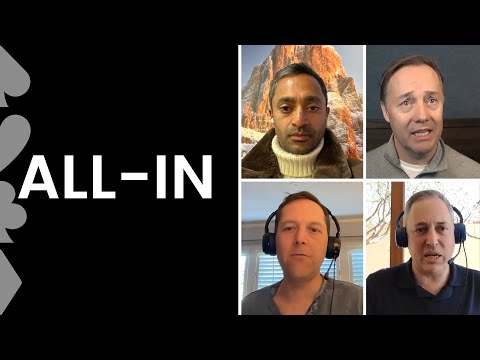
E70: EMERGENCY POD! Russia invades Ukraine: Reactions, Putin's ambition, Biden's response and more
David Sacks (host), Chamath Palihapitiya (host), Jason Calacanis (host), David Friedberg (host), Jason Calacanis (host), Chamath Palihapitiya (host), David Friedberg (host), David Sacks (host)
In this episode of All-In Podcast, featuring David Sacks and Chamath Palihapitiya, E70: EMERGENCY POD! Russia invades Ukraine: Reactions, Putin's ambition, Biden's response and more explores all-In Podcast debates Ukraine invasion, U.S. response, and energy independence The hosts react in real time to Russia’s invasion of Ukraine, debating whether the U.S. should intervene militarily and how far sanctions ought to go.
All-In Podcast debates Ukraine invasion, U.S. response, and energy independence
The hosts react in real time to Russia’s invasion of Ukraine, debating whether the U.S. should intervene militarily and how far sanctions ought to go.
David Sacks argues forcefully against U.S. military involvement, framing Ukraine as outside core American interests and warning of World War III–style escalation, while others probe the costs to U.S. credibility.
The conversation shifts into a deep dive on energy policy, linking Europe’s dependence on Russian gas to strategic vulnerability and arguing over fracking, nuclear power, and a massive U.S. solar build‑out.
They close by discussing market reactions to the war, the repricing of tech and growth stocks, and how investors might look for durable, long-term opportunities in a more volatile world.
Key Takeaways
U.S. military intervention in Ukraine is widely viewed as a red line that risks World War III.
Sacks stresses that Ukraine is not a NATO member, the U. ...
Get the full analysis with uListen AI
Diplomatic off‑ramps—especially on NATO expansion—may have been underused before the invasion.
Several hosts argue that formally taking Ukrainian NATO membership off the table, even temporarily, was a low-cost concession that might have de‑escalated tensions given Russia’s long‑stated red line on this issue.
Get the full analysis with uListen AI
Sanctions will hurt Russia but are unlikely on their own to reverse Putin’s move.
They note Russia’s large foreign currency reserves, past experience absorbing sanctions, and the limited appetite in Europe for extreme measures like removing Russia from SWIFT, suggesting sanctions are more punishment than true deterrent.
Get the full analysis with uListen AI
Energy dependence is a core strategic vulnerability for Europe and the U.S.
The discussion links Europe’s reliance on Russian gas and America’s policy swings on fracking and pipelines to reduced geopolitical leverage, arguing that whoever controls cheap, reliable energy has major strategic and economic advantage.
Get the full analysis with uListen AI
A massive transition to renewables—especially solar—could be both feasible and transformative.
Chamath and Friedberg claim that on the order of $2. ...
Get the full analysis with uListen AI
Nuclear power remains a powerful but politically constrained tool for energy security.
Friedberg advocates rapid nuclear build‑out, citing China’s aggressive plans and ultra‑low projected costs per kWh, while Chamath doubts U. ...
Get the full analysis with uListen AI
Markets are repricing from speculative growth to durable, cash‑generating businesses.
They observe that tech and SaaS multiples have fallen back toward or below historical norms, pandemic ‘pull‑forward’ demand is unwinding, and wartime uncertainty may slow Fed hikes—creating a stock‑picker’s environment for long‑term investors.
Get the full analysis with uListen AI
Notable Quotes
““It is not a vital American interest who rules the Donbass.””
— David Sacks
““Our absolute priority right now should be to make sure that this war doesn’t spread.””
— David Sacks
““Deterrence is a simple equation. It’s the product of will and capability.””
— Chamath Palihapitiya, quoting H.R. McMaster
““If automation is the future of manufacturing, then electricity ends up being the biggest cost driver… whoever’s got the cheaper energy wins.””
— David Friedberg
““We’ve Twitterized our foreign policy… that is a way to find yourself in greater conflicts, not avoid them.””
— David Sacks
Questions Answered in This Episode
If Ukrainian NATO membership had been formally ruled out years ago, how likely is it that Russia would still have invaded?
The hosts react in real time to Russia’s invasion of Ukraine, debating whether the U. ...
Get the full analysis with uListen AI
At what point, if any, should the U.S. treat an attack on a non‑NATO democracy as a vital national interest worth military risk?
David Sacks argues forcefully against U. ...
Get the full analysis with uListen AI
How can Western democracies realistically build political consensus for large‑scale nuclear or solar investments framed as national security imperatives?
The conversation shifts into a deep dive on energy policy, linking Europe’s dependence on Russian gas to strategic vulnerability and arguing over fracking, nuclear power, and a massive U. ...
Get the full analysis with uListen AI
Do media incentives toward sensational ‘war coverage’ meaningfully increase the risk of escalation by shaping public opinion and elite rhetoric?
They close by discussing market reactions to the war, the repricing of tech and growth stocks, and how investors might look for durable, long-term opportunities in a more volatile world.
Get the full analysis with uListen AI
Given the repricing of high‑growth tech stocks, what criteria should investors now prioritize when distinguishing between temporary pull‑backs and broken business models?
Get the full analysis with uListen AI
Transcript Preview
... besties are back-
I'm going all in. Let your winners ride.
Rain Man, David Sachs.
I'm going all in. And I said- We opened source just for the fans and they've just gone crazy with it.
Love you, bestie.
Queen of Quinoa. I'm going all in.
All right, everybody. Welcome to another episode of the All-In Podcast, episode number 70. We made it to 70 episodes, which is just shocking to me. And we're recording a little bit earlier, uh, because one of our besties, uh, had to change their schedule, Chamath. And, um, it's, um, a crazy day to be doing this. Last night, Putin decided to invade the Ukraine, um, late Wednesday night, early into Thursday morning. Putin, uh, started a special military operation, in quotes, "to demilitarize" the Ukraine, and, uh, we've been watching this build up for weeks. You're missing a... He said to demilitarize and de-Nazify. And de-Nazify, yes, of course, um, because the Ukraine was filled with so many Nazis. Uh, his trolling continues. I guess, just starting it off, um, Sachs, you're a big Putin fan, uh-
(laughs)
... along with Trump and, uh... You're the right wing, so tell us how glorious is, uh, this invasion for the Republican Party?
Well, it's, it's, it's interesting what... It, it's... Well, that's funny, but it's also, it's also kind of sad, because what you're doing right there is exactly what the whole Twittersphere is doing, which is anybody who wants to actually de-escalate and defuse this war before it escalates and metastasizes into something much worse gets denounced as a Putin apologist. I have no dealings in either, you know, Russia or Ukraine, for that matter. Ukrainian cash is not lining my pockets, like many of our politicians and their families in Washington. I have no interest, except preserving the safety of the United States of America. And the point is that I think Biden... The, the one clear elusive point that he made in his last speech, I know he's giving one today, is that the United States of America would not intervene militarily in Ukraine. We should all understand that. He made it very clear. The troops that were being sent over there were to defend our NATO allies. Ukraine is not one. We do not have a treaty obligation to defend them. What is happening right now is tragic. Putin is the aggressor. It's a humanitarian disaster. I do feel bad for the people of Ukraine. Our thoughts and prayers are with them. However, we are not going to intervene militarily in that conflict, nor should we, because we cannot risk starting World War III. It is not a vital American interest. Who rules the Donbass in a way that it is a vital American interest to avoid a war with Russia? And the tragedy here, the second tragedy, is that we did not do everything we could to diplomatically try and solve this problem. And what do I mean by that? On this pod three weeks ago, I said that Ukraine was never going to be part of NATO. Why? Because Biden just said it. We can't defend them militarily against Russia. We were never going to admit them. Why didn't we give up that card? That... I'm... We don't know for sure what would have happened, but if we had been willing to basically affirm that we believe in Ukraine's sovereignty, but they are not-
Install uListen to search the full transcript and get AI-powered insights
Get Full TranscriptGet more from every podcast
AI summaries, searchable transcripts, and fact-checking. Free forever.
Add to Chrome