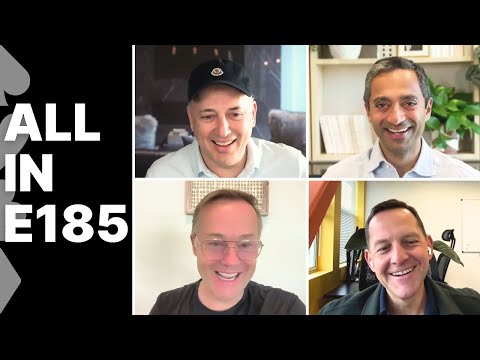
Presidential Debate Reaction, Biden Hot Swap?, Tech unemployment, OpenAI considers for-profit & more
Jason Calacanis (host), David Sacks (host), David Friedberg (host), Chamath Palihapitiya (host), Joe Biden (debate clip) (guest), Jake Tapper (debate moderator clip) (guest), Van Jones (CNN reaction clip) (guest), Rachel Maddow (MSNBC reaction clip) (guest), John King (CNN reaction clip) (guest), Unidentified CNN/MSNBC panelist (guest), Chamath Palihapitiya (host), David Friedberg (host), Jill Biden (campaign event clip) (guest), Chamath Palihapitiya (soundboard/outro drops) (host), Jason Calacanis (soundboard/outro drops) (host)
In this episode of All-In Podcast, featuring Jason Calacanis and David Sacks, Presidential Debate Reaction, Biden Hot Swap?, Tech unemployment, OpenAI considers for-profit & more explores all-In Reacts: Biden Meltdown, Hot Swap Theories, AI Shakeups, Antitrust Wars This All-In Podcast episode centers on the fallout from President Biden’s disastrous debate performance, with the hosts arguing it exposed a long-running cover-up by Democratic leadership and mainstream media about his cognitive decline. They debate the likelihood and mechanics of a ‘hot swap’ candidate replacement, the broader implications for American democracy, and the role of party elites and donors.
All-In Reacts: Biden Meltdown, Hot Swap Theories, AI Shakeups, Antitrust Wars
This All-In Podcast episode centers on the fallout from President Biden’s disastrous debate performance, with the hosts arguing it exposed a long-running cover-up by Democratic leadership and mainstream media about his cognitive decline. They debate the likelihood and mechanics of a ‘hot swap’ candidate replacement, the broader implications for American democracy, and the role of party elites and donors.
The conversation then shifts to structural changes in the tech economy: collapsing software developer job postings, AI’s real impact on employment, and OpenAI’s potential conversion to a for‑profit/IPO alongside Ilya Sutskever’s new ‘safe superintelligence’ startup. The hosts dissect the economics and power politics of frontier AI, including deep state ties and capital intensity.
Finally, they examine Microsoft’s bundling strategy with Teams and Office, praising EU antitrust action as a better alternative to blocking M&A. Throughout, the episode threads together themes of institutional deception, concentration of power, market distortion, and the erosion of genuine competition in both politics and tech.
Key Takeaways
Biden’s debate performance crystallized long-running concerns about his fitness and exposed institutional denial.
The hosts argue Biden’s visible confusion and verbal breakdowns confirmed what many voters, donors, and insiders had already suspected: significant cognitive decline. ...
Get the full analysis with uListen AI
A ‘hot swap’ of Biden is possible but faces structural, political, and Kamala-related obstacles.
Jason argues Biden will be forced out within 30 days via donor pressure, party elders (especially Obama), and a pivot to a new moderate ticket, while Chamath and Sacks emphasize there is no formal mechanism to replace a nominee who won the primaries without his consent. ...
Get the full analysis with uListen AI
The core democratic problem isn’t one bad debate; it’s a small group of unelected power brokers controlling choice.
Chamath and Friedberg argue the real scandal is not Biden’s age, but the way party leadership, big donors, and mainstream media engineered the primary to shield him from competition (blocking RFK Jr. ...
Get the full analysis with uListen AI
Tech job softness is more about macro conditions and post‑ZIRP effects than AI replacing developers—so far.
The 80% drop in software developer job postings on Indeed is attributed mainly to higher interest rates, contraction in SaaS, big-tech layoffs, and burned-off job backlogs—not to AI tools replacing engineers at scale yet. ...
Get the full analysis with uListen AI
OpenAI is executing a sophisticated ‘become the establishment’ strategy that goes beyond valuation math.
The panel supports simplifying OpenAI’s structure into a standard for‑profit (likely with a B‑corp twist) and taking it public, both to reward early backers and to let the public participate in the AI wave. ...
Get the full analysis with uListen AI
Frontier AI models are becoming an arms race that may be uneconomic for new startups to enter.
Chamath notes that as foundational models approach asymptotic performance, the main lever left is massively increasing data quality and compute—pushing model training costs from billions today toward potentially $100B by 2027 (per Anthropic’s estimates). ...
Get the full analysis with uListen AI
Microsoft’s bundling strategy is seen as the real antitrust problem—more damaging than blocking tech M&A.
Sacks and Chamath argue that Microsoft leveraging its de facto monopoly in Office/365 to bundle products like Teams (appearing “free” on the margin) is classic illegal tying: it starves independent rivals like Slack and Zoom and then allows Microsoft to raise bundle prices once competition is weakened. ...
Get the full analysis with uListen AI
Notable Quotes
“I don’t think you should take away from last night that Joe Biden had a bad debate. I think what we should take away is that there is a person who should be allowed to transition into the sunset and be celebrated for what he’s done. And instead there are people… acting somewhat diabolically to prop this person up so that they can keep power.”
— Chamath Palihapitiya
“The big loser of last night’s debate was the American public. The big winner… was probably Russia, China, Iran, maybe the Saudis, licking their chops watching the utter dysfunction in the leadership of the party and the leadership of the country as it stands today.”
— David Friedberg
“Let’s just put it plainly, the Democratic Party is a collection of interests who wanna remain in power… a collection of interests who want to loot the republic. Obviously no one’s gonna vote for that, so they have to make it about something else. They choose a figurehead.”
— David Sacks
“Foundational models are quickly becoming a consumer surplus. Every model is roughly the same… and they’re approaching these asymptotic returns. At some point these tools will be good enough, and the cost to push them further is in the tens of billions.”
— Chamath Palihapitiya
“If Microsoft can basically clone the breakthrough innovative product, put a crappy version of that in their bundle and give it away for free, they pull the legs out from under that other company so it can’t be a vibrant competitor… Can we have a vibrant tech ecosystem if Microsoft can just keep doing that indefinitely?”
— David Sacks
Questions Answered in This Episode
You describe Biden’s debate as exposing a ‘shadow cabinet’ or managerial class running the country—what concrete evidence, beyond anecdotal stories and media spin, would you point to that this unelected group is actually making key policy decisions rather than Biden himself?
This All-In Podcast episode centers on the fallout from President Biden’s disastrous debate performance, with the hosts arguing it exposed a long-running cover-up by Democratic leadership and mainstream media about his cognitive decline. ...
Get the full analysis with uListen AI
On the ‘hot swap’ scenario: if Biden refuses to release his delegates and Kamala Harris insists on her rightful place as nominee, what specific political maneuvers do you think Democratic power brokers would realistically use to resolve that standoff before November?
The conversation then shifts to structural changes in the tech economy: collapsing software developer job postings, AI’s real impact on employment, and OpenAI’s potential conversion to a for‑profit/IPO alongside Ilya Sutskever’s new ‘safe superintelligence’ startup. ...
Get the full analysis with uListen AI
Friedberg’s email warns about a looming fiscal crisis and failed federal programs, yet most of your critique in this episode is focused on Democratic leadership—what precise policy platform or structural reforms would your ideal ‘party of reason and results’ adopt that neither Democrats nor Republicans are currently championing?
Finally, they examine Microsoft’s bundling strategy with Teams and Office, praising EU antitrust action as a better alternative to blocking M&A. ...
Get the full analysis with uListen AI
Chamath argues OpenAI is intentionally embedding itself in the U.S. security and financial establishment to protect its interests; if you were a regulator or lawmaker, what guardrails would you put in place to prevent this deep-state–Big Tech fusion from undermining civil liberties and competitive markets?
Get the full analysis with uListen AI
On Microsoft’s bundling and broader antitrust strategy: if regulators ban practices like Teams–Office tying but simultaneously loosen constraints on tech M&A, how would you design a clear, principled framework that distinguishes healthy ecosystem exits (like Slack–Salesforce or Figma–Adobe) from acquisitions that truly threaten long-term innovation?
Get the full analysis with uListen AI
Transcript Preview
All right, everybody. Welcome back to the number one podcast in the world. It's episode 185, and, uh, you're gonna be delighted by today's docket if you're into politics. We, we moved the taping back a day, gentlemen, because we knew there would be a presidential debate. So, with me to discuss all things presidential debate and the news, finance, markets, maybe even a little science from our science boy, David Freiberg, is the Rain Man, David Sacks, yeah. His body probably has frozen (laughs) or he's staring everybody down. How are you, sir? We're about to enter the endgame, Jason.
(laughs)
Oh. Oh, the endgame is here. Okay.
We're in the endgame now. (laughs)
And from a We Work in the home office in Pasadena is, uh, our friend, the sultan of science. He's back to work. He's in his cube. Did you get the TPS reports done? How you doing there, Freiberg?
The humble headquarters of Ohalo Genetics. Beautiful lab downstairs. I'll take you on a tour one day.
Oh, nice.
Can't wait to hear my friends gloat and bloat themselves on the show today after the debate last night. It's gonna be insufferable. I'm looking forward to it.
Okay, so you're building the next $10 billion company and we don't get to invest, but we do get a tour. Thank you. It's good to know.
(laughs)
Not that we're bitter. Uh, we promote this (censored) every (censored) week. We came here on our own week s- If you guys want to put money in, I will open up the round again for you and you guys can come in. You said this three (censored) times. When do we wet our beaks?
Jake, Hal's right about this actually.
That's how you know the winner.
(laughs)
The one he doesn't let us invest in is the winner. Um- It's the easiest way in his portfolio. He's like, "Hey, can I, can I introduce you to a soda pop machine?"
(laughs)
What's going on? Let your winners ride. Rain Man, David Sacks. What's going on? And it's sad. We open source it to the fans and they've just gone crazy with it. Love you, Betsy. Queen of quinoa. What's going on?
All right, everybody. Let's get to the show here. Enough of the craziness. Last night was the first presidential debate, and there's no easy way to put this, it was an unmitigated disaster for the Democrats and President Biden. Uh, gosh, he looked confused. Uh, lots of slips, lots of gaffes. If you are under a rock living in a cave without Starlink and you missed it, here's a couple clips. Everybody's talking about this one where Biden lost his train of thought for, I don't know, close to 10 seconds. Play the clip, Nick.
Making sure that we're able to make every single solitary person, uh, e- eligible for what I've been able to do with the, uh, with, with, with the COVID... or excuse me, with, um, dealing with everything we have to do with, uh... Look, if... We finally beat Medicare.
Install uListen to search the full transcript and get AI-powered insights
Get Full TranscriptGet more from every podcast
AI summaries, searchable transcripts, and fact-checking. Free forever.
Add to Chrome