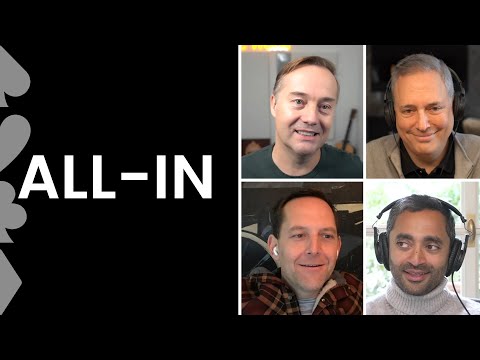
E56: Constitution DAO, Rittenhouse trial coverage, private sector efficiency vs the government
Jason Calacanis (host), David Sacks (host), Chamath Palihapitiya (host), David Friedberg (host), David Friedberg (host), Guest (guest), Narrator, Jason Calacanis (host), Narrator
In this episode of All-In Podcast, featuring Jason Calacanis and David Sacks, E56: Constitution DAO, Rittenhouse trial coverage, private sector efficiency vs the government explores crypto DAOs, Rittenhouse verdict, and why government spending inflates costs This episode centers on ConstitutionDAO’s failed bid to buy a rare U.S. Constitution copy, using it as a springboard to debate DAOs, securities law, crowdfunding, and retail investor access to private deals.
Crypto DAOs, Rittenhouse verdict, and why government spending inflates costs
This episode centers on ConstitutionDAO’s failed bid to buy a rare U.S. Constitution copy, using it as a springboard to debate DAOs, securities law, crowdfunding, and retail investor access to private deals.
The hosts then dissect media coverage and political narratives around the Kyle Rittenhouse trial, contrasting facts revealed in court with initial reporting and exploring how legacy and social media drive polarization.
They broaden the discussion to private vs. public sector efficiency, using examples like NASA vs. SpaceX, nuclear power, and government budgeting, arguing that open-ended public spending often inflates prices and misallocates capital.
The show closes with lighter banter on pop culture, parenting, and music, but the core through-lines are capital formation, regulatory friction, media trust, and the comparative effectiveness of markets versus government.
Key Takeaways
DAOs can form capital incredibly fast, but current implementations are structurally immature.
ConstitutionDAO raised ~$46M from ~20,000 people in days, yet suffered huge gas fees, poor auction strategy (public max bid), unclear ownership terms, and no good way for small contributors to exit, revealing real design flaws.
Get the full analysis with uListen AI
If DAO tokens represent ownership or profit claims, they will likely be regulated as securities.
The hosts note that governance-by-code does not exempt a DAO from securities law; once tokens convey economic rights, U. ...
Get the full analysis with uListen AI
Retail investors are structurally locked out of the best private deals by current rules.
JCal argues that accreditation and crowdfunding regulations are so onerous that top startups avoid equity crowdfunding, leaving high-upside early-stage investments to already-wealthy insiders while non-accredited investors are limited to worse options.
Get the full analysis with uListen AI
Media misframing of high-profile cases amplifies polarization and racial tension.
On Rittenhouse, the hosts argue coverage frequently misstated key facts (e. ...
Get the full analysis with uListen AI
Government transparency and fixed budgets often drive cost inflation rather than efficiency.
Friedberg contends that when governments publish how much they will spend (e. ...
Get the full analysis with uListen AI
Private innovators are often delivering public-goods-like outcomes more cheaply and faster.
Examples like SpaceX vs. ...
Get the full analysis with uListen AI
Regulators should create narrow experimental space for DAOs and new crowdfunding models.
Sacks and JCal float ideas like de minimis or capped-amount carve-outs so DAOs can experiment with startup investing, environmental assets, or community projects without being crushed early by full securities-law compliance.
Get the full analysis with uListen AI
Notable Quotes
“These DAOs are absolutely game-changing. The ability to have $47 million show up and be prepared to be deployed in 48 hours is game-changing.”
— Jason Calacanis
“You’re painting the optimistic scenario of what these things could do. And you are correct. But what’s always happened in the history of humanity is these scenarios have resolved to people figuring out ways to scam other people to make money.”
— David Friedberg
“This case should never have been brought, and then the media fuels this thing. The story really is about the media constructing this narrative that fell apart so quickly as soon as all the facts came out.”
— David Sacks
“The only fractionalized asset that has ever been proven to appreciate reliably are stocks. Every other fractionalized asset where you take something and divvy it up generally has been a trash burger.”
— Chamath Palihapitiya
“What we need is next-gen infrastructure… things that the free market cannot afford to fund and stand up, like next-gen nuclear power stations and biomanufacturing. The things where the government is the only customer, the cost will only go up over time.”
— David Friedberg
Questions Answered in This Episode
How could future DAO designs address the ownership, governance, and transparency problems exposed by ConstitutionDAO while staying on the right side of securities law?
This episode centers on ConstitutionDAO’s failed bid to buy a rare U. ...
Get the full analysis with uListen AI
What concrete regulatory reforms would best expand non-accredited investors’ access to high-quality private deals without simply recreating the ICO-era scams?
The hosts then dissect media coverage and political narratives around the Kyle Rittenhouse trial, contrasting facts revealed in court with initial reporting and exploring how legacy and social media drive polarization.
Get the full analysis with uListen AI
To what extent did media errors and framing in the Rittenhouse case shape public perception—and how can consumers realistically defend themselves against such narrative bias?
They broaden the discussion to private vs. ...
Get the full analysis with uListen AI
Where should the line be drawn between healthy public-sector support (e.g., co-funding nuclear plants) and wasteful government spending that crowds out private innovation?
The show closes with lighter banter on pop culture, parenting, and music, but the core through-lines are capital formation, regulatory friction, media trust, and the comparative effectiveness of markets versus government.
Get the full analysis with uListen AI
If alternative media and direct-to-audience channels replace legacy outlets, how do we incentivize truth-seeking over emotion-seeking in a fragmented information ecosystem?
Get the full analysis with uListen AI
Transcript Preview
It was very interesting going to Sacks's kids' birthday party. Um, Friedberg and I were there for about two or three hours. Sacks showed up for the last half hour.
(laughs) I think I was there for- I, I think I was there for two hours and didn't see Sacks and then I saw him on my way out the door.
But he had some YouTubers there who were pretty cool.
Yeah, Papa Jake and Logan, thank you.
Papa Jake was great.
Yeah. You know they have seven million followers on YouTube. Eat your heart out, J-Cal.
(laughs)
How many times bigger are- is Papa Jake than you?
Business and podcasting on YouTube is a new concept, uh, long form. And long form is not what the algorithm's designed for. It's obviously designed for short form and people getting to completion, so getting to completion on a 90-minute video-
Are we talking about lovemaking again? Sorry, what?
Oh, God.
(laughs)
Jesus. When I say completion, I- it's not...
(laughs) .
We need an HR department at All In. (laughs)
Yeah, I pre- I prefer the short form format for that too.
(upbeat music) Let your winners ride.
Oh, yeah.
Rain Man, David Sacks.
I'm going all in.
And I said, we open sourced it to the fans and they've just gone crazy with it.
Love you, What's his... Queen of Quinoa.
I'm going all in.
Hey, everybody. Welcome to another episode of the All In podcast. It's episode 56. We've made it past 55. The show, the band is still together, coming to you every Friday night, far too late, because the Rain Man obsesses over every edit in the podcast. With us again, the All In Scorsese himself, David Rain Man Sacks. And the Queen of Quinoa, the Sultan of Science, David Friedberg is here. And with a power sweater that cost more-
No, turtleneck. Turtleneck.
I'm sorry, a, a, a power turtleneck that cost more than your mortgage payment this month, the dictator himself, Chamath Palihapitiya. I'm J-Cal. It was a pretty incredible week. I think we have to pander to the cryptocurrency crowd, because that's just making ratings go through the roof here. I am absolutely inspired by what we saw this week with the ConstitutionDAO forming in about a week and going from one or two million to $46 million raised through a DAO. If you don't know what these decentralized autonomous organizations are, it's basically analogous to a, a corporate structure, but that's written in code. So you can get a group of people together, typically in a Discord, then you create a smart contract, they collect in a wallet a bunch of ETH, or it's typically ETH right now, and then you get some kind of governance written into the DAO where people get voting power. They brought this together to bid on one of 13 copies of the original Constitution of the United States. And it was a very controversial moment last night when 80% of the money was raised in the last 48 hours and there was this crazy auction going back and forth with two representatives of Sotheby's on the phone. It hit $41 million. Everybody thought that the DAO had won, which would have mean- would have meant that almost 20,000 people who participated in this would then vote on what to do with this $41 million offer. CoinDesk incorrectly, uh, reported that the DAO won, and then the DAO, uh, announced that they had in fact not. Some other statistics, uh, their Twitter has 36,000 followers. The group reported they needed 14 million to participate, 30 million to be competitive, and 40 million to have a great chance of winning. They raised like, I think six or seven million while they were on the air, you know, and the auction had started. And the only, uh, downside to all of this is that there were huge gas fees. Uh, people were spending 30, 40, 50 bucks to donate 200, which was the average size of these.
Install uListen to search the full transcript and get AI-powered insights
Get Full TranscriptGet more from every podcast
AI summaries, searchable transcripts, and fact-checking. Free forever.
Add to Chrome