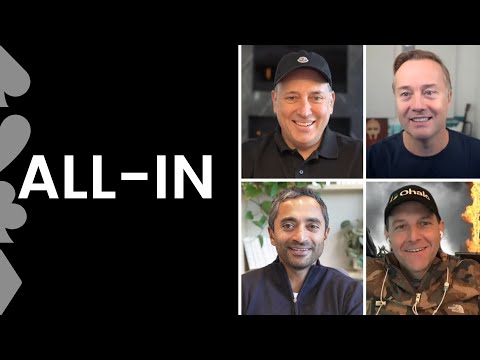
E97: SPAC updates, public/private market overview, Putin's end game & more
Jason Calacanis (host), Chamath Palihapitiya (host), Narrator, David Friedberg (host), David Sacks (host), Narrator
In this episode of All-In Podcast, featuring Jason Calacanis and Chamath Palihapitiya, E97: SPAC updates, public/private market overview, Putin's end game & more explores sPAC reckoning, market turmoil, and geopolitical risks reshape investing landscape The hosts dissect the SPAC boom and bust, with Chamath explaining why he is winding down several SPACs amid extreme volatility, broken late‑stage valuations, and poor risk‑reward for sponsors and investors.
SPAC reckoning, market turmoil, and geopolitical risks reshape investing landscape
The hosts dissect the SPAC boom and bust, with Chamath explaining why he is winding down several SPACs amid extreme volatility, broken late‑stage valuations, and poor risk‑reward for sponsors and investors.
They broaden the discussion to private and public markets, Fed policy, inflation, and the likely persistence of a tough macro environment, while warning founders not to be lulled by headline “dry powder” numbers in venture capital.
The conversation then shifts to governance failures and due diligence lapses in high‑growth companies, the weaponization and mis‑implementation of ESG, and the growing geopolitical overhang from Russia’s war in Ukraine and energy policy missteps.
They close by touching on AI’s impact on games like poker and chess, the ethics of cheating, and worldwide political unrest from Russia to Iran, framing all of it as part of a broader era of institutional decay and elevated risk.
Key Takeaways
In the current environment, many SPACs are unworkable and should return capital.
With 6–9 month closing timelines, extreme volatility, and late‑stage private valuations often 50–60% above realistic prices, Chamath argues the risk‑reward no longer justifies deals, especially when investors can simply redeem at $10.
Get the full analysis with uListen AI
Founders and investors must proactively manage risk instead of assuming assets always go up.
Chamath points to signals like all‑time highs across assets, surging inflation, massive stimulus, and major founders (Musk, Bezos) selling stock as indicators to trim risk and manage personal liquidity, rather than blindly “hodling.”
Get the full analysis with uListen AI
Headline VC ‘dry powder’ overstates how much fresh capital is truly available.
Sacks notes many funds were actually raised and partially deployed before the crash and that deployment paces are normalizing, so founders shouldn’t assume easy funding; standards are higher and valuations lower.
Get the full analysis with uListen AI
Lack of diligence and overreliance on social proof create adverse selection.
Cases like Byju’s and frontier‑market frauds illustrate that investors who skip data rooms and piggyback on big-brand funds or friends invite “bad deals to find bad investors,” amplifying losses when the tide goes out.
Get the full analysis with uListen AI
Energy transitions must prioritize affordability and household‑level resilience.
While renewable generation costs have fallen sharply, California’s retail power prices are soaring due to policy and regulatory complexity; the hosts argue real energy independence means enabling each household to adopt solar, storage, and basic self‑reliance.
Get the full analysis with uListen AI
Geopolitical risks—especially around Russia and energy—are a structural overhang for markets.
With the Fed telegraphing higher‑for‑longer rates and Putin explicitly raising the specter of tactical nukes, they see a high‑risk backdrop where Western policy appears aimed at regime change rather than a negotiated ‘golden bridge’ exit.
Get the full analysis with uListen AI
AI and solvers are reshaping competitive games and blurring the line between preparation and cheating.
Neural nets and solvers in chess and poker create “game theory optimal” baselines humans can’t memorize, raising both performance and new cheating vectors (e. ...
Get the full analysis with uListen AI
Notable Quotes
““At this point to do a deal would probably put a lot of capital at risk… the responsible thing to do was just to wind these things down.””
— Chamath Palihapitiya (on shutting down his SPACs)
““If the smartest people in the world are now selling their core holdings… and you are not reconsidering your position, you’re either much smarter than them or you’re being really, really reckless.””
— Chamath Palihapitiya
““Founders looking at this tweet storm, I would not get lulled into a false sense of security… the bar has gone up, valuations have gone down.””
— David Sacks
““The government will not solve your problems. They are going to make things more complicated and more expensive.””
— Chamath Palihapitiya (on energy and regulation)
““Do you want to play poker with a KGB agent with nukes?””
— David Sacks (on underestimating Putin’s nuclear threats)
Questions Answered in This Episode
How should SPAC sponsors and retail investors think about the remaining 500+ SPACs that are still searching for targets?
The hosts dissect the SPAC boom and bust, with Chamath explaining why he is winding down several SPACs amid extreme volatility, broken late‑stage valuations, and poor risk‑reward for sponsors and investors.
Get the full analysis with uListen AI
What practical frameworks can founders use to manage liquidity and risk when public markets are volatile and private valuations are dislocated?
They broaden the discussion to private and public markets, Fed policy, inflation, and the likely persistence of a tough macro environment, while warning founders not to be lulled by headline “dry powder” numbers in venture capital.
Get the full analysis with uListen AI
Given the apparent failures in due diligence highlighted by Byju’s and others, what minimum diligence standards should institutional and angel investors refuse to compromise on?
The conversation then shifts to governance failures and due diligence lapses in high‑growth companies, the weaponization and mis‑implementation of ESG, and the growing geopolitical overhang from Russia’s war in Ukraine and energy policy missteps.
Get the full analysis with uListen AI
How can policymakers balance decarbonization goals with affordability so that lower‑income districts aren’t hurt by rapid fossil fuel divestment?
They close by touching on AI’s impact on games like poker and chess, the ethics of cheating, and worldwide political unrest from Russia to Iran, framing all of it as part of a broader era of institutional decay and elevated risk.
Get the full analysis with uListen AI
If AI and solvers make ‘perfect’ play accessible, where should sports and games draw the ethical line between legitimate preparation and in‑game cheating assistance?
Get the full analysis with uListen AI
Transcript Preview
I'm in a very Daniel Plainview mood this week. The There Will Be Blood scene behind me.
I have a competition in me. I don't want to see other people succeed.
That's right. Best scene ever.
You are the furthest from that character. Like, that is not your spirit animal. Okay?
Oh, There Will Be Blood? That guy?
Yeah.
Daniel Day-Lewis?
Has nothing to do with you.
Daniel Plainview.
Nothing.
I've watched it about 100 times. Incredible.
(laughs)
You must be so stormy and roiled on the inside.
(laughs)
Oh my gosh. I mean, like-
There is a lot of pent-up...
D- Did you not see my roast at Sacks' birthday?
It's just a roast.
Did I not see it? I lived it.
(laughs)
It was the most off-color, disgusting, egregious, mean diatribe I've ever heard.
My lord.
"I have a competition in me."
"I don't like to see others succeed." I can't stand that Jake Kaul is a good moderate.
(laughs)
I'm going all in. Don't let your winners ride. Rainman, David Sacks. I'm going all in. And I said- We open source it to the fans and they've just gone crazy with it.
WUSI.
Queen of quinoa. I'm going all in.
I guess everybody wants to know, Chamath, you've wound down two SPACs. Thank you for doing this for, uh, IPOF specifically because people are replying to me every day asking, "What are you going to SPAC?" But IPO D and F, the money has been returned to investors.
No, it's, it's goi- going to be returned.
Going to be returned to investors. Thank you. And Bill Ackman, uh, of course, he wound down his SPAC returning four billion. There's over 500 SPACs out there looking for deals. Uh, tell us, why this decision?
Look, I, I've raised 10 SPACs, six, six in technology and four in biotechnology. And I've done, uh, six deals, two in tech and two in biotech. Um, and- Four in foreign tech. Sorry, foreign tech. Foreign tech, thank you, and two in biotech. So, the, the, the reason to shut it down is pretty straightforward. It's like, you know, when we launched these things, the stock market was in a much different place than it is today. And so over the last two years at looking at deals, um, it's gotten harder and harder to find a good risk-reward. Now, why is that? Well, the, the thing with the SPAC is you do a deal today, but it doesn't usually close for six or seven months in the future. And so you have to do a deal where you have a really good sense that in six or seven months when the deal is, comes to close, that the price will be the same or even higher than what it is today. And if it isn't, all of the investors that you've brought along in the SPAC have a right to redeem, which is to say they file a notice that says, "You can complete the deal, but I want my money back." And what they get back is the initial $10 that they used to buy the stock in the first place. 'Cause when we sold, when we started the SPAC, we wo- we sold stock at $10. And so from my perspective, I was looking at this and I'm like, you know, this is a super volatile, ugly point in the market. This last year has been really problematic. I, I, and I, and I kind of said this last November, and Nick, we can, we can play the clip after and we can come back to it. But basically, my decision was that at this point to do a deal would probably, you know, put a lot of capital at risk. And in all of these deals, I'm typically investing $100 million at least in each of them. And so I couldn't justify that. I couldn't see a good risk-reward, and I thought the right thing to do, the responsible thing to do was just to wind these things down. You know, I'll, I'll lose, I don't know, 10, 15, 20 million bucks for having set these things up. But we give everybody their money back, that $10, and I think that's actually better over the next five or six months than what it'll otherwise do if you were invested in the market. Now, that's a belief that I have. But hopefully when people get the $10 back in the next few weeks, if they want, they can go and put that money back in the market, and hopefully they'll do well, but, uh, you know, from my perspective, the risk-reward was not good.
Install uListen to search the full transcript and get AI-powered insights
Get Full TranscriptGet more from every podcast
AI summaries, searchable transcripts, and fact-checking. Free forever.
Add to Chrome