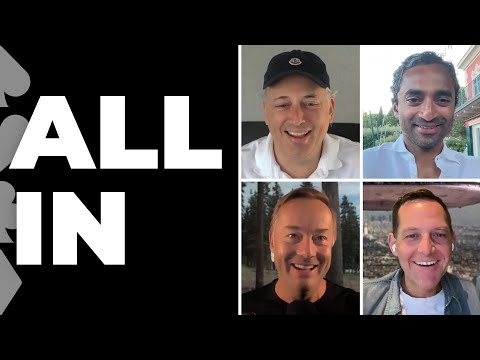
E142: "Rich Men North of Richmond" hits #1, upward mobility, real estate capital crunch, Trump RICO
Jason Calacanis (host), Chamath Palihapitiya (host), David Sacks (host), Narrator, David Friedberg (host), Oliver Anthony (guest), Narrator, Narrator
In this episode of All-In Podcast, featuring Jason Calacanis and Chamath Palihapitiya, E142: "Rich Men North of Richmond" hits #1, upward mobility, real estate capital crunch, Trump RICO explores viral protest song sparks deep debate on class, elites, and opportunity The hosts of the All-In Podcast move from light banter about nightlife, cocktails, and wealth signaling into a substantial discussion of Oliver Anthony’s viral song “Rich Men North of Richmond.”
Viral protest song sparks deep debate on class, elites, and opportunity
The hosts of the All-In Podcast move from light banter about nightlife, cocktails, and wealth signaling into a substantial discussion of Oliver Anthony’s viral song “Rich Men North of Richmond.”
They interpret the song as an expression of working-class frustration with stagnant wages, elite failure, government overreach, and a sense that the system is rigged and unaccountable.
Using income data by quintile, they debate whether policy should compress the gap between top earners and everyone else, contrasting redistribution with enabling upward mobility and entrepreneurship.
The conversation broadens into American culture’s obsession with progress and scorecards versus European contentment, the dangers of victimhood narratives on both left and right, and how personal agency and social media shape perceptions of inequality.
Key Takeaways
The song captures a broad sense of betrayal by elites and institutions.
They see “Rich Men North of Richmond” as voicing anger at government, big tech, and security agencies that seek “total control,” while assuming ordinary people don’t notice—echoing broader distrust of the ruling class.
Get the full analysis with uListen AI
Income gains have heavily favored the top quintile over recent decades.
Referencing data, the hosts note that since the mid-1990s, the top 5–20% of U. ...
Get the full analysis with uListen AI
Simple redistribution is seen as politically tempting but economically dangerous.
Several argue that aggressively “bringing down” top earners via taxation or Marxist-style redistribution would slow productivity, innovation, and overall progress, citing historical examples where such policies impoverished societies.
Get the full analysis with uListen AI
Policy should focus on removing barriers and enabling entrepreneurship at the bottom.
Instead of compressing top incomes, they advocate dismantling licensing and regulatory hurdles (like costly hair-braiding licenses) that block low-income people from starting businesses and advancing economically.
Get the full analysis with uListen AI
Government interventions in housing, education, and healthcare have inflated costs.
Programs designed to guarantee access—student loans, housing promotion, healthcare spending—have, in their view, created asset bubbles and perverse incentives, making those essentials more expensive and leaving many still struggling.
Get the full analysis with uListen AI
Upward mobility, not static class position, is the key metric that’s missing.
They criticize “chart porn” showing quintile income gaps without tracking whether individuals and families move from lower to higher quintiles over generations—the core of the American opportunity story they themselves embody.
Get the full analysis with uListen AI
Culture and psychology—comparison, social media, and victimhood—shape how inequality feels.
Beyond economics, they highlight how Instagram-style status projection and political victim narratives fuel envy and resentment, contrasting that with Italian friends who focus more on relationships and present-moment happiness than on “what’s next.”
Get the full analysis with uListen AI
Notable Quotes
“The way I interpret this word populism is failure of the elites.”
— David Sacks
“For most Americans, that story [of the American dream] has not played out…they’ve followed the rules…and they’re left with flat earnings over several decades.”
— David Friedberg
“The ugly truth is, none of us want the government to try to bring that dashed black line or that blue line down, we want them to stay out of our way.”
— Chamath Palihapitiya
“Victimization is a choice…people can’t just buy into this victimhood mentality where they’re like, ‘I don’t need to do anything on my own to improve my circumstances.’”
— David Sacks (paraphrasing and extending Vivek Ramaswamy’s line)
“The healthiest people in each of those lines are the ones that actually have a definition of themselves that comes from within…and is not defined by where you want to go and where you want to be.”
— Chamath Palihapitiya
Questions Answered in This Episode
Does focusing on elite failure and populist anger help solve inequality, or does it risk deepening polarization without improving outcomes?
The hosts of the All-In Podcast move from light banter about nightlife, cocktails, and wealth signaling into a substantial discussion of Oliver Anthony’s viral song “Rich Men North of Richmond.”
Get the full analysis with uListen AI
What concrete policy mix could increase upward mobility for the bottom 80% without significantly undermining innovation and growth at the top?
They interpret the song as an expression of working-class frustration with stagnant wages, elite failure, government overreach, and a sense that the system is rigged and unaccountable.
Get the full analysis with uListen AI
How much of working-class frustration is driven by real economic stagnation versus social comparison amplified by media and social networks?
Using income data by quintile, they debate whether policy should compress the gap between top earners and everyone else, contrasting redistribution with enabling upward mobility and entrepreneurship.
Get the full analysis with uListen AI
If government interventions in housing, education, and healthcare have inflated costs, what alternative models could expand access without triggering bubbles?
The conversation broadens into American culture’s obsession with progress and scorecards versus European contentment, the dangers of victimhood narratives on both left and right, and how personal agency and social media shape perceptions of inequality.
Get the full analysis with uListen AI
Is the American cultural emphasis on constant progress and scorecards ultimately a feature that drives prosperity, or a bug that erodes contentment and social cohesion?
Get the full analysis with uListen AI
Transcript Preview
Oh, my God. Sax looks like he got hit by a Mac truck. You okay, little fella? Oh, oh.
How long were you out last night, Sax? (laughs)
(laughs)
Oh, boy. (laughs) Did you see this, the message?
I got the text messages. I was like, "What the fuck is going on over there?"
(laughs)
(laughs)
"I gotta get back to the United States."
Timestamp, 1:39 AM Pacific. "I'm still out (laughs) drinking tonight. There's no way I'm making 9:00 AM. I'll do 10:00 AM to noon." This is Sax. The negotiation has, uh, begun.
And I'm waking up. It's my last day on the boat. I'm trying to get off the boat in a reasonable manner. And that's the first text message I get.
That's the first text. Then six minutes later, Drake just came in, "Better make it 11." (laughs)
(laughs)
(upbeat music) Don't let your winner slide. Rain Man, David Sachs. I'm goin' all in. And I said- We open-sourced it to the fans and they've just gone crazy with it.
Love you, SI.
Queen of Kinwai. I'm goin' all in.
Do you wanna tell you the story? So the thing I would compare it to is, do you remember that episode of Seinfeld where Costanza stumbles onto the model bar? You know, he finds the place that all the supermodels are hanging out.
Ah.
And he calls it Shangri-La because it's like-
(laughs)
... this mythical place.
Yeah.
And he spends the rest of his life trying to find Shangri-La again, but he can never find it.
Yes. That was you last night in LA.
Well, so we were just out having a few drinks at this private club that's, uh, new in town. It's just me and, you know, my wack pack. And the room is, it's just, you know, a few of us having drinks.
Hey, sorry. Who, who is your wack pack? We can bleep out these names, but I'm just curious. (laughs)
How many of the wack pack are on salary versus-
(laughs)
Yeah, yeah, yeah. That's what I want.
He's like an NBA player. It's like he rolls there with six people. Four of them are on the payroll, two are friends.
What percentage do you pay and what percentage are your friends?
Yes.
Um-
(laughs) He's doing the calculation.
About, uh, I guess about half-
Half. (laughs)
... receive some sort of monetary payment from me. Not all of them d- are direct employees.
(laughs)
Some are vendors.
(laughs)
Some are vendors. Okay, got it.
Yeah.
Lawyer, accountant.
One's a lawyer, you know? Yeah.
Yeah, of course. Real estate brokers.
(laughs) Yeah.
Like Blackwater.
Banker.
Yeah.
You don't have to have them on payroll.
Install uListen to search the full transcript and get AI-powered insights
Get Full TranscriptGet more from every podcast
AI summaries, searchable transcripts, and fact-checking. Free forever.
Add to Chrome