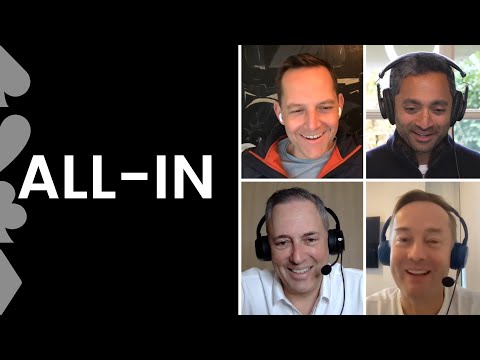
E57: Understanding Omicron, tech stocks plummet, VC's great resignation, Jack Dorsey's departure
David Sacks (host), Jason Calacanis (host), Chamath Palihapitiya (host), David Friedberg (host), Narrator, David Friedberg (host), Chamath Palihapitiya (host), Jason Calacanis (host), David Sacks (host)
In this episode of All-In Podcast, featuring David Sacks and Jason Calacanis, E57: Understanding Omicron, tech stocks plummet, VC's great resignation, Jack Dorsey's departure explores omicron fears, tech correction, VC exits, and Twitter’s new era The All-In hosts open with banter but quickly dig into the emerging Omicron COVID variant, debating its likely medical impact versus media and policy overreaction. They then unpack the sharp drawdown in high-growth tech stocks, tying it to inflation, interest-rate expectations, and overextended private valuations.
Omicron fears, tech correction, VC exits, and Twitter’s new era
The All-In hosts open with banter but quickly dig into the emerging Omicron COVID variant, debating its likely medical impact versus media and policy overreaction. They then unpack the sharp drawdown in high-growth tech stocks, tying it to inflation, interest-rate expectations, and overextended private valuations.
A major thread is the “great resignation” among veteran VCs, who, after a decade of easy money and huge wins, are retiring or pivoting to more mission-driven areas like climate tech and Web3. The group also covers political and social issues including inflation’s structural roots, urban disorder in San Francisco, Bloomberg’s $750M charter-school bet, and the implications of Jack Dorsey’s departure from Twitter.
Throughout, they argue that Omicron is likely a medical “nothing burger” but a real policy and market risk, that inflation is more structural than transitory, and that the coming decade will be far tougher for growth investors. They close by warning of rising social-media censorship and the competitive opening it creates for platforms like TikTok.
Key Takeaways
Omicron’s spread may be huge, but severity looks limited so far.
Friedberg notes Omicron is highly transmissible with many spike-protein mutations and strong immune evasion, yet early South African data show high case counts with relatively mild disease and limited hospital spikes, suggesting it could be less severe than feared.
Get the full analysis with uListen AI
Markets used Omicron as cover for an overdue growth-stock reset.
Chamath argues the variant was a convenient narrative for investors who already wanted to de-risk; hundreds of growth names are down 30–40% while the overall indices remain near highs, implying a sector-specific multiple compression rather than a broad crash.
Get the full analysis with uListen AI
Rising inflation and rate expectations shrink the value of distant cash flows.
Friedberg explains that when interest rates rise from near zero, investors can earn a risk-free return, so they must discount far-future revenues more heavily—compressing 70–100x revenue multiples in public markets and stranding private companies priced off those peaks.
Get the full analysis with uListen AI
Structural inflation stems from underinvestment and labor distortions, not just supply shocks.
Chamath points to years of underinvestment in domestic energy and critical minerals, combined with reduced immigration and changing work incentives, as drivers of persistent price pressure that won’t be solved quickly by stock-market moves or short-term policy tweaks.
Get the full analysis with uListen AI
Veteran VCs are cashing out or pivoting as the easy-money decade ends.
Sacks and Friedberg describe a cohort of partners at large firms who’ve had huge 10-year runs and now question committing to a tougher macro environment; many are instead moving into climate tech, healthcare, or Web3 where they see more purpose-driven impact.
Get the full analysis with uListen AI
Lockdowns and heavy-handed COVID restrictions will be politically hard to revive.
The hosts argue that Biden’s vow not to return to lockdowns reflects voter backlash, evidence that restrictions mainly delayed rather than stopped spread, and growing recognition that vaccines and boosters, not mandates and closures, are the sustainable tools.
Get the full analysis with uListen AI
Twitter’s leadership change may accelerate censorship and drive users elsewhere.
With Parag Agrawal on record saying Twitter need not follow First Amendment principles, Sacks fears more aggressive, biased moderation (e. ...
Get the full analysis with uListen AI
Notable Quotes
“This whole thing is a complete fucking nothing burger.”
— Chamath Palihapitiya (on Omicron’s likely real-world impact)
“What’s really important now is how policymakers are gonna respond to this, not the true severity of the risk.”
— David Friedberg (on Omicron and policy-driven economic damage)
“Everybody that thinks the stock market is doing poorly is wrong. It is doing exceptionally well. It’s just that the 400 stocks people in Silicon Valley care about have been getting kicked in the teeth.”
— Chamath Palihapitiya (on sector-specific pain in growth tech)
“If you buy lottery tickets every day and one day you hit the $12 million jackpot, you’re not going back to 7-Eleven the next day to keep buying lottery tickets.”
— David Friedberg (on why many VCs are stepping back after big wins)
“All that is necessary for evil to triumph is for good men to do nothing. Jack Dorsey may be a good man, but he did nothing, or very little, to stop this agenda of censorship.”
— David Sacks (on Twitter’s free-speech retreat under Dorsey)
Questions Answered in This Episode
If Omicron turns out to be highly transmissible but mild, should it change how we think about COVID policy permanently?
The All-In hosts open with banter but quickly dig into the emerging Omicron COVID variant, debating its likely medical impact versus media and policy overreaction. ...
Get the full analysis with uListen AI
How far can growth-tech valuations realistically compress before high-quality companies become compelling buys again?
A major thread is the “great resignation” among veteran VCs, who, after a decade of easy money and huge wins, are retiring or pivoting to more mission-driven areas like climate tech and Web3. ...
Get the full analysis with uListen AI
What are the long-term consequences for innovation if many experienced VCs retire or pivot away from classic venture investing?
Throughout, they argue that Omicron is likely a medical “nothing burger” but a real policy and market risk, that inflation is more structural than transitory, and that the coming decade will be far tougher for growth investors. ...
Get the full analysis with uListen AI
Is today’s inflation mostly a one-time supply-chain shock, or has the U.S. crossed into a structurally higher-inflation regime?
Get the full analysis with uListen AI
Will Twitter’s evolving content policies create a durable opening for rival platforms, or are users too locked into existing networks to move?
Get the full analysis with uListen AI
Transcript Preview
Yeah, Chamath goes to those sorts of events and they all pick some endangered animal and then they skin it and they make a sweater out of it for him.
That's that Illuminati (censored) . The Illuminati.
So this is cashmere, it's Loro Piana. The lining is chinchilla.
(laughs)
Oh, chinchilla. I knew it.
Oh no, geez.
I knew it was some poor animal.
I- I mean, it is so-
Some poor animal.
... phenomenal.
Probably nicer than a, than a dog.
It's so warm.
Probably sweet, sweeter than any dog you've ever met if you actually played with a chinchilla.
Look, it's so, it's so warm.
(laughs)
It's so, oh, I'm just rubbing it. Mm.
PETA is, uh, PETA is-
Who?
... boycotting the show right now.
Who?
(laughs)
(laughs) Nobody cares.
(laughs)
Nobody cares.
Let your winners ride.
Rain Man, David Sa-
I'm going all in.
And it's sad.
We open sourced it to the fans and they've just gone crazy with it.
Love you, besties.
I mean, Queen of Quinoa.
I'm going all in.
Hey, everybody. Hey, everybody. Welcome to another episode of the All In Illuminati Podcast. We took Thanksgiving off-
(laughs)
... but the Illuminati is back to tell you what's going on in the Star Chamber. David Freiberg, the Sultan of Science, Queen of Quinoa, back with us.
I like it, Sultan of Science.
Super thin, looking svelte. David Sacks at his fighting weight, 168 to 172 pounds in the red corner, and with a cashmere chinchilla sweater.
Chinchilla.
(laughs)
The Urkel from Sri Lanka at 142 pounds, Chamath Palihapitiya. And I'm, of course, J-Cow.
I'm at my, uh, I'm at my, not peak weight, but in my 20s and 30s I was like 172 pounds.
Well, well, you're six foot, right? So that's-
6'2", so I'm-
So I mean, wow.
... I'm currently 166.
What? Wow. And you, and you, and you are wearing a shirt. Wow, that's incredible. If I was 166, I would, I would-
I did my, I did my body s-
... be in a Speedo right now.
I did my, I did my body scan. I was, um-
Percentage body fat is what? 14%?
11.1%.
What? You're going into elite athlete/castaway territory.
I've been there. I've been there for real.
Yeah. And Sacks?
Lean body mass was 152.8 pounds.
Unbelievable.
My basal metabolic rate was 1,868 calories.
Okay.
Sorry, sorry, sorry, sorry. Yeah, and this was with my jeans on. Sorry. And, and this was midday so I had had breakfast. So it was 171.9, so 172. So minus the clothes in the morning, I think I'm 167, less eating.
Install uListen to search the full transcript and get AI-powered insights
Get Full TranscriptGet more from every podcast
AI summaries, searchable transcripts, and fact-checking. Free forever.
Add to Chrome