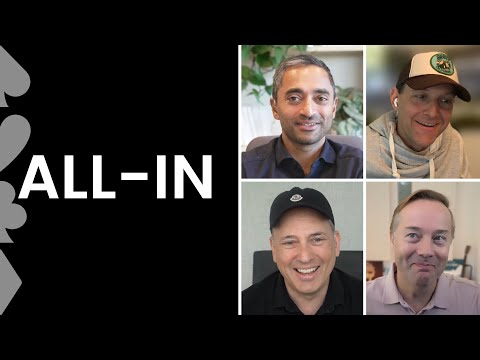
E98: Big tech starts making cuts, Fed incompetency, global debt, Russia/Ukraine & more
Jason Calacanis (host), David Friedberg (host), Chamath Palihapitiya (host), David Sacks (host), Narrator, Coolio (guest), Narrator
In this episode of All-In Podcast, featuring Jason Calacanis and David Friedberg, E98: Big tech starts making cuts, Fed incompetency, global debt, Russia/Ukraine & more explores big Tech Retrenches As Fed Missteps Fuel Debt, Recession Fears The hosts discuss major pullbacks at big tech companies like Meta, Apple, and Google, framing them as the end of a twenty-year era of easy growth, lavish perks, and unlimited hiring in Silicon Valley.
Big Tech Retrenches As Fed Missteps Fuel Debt, Recession Fears
The hosts discuss major pullbacks at big tech companies like Meta, Apple, and Google, framing them as the end of a twenty-year era of easy growth, lavish perks, and unlimited hiring in Silicon Valley.
They argue this downturn, driven by Fed policy errors, inflation, and global debt overhang, will hurt in the real economy but may create a prime environment for startups and investors as talent and capital consolidate.
A substantial portion of the conversation critiques Federal Reserve and government responses since 2008 and during COVID, including zero-interest-rate policy, quantitative easing, and ongoing political pressure on central banks.
They close by examining geopolitical tail risks—especially the Russia-Ukraine war and nuclear escalation—debating how much these risks, alongside macroeconomic factors, should influence market timing and investor behavior.
Key Takeaways
Big Tech is transitioning from growth-at-all-costs to cash-cow discipline.
Meta, Apple, and Google are cutting headcount, perks, and experimental projects, signaling that even the strongest tech firms must now tightly manage expenses and focus on bottom-line performance.
Get the full analysis with uListen AI
The talent market is flipping from employee leverage to employer leverage.
After two decades of rising salaries and lavish benefits, tech workers face fewer offers, tighter comp bands, and less job-hopping, while strong startups will be able to hire better talent at more rational prices.
Get the full analysis with uListen AI
Downturns often produce the next generation of great companies.
The hosts highlight that firms like Google, Tesla, Airbnb, Uber, Instagram, and WhatsApp were founded or funded in prior recessions, arguing that 2022–2024 vintages may again deliver outsized returns.
Get the full analysis with uListen AI
Fed policy missteps and political pressure have distorted markets.
They argue that prolonged zero-interest-rate policy, aggressive money printing, and delayed recognition of inflation—driven partly by politics—created asset bubbles and now force painful rate hikes and demand destruction.
Get the full analysis with uListen AI
Global debt plus rising rates create enormous pressure on households and states.
With roughly $300 trillion in global debt, moving rates from ~0% to ~5% implies trillions more in annual debt service, squeezing governments, businesses, and consumers and likely curbing discretionary spending.
Get the full analysis with uListen AI
Markets may bottom before the real economy does, but tail risks remain.
Chamath suggests equities are near a cyclical bottom based on past rate-hiking cycles, while others caution that unresolved ‘fat tail’ risks—especially escalation in Ukraine—justify investor caution.
Get the full analysis with uListen AI
Boomer asset wealth and pandemic-era policy have warped labor incentives.
Massive gains in housing and equities for U. ...
Get the full analysis with uListen AI
Notable Quotes
“It is the end of this phase of big tech, where you had unfettered growth and unassailable business models. Now they have to operate more like cash-cow businesses.”
— Chamath Palihapitiya
“This is the first time since 2003–2004 that instead of adding more benefits and giving more value to employees, we’re seeing things start to turn the other way.”
— David Friedberg
“The big takeaway here is that nobody is safe… we’re headed for a broad-based recession. No one’s talking about a soft landing anymore—in fact, we’re all wondering who’s flying the plane.”
— David Sacks
“Fortunes are made in the down market; they’re collected in the upmarket.”
— Jason Calacanis
“We are basically engaging in a proxy war with the person in the world who has the most ICBMs… It’s like Achilles going in front of the walls of Troy and drawing a bullseye around his heel.”
— David Sacks
Questions Answered in This Episode
How should tech workers and founders practically adjust to a world where Big Tech is cutting costs instead of expanding perks and headcount?
The hosts discuss major pullbacks at big tech companies like Meta, Apple, and Google, framing them as the end of a twenty-year era of easy growth, lavish perks, and unlimited hiring in Silicon Valley.
Get the full analysis with uListen AI
Given the critiques of the Fed, what would a modern, data-driven central bank actually look like in practice—and who would oversee it?
They argue this downturn, driven by Fed policy errors, inflation, and global debt overhang, will hurt in the real economy but may create a prime environment for startups and investors as talent and capital consolidate.
Get the full analysis with uListen AI
For investors, how do you balance Chamath’s argument that markets are near a bottom with Sacks and Friedberg’s concerns about fat-tail geopolitical and macro risks?
A substantial portion of the conversation critiques Federal Reserve and government responses since 2008 and during COVID, including zero-interest-rate policy, quantitative easing, and ongoing political pressure on central banks.
Get the full analysis with uListen AI
In what concrete ways can startups best capitalize on this period of talent consolidation and lower customer acquisition costs?
They close by examining geopolitical tail risks—especially the Russia-Ukraine war and nuclear escalation—debating how much these risks, alongside macroeconomic factors, should influence market timing and investor behavior.
Get the full analysis with uListen AI
How might the Russia-Ukraine conflict realistically escalate or de-escalate from here, and what scenarios would most materially change global markets and energy dynamics?
Get the full analysis with uListen AI
Transcript Preview
Hey, everybody. Welcome to Episode 98 of the All-In Podcast. With us again, the Sultan of Science, the Queen of Quinoa, looks like he brought a trucker hat. What- what- what- are you getting jealous of the Moncler hat, or are you just not bathing anymore? This is going off to our-
No, I need a haircut. I haven't had a haircut in, like, six weeks. I'm getting my hair cut this afternoon.
It's not going to make a difference.
I think what Freeberg is trying to tell us is that he is the Zodiac Killer.
(laughs)
It's long been known. All right, there it is, the uni-bar. Uh, all right, uh, and Moncler Saxe is here with his $400 Moncler hat and, of course, the dictator himself.
I asked Ron, I asked Ron to cut my hair so that the white patch is more prominent. I think he did a good job.
Do you add the white patch with coloring or is it, uh...
(laughs)
No, it's natural. It's just there. It's just there nowhere else.
Why would you make it look so odd if you were doing it on purpose?
(laughs)
It's super random what Chamath gets to be talking about.
I like the way it looks. I like the way it looks.
Jay Leno had a look like that.
I'm about to go... By the way, you know this, in the fall, in truffle season, I like to grow it so that it's more wavy.
White for white truffle season. Got it.
I needed to have a reset cut so that then we could grow it wavy for the fall for truffle season.
Listen, Chamath, the only thing less relevant to us than your cashmere sweaters is your (beep) haircut. (laughing)
Going all in. Let your winners ride. Rain man, David Sacks. Going all in. And I said, we open sourced it to the fans and they've just gone crazy with it. Love you guys. Queen of Quinoa. Going all in.
All right. Zuck announced a hiring freeze and reorg at Meta. He also said Meta will reduce headcount for the first time in its history. Meta's headcount in 2023 will be smaller than it was this year. He called it the end of an era of rapid growth. This on top of, uh, Apple reporting, and Apple got walloped in the market for the first time (laughs) in forever. Uh, Apple pulled back iPhone production, uh, for the 14 after slower than anticipated demand. As I mentioned on previous episodes, they've kind of done a gentleman's layoff, similar to, I think, Meta, in that Apple said, "You have to be back in the office three days a week." A bunch of people quit. So, uh, you don't have to pay them, I guess, huge packages when they quit that way. Google CEO Sundar Pichai also called out employees in July, as you guys all read, and he wrote, "There are real concerns that our productivity as a whole is not where it needs to be for the headcount we have." Google, of course, 174,000 employees. So, I guess, the question I have for you is, are these the last towers to fall, Chamath, in this, uh, pullback that we've seen? These are companies that don't need to do the layoffs. They have tons of cash, so they're obviously doing that to maintain earnings, uh, one would, and to maybe, uh, send a signal to employees that they need to work harder. Wh- what's your read on these, this past week's shoes to drop?
Install uListen to search the full transcript and get AI-powered insights
Get Full TranscriptGet more from every podcast
AI summaries, searchable transcripts, and fact-checking. Free forever.
Add to Chrome