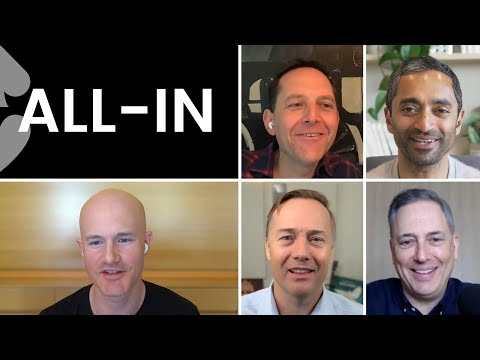
E77: Tech work culture, crypto regulation, stablecoins, $NFLX & more w/ Coinbase CEO Brian Armstrong
Jason Calacanis (host), Brian Armstrong (guest), Chamath Palihapitiya (host), David Sacks (host), David Friedberg (host), David Friedberg (host), David Sacks (host), Chamath Palihapitiya (host), Narrator
In this episode of All-In Podcast, featuring Jason Calacanis and Brian Armstrong, E77: Tech work culture, crypto regulation, stablecoins, $NFLX & more w/ Coinbase CEO Brian Armstrong explores coinbase CEO on mission-focused culture, crypto rules, and streaming wars Brian Armstrong joins the All-In crew to explain Coinbase’s decision to ban political and social-issue debates at work, arguing that companies must be mission-focused and CEOs cannot be held hostage by internal activism. He describes the painful short-term fallout—media backlash, 5% of staff taking exit packages, and temporary team gaps—but says it ultimately improved productivity, talent quality, and cultural clarity.
Coinbase CEO on mission-focused culture, crypto rules, and streaming wars
Brian Armstrong joins the All-In crew to explain Coinbase’s decision to ban political and social-issue debates at work, arguing that companies must be mission-focused and CEOs cannot be held hostage by internal activism. He describes the painful short-term fallout—media backlash, 5% of staff taking exit packages, and temporary team gaps—but says it ultimately improved productivity, talent quality, and cultural clarity.
The discussion broadens into how Big Tech cultures drifted into “soft” appeasement of activist employees, the role of Slack and open-mic Q&As in fueling internal mobs, and why founders should now be explicit from day one about whether politics are in or out of bounds at work. Armstrong also outlines his view on crypto regulation: multiple regulators will be involved, clear distinctions are needed between commodities, securities, currencies, and “other,” and the U.S. must avoid heavy-handed rules that stifle innovation.
The group debates investor protection, ICO-era scams, stablecoins (Tether vs. USDC, DAI, algorithmic models), and possible policy ideas like investor sophistication tests and regulatory sandboxes, while warning that over-regulation will drive innovation offshore. In the final segment, they pivot to Netflix’s subscriber collapse, framing it as a mix of Apple-driven ad targeting changes, fierce streaming competition, and misaligned, increasingly “woke” content, contrasting Netflix’s struggles with the perceived creative strength of HBO Max, Disney+, and others.
Key Takeaways
Define cultural boundaries explicitly and early, or drift will define them for you.
Armstrong says Coinbase’s apolitical stance caused short-term pain because it was introduced mid-flight; if he were starting again, he’d declare from day one that work time is for the company’s mission, not broader political debates, to avoid a messy public realignment.
Get the full analysis with uListen AI
Mission-driven companies need “hard” clarity on what they won’t do, not just inspiring missions.
The group contrasts hard cultures (clear on what’s off-limits, including distractions) with soft, appeasing ones; they argue that letting a vocal 5% drive the agenda demoralizes the productive 80% and confuses the middle 15%.
Get the full analysis with uListen AI
Slack and open-mic all-hands can unintentionally turn companies into internal social networks.
Armstrong notes that large Slack channels and open Q&As began to resemble social media mobs and grandstanding; Coinbase now pre-screens questions and locks large channels to limited posters to preserve focus and reduce internal performative activism.
Get the full analysis with uListen AI
Crypto needs a multi-regulator, multi-category framework, not one-size-fits-all rules.
Armstrong expects different types of tokens to fall under the CFTC, SEC, Treasury, or remain largely unregulated (e. ...
Get the full analysis with uListen AI
Regulation should target fraud and systemic risk without locking out non-wealthy innovators and investors.
Participants distinguish between stopping outright lies and scams versus using wealth tests that exclude most people; ideas floated include financial literacy exams, size-based sandboxes for small projects, and clearer safe harbors for utility tokens.
Get the full analysis with uListen AI
Decentralized finance will still collide with state power, especially around hacks and consumer losses.
Chamath and Friedberg highlight weekly crypto hacks and the lack of clear recourse for users, arguing Congress must modernize laws so agencies can address security, audits, and liability without killing decentralized innovation.
Get the full analysis with uListen AI
Netflix’s woes reflect both macro ad shifts and relative content decline amidst fierce competition.
The hosts link Netflix’s subscriber loss to Apple’s privacy changes that hurt ad-driven acquisition, rising CAC, and an increasingly crowded streaming market where HBO Max, Disney+, and others are perceived as offering better, less “pandering” content at lower prices.
Get the full analysis with uListen AI
Notable Quotes
“Short term, it was quite a painful transition… but long term, it turned out to be an incredibly positive decision for the company.”
— Brian Armstrong (on Coinbase’s apolitical workplace policy)
“This is not a democracy… I’m not going to rule with an iron fist, but ultimately I’m the CEO. I need to help guide this company in one direction and force the hard decisions.”
— Brian Armstrong
“Every company eventually is gonna have to either be Coinbase or be Disney. You’re either gonna have to give in to the mob and suffer the consequences, or you take the short-term pain of doing what Brian did.”
— David Sacks
“The danger is if we ever get into a place where we say, ‘Only wealthy people can now invest.’ That’s inherently exclusionary.”
— Brian Armstrong
“The first rule of capitalism says that excess returns will always get competed away… mathematically Netflix can’t win the way that they used to.”
— Chamath Palihapitiya
Questions Answered in This Episode
If you were founding a company today, how explicitly would you write political-activity boundaries into your culture document and offer letters?
Brian Armstrong joins the All-In crew to explain Coinbase’s decision to ban political and social-issue debates at work, arguing that companies must be mission-focused and CEOs cannot be held hostage by internal activism. ...
Get the full analysis with uListen AI
What concrete criteria should regulators adopt to differentiate a security token from a genuine utility token in a way that founders can reliably design around?
The discussion broadens into how Big Tech cultures drifted into “soft” appeasement of activist employees, the role of Slack and open-mic Q&As in fueling internal mobs, and why founders should now be explicit from day one about whether politics are in or out of bounds at work. ...
Get the full analysis with uListen AI
How can companies preserve the productivity benefits of tools like Slack while avoiding mob dynamics and performative activism at scale?
The group debates investor protection, ICO-era scams, stablecoins (Tether vs. ...
Get the full analysis with uListen AI
In a world of frequent DeFi hacks and rug pulls, what mix of self-custody tools, insurance, and regulation would meaningfully protect users without recreating the old financial system?
Get the full analysis with uListen AI
To what extent are Netflix’s struggles about ideology and content positioning versus simple economics—pricing, competition, and diminishing returns on content spend?
Get the full analysis with uListen AI
Transcript Preview
Brian Armstrong, what's up, bro?
(laughs) What's up?
How are you?
Good to see you.
It's good to see you as well.
Yeah, Jason just pinged me yesterday and he was like, "Why don't you just come on as a guest randomly?" And I was like, "Okay, great. Let's do it."
That's so good. I'm really excited to hear what J Cal's intro is for you.
Oh, man. Yeah, you guys keep- you keep getting wild and wild around this. (upbeat music)
Let your winners ride.
Rain Man, David Sacks.
I'm going all in. And I said- We open sourced it to the fans and they've just gone crazy with it.
Love you, man. Nice.
Queen of Quinoa. I'm going all in.
Hey, everybody. Welcome to Episode 77 of the All In podcast. Less than 30 days for the sold out All In summit and, uh, there's a wait list, but, uh, sadly, I don't think we're gonna get to anybody on the wait list. We've got a great, great episode for you. I thought I'd bring a bestie-guestie in, but not tell my bestie. So we'll see if they can figure out who's coming on the pod today. Uh, but let's get the intros over with. He's investing in SaaS at different stages, coming off a Miami bender for the ages, doing shots with Riboy and Vanilla Ice, the Rain Man is back, he's twice as nice, David Sacks, everybody. How are you, sir? How was your adventures, uh, with Vanilla Ice?
Good. I'm still here.
You're still here. And so Vanilla Ice, uh, that cost $1,600 to get him to show up?
(laughs)
(laughs)
What does, uh, Vanilla Ice cost to show up for a party?
(laughs)
That's about 10K. I think it's about 10 to 20K.
Uh-
No.
A little bit more? Really?
A little more.
And did you go on stage and do Ice Ice Baby with him?
I didn't, but, uh, there was some, like, Teenage Mutant Ninja Turtles type dancing around with him.
Got it.
Uh, whatever, it was interesting.
It was interesting.
People liked it. It was fun. It was fun.
Oh, very nice, very nice. And you're, uh, still in Miami for, uh-
Tech Week.
... whatever. Tech Week, okay. So he won't eat your meat, but he'll take your MDMA. He's very interested in your DNA. When he's in the lab he's in heaven. He hasn't been the same since that rave in 1997. The lord of the laboratory, the sultan of science, David Freiberg. How are you, sir?
That was my favorite one. I like that one.
Yeah. Well, I'll add a few new ones.
That was good.
You peaked in '97-
I peaked, yeah.
... at about 2:00 AM.
Install uListen to search the full transcript and get AI-powered insights
Get Full TranscriptGet more from every podcast
AI summaries, searchable transcripts, and fact-checking. Free forever.
Add to Chrome