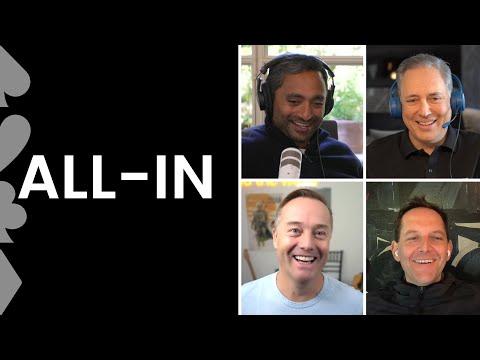
E50: Crypto investing deep dive, Facebook's whistleblower fallout, Chappelle's new special & more
Chamath Palihapitiya (host), David Sacks (host), Jason Calacanis (host), David Friedberg (host), Guest (guest), Guest (guest), Narrator, Narrator
In this episode of All-In Podcast, featuring Chamath Palihapitiya and David Sacks, E50: Crypto investing deep dive, Facebook's whistleblower fallout, Chappelle's new special & more explores crypto bets, Facebook regulation battles, and culture wars collide loudly This All-In Podcast episode weaves together a deep dive on crypto investing, a heated analysis of the Facebook whistleblower saga, and reactions to Dave Chappelle’s controversial Netflix special. The besties unpack how sophisticated investors approach crypto (e.g., Solana via Multicoin, DCG, Bitwise, BitGo), why most individuals shouldn’t pick tokens themselves, and how regulation and ETFs will likely shape mainstream exposure. They argue over Facebook’s algorithms, Section 230, and whether Haugen’s testimony is principled or a coordinated political ‘hit’ aimed at creating a powerful speech-regulating agency. The episode closes with concerns about cancel culture, the economics of comedy, and ideas for comedian-owned platforms and future All-In events.
Crypto bets, Facebook regulation battles, and culture wars collide loudly
This All-In Podcast episode weaves together a deep dive on crypto investing, a heated analysis of the Facebook whistleblower saga, and reactions to Dave Chappelle’s controversial Netflix special. The besties unpack how sophisticated investors approach crypto (e.g., Solana via Multicoin, DCG, Bitwise, BitGo), why most individuals shouldn’t pick tokens themselves, and how regulation and ETFs will likely shape mainstream exposure. They argue over Facebook’s algorithms, Section 230, and whether Haugen’s testimony is principled or a coordinated political ‘hit’ aimed at creating a powerful speech-regulating agency. The episode closes with concerns about cancel culture, the economics of comedy, and ideas for comedian-owned platforms and future All-In events.
Key Takeaways
Treat most crypto exposure as a professionalized, diversified bet—not DIY stock picking.
The hosts emphasize that crypto is too broad and fast-moving (distributed computing, cryptography, economics, infra) for casual investors to reliably pick winners; they instead back specialized managers (e. ...
Get the full analysis with uListen AI
Differentiate between ‘conviction assets’ you love and trades you should rebalance.
They argue investors should distinguish between assets that embody ideas you want to own long-term versus pure trades, and that large, early wins (100x+) still demand risk management and partial profit-taking.
Get the full analysis with uListen AI
Don’t invest in crypto by rank-order market cap or price alone.
Chamath calls it “stupid” to buy tokens just because they’re high on a list or look cheap, noting that Helium, DeSo, and Discord-like projects all have radically different use cases, success paths, and underlying assumptions.
Get the full analysis with uListen AI
Use structured products (ETFs, mutual funds, institutional custody) to access crypto safely.
The group highlights products like Bitwise’s crypto index and institutional custodians like BitGo as realistic on-ramps for institutions and regular investors, especially as US regulators warm to ETFs and clearer rules.
Get the full analysis with uListen AI
Use regulation to enforce transparency and reserves in stablecoins, not to kill innovation.
They criticize Tether’s opaque and risky reserve practices, praise USDC’s move to 100% cash/cash equivalents, and suggest stablecoins should be regulated like money-market funds, with clear reserve and disclosure requirements.
Get the full analysis with uListen AI
Be wary of new speech regulators that can define ‘misinformation’ and control algorithms.
Sacks argues Haugen’s real proposal is a powerful new oversight body staffed by insiders like her, which would effectively sit over Facebook’s newsfeed and risk partisan control of what counts as acceptable speech or ‘misinformation.’
Get the full analysis with uListen AI
Engagement algorithms reflect and amplify human psychology more than corporate malice.
Friedberg and Chamath frame social algorithms as real-time versions of what editors have always done—optimize for what drives reaction—arguing the ugly output is largely a mirror of human appetites for emotional, sensational content rather than uniquely evil code.
Get the full analysis with uListen AI
Notable Quotes
““Crypto is like the internet: business model innovation, technology innovation, economic innovation… there are a lot of layers of activity.””
— David Friedberg
““Looking at [crypto] as a rank list betrays what it is… to look at it on a rank list and just buy something because it’s cheap is stupid. Don’t do that.””
— Chamath Palihapitiya
““The idea that you as an individual investor are gonna pick off the one cryptocurrency here or there to invest in… that’s gonna be a lottery.””
— David Sacks
““You can’t wipe $3 trillion of value out of the world… it’s here to stay and it’s too institutionalized now.””
— Chamath Palihapitiya
““We’re getting a very ugly look in the mirror at what humans actually want to consume… and that is what’s making this all so ugly.””
— David Friedberg
Questions Answered in This Episode
Given the complexity and pace of crypto, what realistic framework can an informed but non-professional investor use to decide between direct token exposure, funds, or no exposure at all?
This All-In Podcast episode weaves together a deep dive on crypto investing, a heated analysis of the Facebook whistleblower saga, and reactions to Dave Chappelle’s controversial Netflix special. ...
Get the full analysis with uListen AI
Where is the line between necessary consumer protection in crypto (e.g., for stablecoins, custody, disclosure) and overreach that would simply push activity into less-regulated jurisdictions or decentralized platforms?
Get the full analysis with uListen AI
If algorithms mainly optimize for engagement rather than truth, what concrete, non-paternalistic design changes—if any—could reduce harms like polarization or mob pile-ons without becoming censorship tools?
Get the full analysis with uListen AI
Would a decentralized social ecosystem genuinely limit the concentration of power and reduce regulatory risk, or would new de facto gatekeepers and amplification dynamics simply emerge in a different form?
Get the full analysis with uListen AI
How much responsibility do comedians and streaming platforms have to resist cancel culture and protect controversial speech, and could a comedian-owned ‘Netflix for comedy’ materially change those incentives?
Get the full analysis with uListen AI
Transcript Preview
Our daughter's head is dropped because the, our doctor, she- she felt the head and she was like, "Yep, it's- it's-"
Hey, Chamath, whose head has gotten bigger? Uh, yours or your daughter's? (rimshot)
(laughs)
(laughs)
What do you mean?
Don't quit your day job, Sacks.
Yeah, Sacks.
That didn't quite land.
That didn't land.
We need to get more respect here on the show.
He's trying out material.
Nah.
Total flop.
(laughs)
We are not in rhythm. You know why? It's Mercury retrograde. Our 50th episode is gonna suck (censored) because of this.
Here we go. Three, two...
What your winners ride.
Rain Man, David Sacks.
I'm going all in. As I said, we open sources to the fans and they've just gone crazy with it.
Love you Betsy.
Queen of Quinoa. I'm going all in.
All right. The Facebook whistleblower hearings occurred and Facebook, um, gave a-
No, but wait, wait. Where's your, "Hey everybody, hey everybody, hey everybody."
Hi everybody. Three, two ... Hey, everybody.
(laughs)
Welcome to another episode of the All In Podcast, Episode 50. We made it to 50.
Cinquanta.
Cinquanta. Nobody expected us to make it. Here we are, we've made it, and everybody is, uh, thrilled, uh, to be here with you. And thank you for the support over the first 50 episodes.
One episode closer to getting canceled.
One episode closer. Man, how great would it be to be canceled and never have to work again? Oh, that'd be wonderful. Okay, so, uh, Frances Haugen, uh, revealed herself on Sunday night on 60 Minutes, and then appeared before the Senate on Tuesday.
Wait, don't we get our own personal intros, or no, we're done with that?
Oh.
(laughs)
I mean, you're unbelievable. He-
Doesn't the audience know us?
Mercury retrograde. Mercury retrograde.
He's Mercury retrograde. I'm all fucked up.
Doesn't the audience know us by now after 50 episodes?
I- anyway, everybody loves the intro.
Do we really have to put a-
Three, two-
Do we have to put a-
All right.
What? What?
With us again this week-
Oh, no.
... is the Rain Man himself-
Oh, no.
... David Sacks, and the Queen of Quinoa, David Friedberg.
I love the intro.
Of course, the dictator, Chamath Palihapitiya, and I'm your boy, J-Cal.
Sacks, I gotta say, I think, I think your AUM is positively correlated with the bags under your eyes.
(laughs)
(laughs)
(laughs) If you mean it's getting bigger, you're correct.
I mean, fuck. They're hi- they're heavy.
Good Lord.
They're heavy, dragging you down.
That's where you're hiding all that Solana, in your fucking, under your eyes.
Jesus Christ.
Install uListen to search the full transcript and get AI-powered insights
Get Full TranscriptGet more from every podcast
AI summaries, searchable transcripts, and fact-checking. Free forever.
Add to Chrome