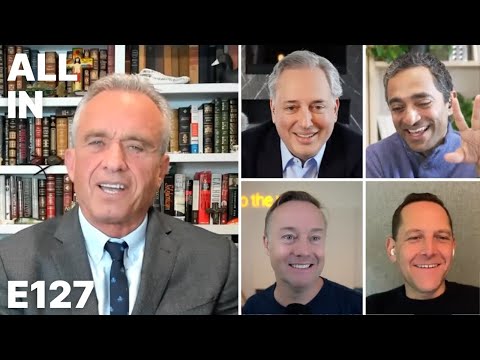
In conversation with Robert F. Kennedy Jr.
Jason Calacanis (host), David Sacks (host), Chamath Palihapitiya (host), David Friedberg (host), Robert F. Kennedy Jr. (guest), Guest (guest)
In this episode of All-In Podcast, featuring Jason Calacanis and David Sacks, In conversation with Robert F. Kennedy Jr. explores rFK Jr. challenges war, pharma, media, and regulatory power structures Robert F. Kennedy Jr. joins the All-In Podcast to outline his 2024 presidential platform, centered on ending “forever wars,” dismantling regulatory capture, and rebuilding the American middle class. He sharply criticizes U.S. foreign policy in Ukraine and toward China, massive military spending, and what he calls a militarized, pharma-driven COVID response. Kennedy argues that key institutions—CIA, FDA, CDC, big pharma, defense contractors, and major media—are structurally captured by corporate interests, distorting policy, science, and public discourse. The hosts push him on economics, vaccines, nuclear energy, culture-war issues, education, and media censorship, revealing both his detailed critiques and areas where he admits he needs more study.
RFK Jr. challenges war, pharma, media, and regulatory power structures
Robert F. Kennedy Jr. joins the All-In Podcast to outline his 2024 presidential platform, centered on ending “forever wars,” dismantling regulatory capture, and rebuilding the American middle class. He sharply criticizes U.S. foreign policy in Ukraine and toward China, massive military spending, and what he calls a militarized, pharma-driven COVID response. Kennedy argues that key institutions—CIA, FDA, CDC, big pharma, defense contractors, and major media—are structurally captured by corporate interests, distorting policy, science, and public discourse. The hosts push him on economics, vaccines, nuclear energy, culture-war issues, education, and media censorship, revealing both his detailed critiques and areas where he admits he needs more study.
Key Takeaways
RFK Jr. would pivot U.S. foreign policy from regime-change wars to negotiated settlements.
He argues the Ukraine war is a U. ...
Get the full analysis with uListen AI
He sees the debt crisis as inseparable from America’s war footing and security state.
Kennedy links $1. ...
Get the full analysis with uListen AI
Kennedy wants to restructure intelligence agencies and dramatically increase transparency.
Citing his father and uncle’s conflicts with the CIA, he proposes separating the CIA’s espionage (information) function from its covert action arm, releasing assassination and other classified records, and pardoning or protecting whistleblowers like Assange and Snowden instead of punishing them.
Get the full analysis with uListen AI
He frames COVID policy as a case study in militarized, monetized public health.
Kennedy claims early treatments were suppressed to preserve vaccine Emergency Use Authorizations, that pandemic management was effectively run by the national security apparatus, and that lockdowns and mandates caused catastrophic collateral damage while failing to prevent a world-leading U. ...
Get the full analysis with uListen AI
RFK Jr. is highly skeptical of current vaccine and pharma regulation, but not “anti-vax” in principle.
He emphasizes that childhood vaccines have legal liability shields and often lack placebo-controlled trials, argues the post-1980s vaccine boom coincides with a surge in chronic disease, and calls for rigorous safety testing and independent research rather than blanket mandates and censorship of critics.
Get the full analysis with uListen AI
On energy, he opposes subsidized nuclear and prefers market-driven renewables plus grid reform.
Kennedy argues nuclear power is uneconomic without massive subsidies and liability protection, criticizes plants like Indian Point on safety and waste grounds, and says the real bottleneck for wind/solar is outdated transmission; he supports any technology that can compete fairly once externalities are priced in.
Get the full analysis with uListen AI
He adopts a civil-liberties lens on culture-war and media issues, favoring autonomy and open debate.
Kennedy supports bodily autonomy for adults but opposes biological males in women’s sports and is cautious on youth gender surgery; he’s wary of CRT as an all-consuming frame in schools yet insists on teaching America’s full history. ...
Get the full analysis with uListen AI
Notable Quotes
““This is not a humanitarian mission in Ukraine. It’s a war of attrition designed to exhaust and degrade Russia, and the flower of Ukrainian youth is paying the price.””
— Robert F. Kennedy Jr.
““The principal job of a president of the United States is to keep the nation out of war.””
— Robert F. Kennedy Jr., quoting John F. Kennedy
““We had, instead of a public health response to a public health crisis, a militarized and monetized response that was the inverse of what you’d want if you actually cared about public health.””
— Robert F. Kennedy Jr.
““I’m not anti-vax. I’m fully vaccinated, my kids were fully vaccinated. I wish I had not done that, because I know enough about them now.””
— Robert F. Kennedy Jr.
““Show me facts and I will change [my opinion] so fast. But you need to show me facts, not just call me a misinformation spreader.””
— Robert F. Kennedy Jr.
Questions Answered in This Episode
How would RFK Jr. practically force a Ukraine settlement if Zelenskyy refuses, and what concessions to Russia would he actually accept?
Robert F. ...
Get the full analysis with uListen AI
If military and security cuts aren’t enough to stabilize the debt, what specific tax or entitlement reforms—if any—would he ultimately support?
Get the full analysis with uListen AI
How would he design a new regulatory and research framework for vaccines that both protects public health and addresses his concerns about safety and liability?
Get the full analysis with uListen AI
What concrete steps would he take in his first 100 days to “de-capture” agencies like the CIA, FDA, CDC, and EPA without crippling their core functions?
Get the full analysis with uListen AI
Given his skepticism of mainstream media and pharma influence, how would an RFK Jr. administration ensure that public health communication is both independent and trusted in a future pandemic?
Get the full analysis with uListen AI
Transcript Preview
Sachs, you ready? You got your QuickTime going?
Oh, uh, let me do that real quick.
And just a quick note, Sachs, Mr. Kennedy doesn't have earpieces in, so he... We just have to be careful of the crosstalk or talking over each other. I'll direct, uh, questions to each person and then follow up, so you can obviously just use your judgment of when to insert yourself. But be, uh, be gentle on the insertion there because we don't want... That came out wrong. Um, just be, uh-
(laughs)
... be gentle when you interrupt. Cut. There's your cold open.
At least if you did it incorrectly, it'll be quick. Where you'll be...
Okay, here we go in three-
(laughs)
... two...
I'm going all in. Don't let your winner slide. Rain Man, David Sachs. I'm going all in. As I said...
We open sourced it to the fans and they've just gone crazy with it.
Love you, S.I.D.E. West Side Queen of Kinwah. I'm going all in.
All right, everybody. Welcome to the All-In Podcast. As many of you know, this podcast has gotten quite popular over the last two years, typically in the top 10 or 20 each week. And we talk about politics.
(laughs)
We've got a big, uh, following in DC and-
Why are you calling me self-absorbed, Chavan? I mean, listen to how your co-host opens his show.
Calm down, everybody.
It's okay. Yeah. Yeah, go ahead.
And as part of that, our ongoing discussions about politics and presidential candidates has resonated in particular communities. And today, we are lucky enough to have one of the top presidential hopefuls in the 2024 election joining us, uh, Robert Kennedy Jr. And we will be inviting all presidential candidates to come on to the All-In Podcast and have candid, uh, discussions that are unfiltered, uh, the way the audience would expect them. We're gonna play with different formats, but we decided for this first one, we've got a series of topics we'd like to cover, and we're gonna treat it like any other All-In Podcast. With that, I'll have David Sachs, who has... is the most conservative of our panel, who has been also the most enthusiastic, I think, of everybody here, uh, and one of the most enthusiastic supporters of Robert Kennedy Jr's pursuit of the presidency of the United States. So with that, Dave, would you like to introduce our guest?
Yeah, let me give, uh, Bobby a proper introduction here. So Robert Francis Kennedy Jr. is entering the political arena as a candidate for the first time at the age of 69. But it's perhaps no exaggeration to say that he was destined for the mission he is now pursuing. He is the nephew of President John F. Kennedy and the son of Attorney General and Senator Robert F. Kennedy. When Bobby was 14, his dad was running for president on a platform of civil rights, civil liberties, lifting Americans out of poverty and opposing the Vietnam War. He had just won the California primary when he was tragically assassinated. RFK Jr. graduated from Harvard and the University of Virginia Law School and became an environmental lawyer who aggressively litigated against corporate polluters and government agencies that were failing to regulate them. He has always put the health and safety of the American people at the forefront of his activism, and this has made him controversial at times as he has questioned the safety of some pharmaceutical products and also criticized COVID restrictions during the pandemic. For this, the mainstream media has tried to paint him as a "conspiracy theorist." But given that so many conspiracy theories about COVID have been vindicated, Tablet Magazine wrote, "At this point, the fact that Robert F. Kennedy is the country's leading conspiracy theorist alone qualifies him to be president." But the biggest reason why I think his candidacy is so interesting and relevant is that it hearkens back to a Democratic Party that believed in peace instead of war, free speech and civil liberties instead of censorship, building up the middle class instead of the donor class, and opposing corporate greed, especially in the military-industrial complex, which is a message you just don't hear much anymore coming from the Democratic side of the aisle. So with that, Bobby Kennedy, welcome to the program.
Install uListen to search the full transcript and get AI-powered insights
Get Full TranscriptGet more from every podcast
AI summaries, searchable transcripts, and fact-checking. Free forever.
Add to Chrome