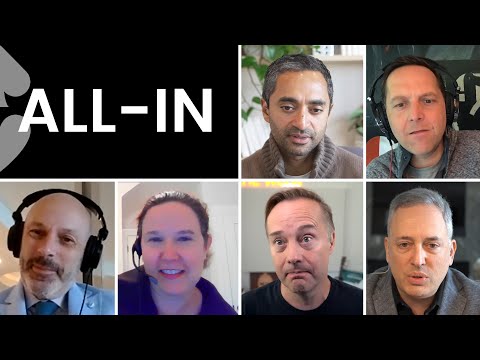
E79: Analyzing the leaked draft overturning Roe v. Wade with Amy Howe and Tom Goldstein
Jason Calacanis (host), Tom Goldstein (guest), David Sacks (host), Amy Howe (guest), Chamath Palihapitiya (host), David Friedberg (host), Jason Calacanis (host), Chamath Palihapitiya (host)
In this episode of All-In Podcast, featuring Jason Calacanis and Tom Goldstein, E79: Analyzing the leaked draft overturning Roe v. Wade with Amy Howe and Tom Goldstein explores supreme Court Leak on Roe Spurs Fears for Rights and Legitimacy Legal experts Amy Howe and Tom Goldstein explain the history of Roe v. Wade and Planned Parenthood v. Casey, and analyze Justice Alito’s leaked draft opinion that would overturn Roe and return abortion regulation to legislatures.
Supreme Court Leak on Roe Spurs Fears for Rights and Legitimacy
Legal experts Amy Howe and Tom Goldstein explain the history of Roe v. Wade and Planned Parenthood v. Casey, and analyze Justice Alito’s leaked draft opinion that would overturn Roe and return abortion regulation to legislatures.
They unpack originalism versus living constitutionalism, stare decisis, and why conservatives have spent 50 years methodically building a Court majority to reverse Roe.
The conversation explores downstream risks to other privacy-based rights like contraception and same-sex marriage, as well as how Congress and state legislatures could respond if Roe falls.
The hosts and guests also examine the impact of the leak on the Court’s legitimacy, potential internal dynamics among the justices, and structural reform ideas such as term limits.
Key Takeaways
Overturning Roe shifts abortion from a constitutional right to a policy choice.
If the Alito draft stands, abortion would no longer be protected as a federal constitutional right; instead, state and possibly federal legislatures would decide whether and how it is legal, leading to sharply divergent laws across the country.
Get the full analysis with uListen AI
The draft uses history and originalism to deny abortion as a fundamental right.
Alito argues abortion is not “deeply rooted” in American history and tradition, highlighting past criminalization and rejecting the privacy-based reasoning that underpinned Roe and Casey.
Get the full analysis with uListen AI
Stare decisis is weakened when the Court interprets the Constitution, not statutes.
The draft emphasizes that precedent is at its “weakest” in constitutional cases because only the Court can correct its own constitutional errors, making it easier to overturn even long‑standing rulings like Roe and Casey.
Get the full analysis with uListen AI
Other privacy-based rights are doctrinally exposed, even if politically safer—for now.
The same substantive due process framework used for contraception and same-sex marriage is rejected in the Dobbs draft; although Alito says those rulings are different, the reasoning could later be applied to challenge them, especially if the Court shifts further right.
Get the full analysis with uListen AI
The leak likely came from someone trying to lock in or derail votes.
Goldstein suggests the Wall Street Journal leak may have aimed to keep Kavanaugh and Barrett from moderating, while the Politico leak appears designed to alert and mobilize the public and progressive groups that Roe is genuinely at risk.
Get the full analysis with uListen AI
Returning abortion to politics will force real legislative compromise in swing states.
Once courts step back, lawmakers in purple states will have to specify gestational limits and exceptions; politicians who refuse compromises on issues like rape, incest, or late-term limits risk electoral backlash.
Get the full analysis with uListen AI
Structural features of the Court amplify partisan stakes and long-term impact.
Life tenure, strategic confirmation tactics, and the difficulty of constitutional amendments give five justices enormous power over social policy, prompting proposals like 18‑year term limits—but these would themselves require constitutional change.
Get the full analysis with uListen AI
Notable Quotes
“The reasoning for overruling Roe is, by and large, the same reason that you would overrule Obergefell.”
— Tom Goldstein
“They have marched forward from that position where they were losing seven to two in the Supreme Court till June of this year, where they will likely win five to four.”
— Tom Goldstein
“Roe halted a political process that was moving in a reform direction, and thereby, I believe, prolonged divisiveness and deferred stable settlement of the issue.”
— David Sacks (quoting Ruth Bader Ginsburg’s 1992 article)
“It’s going to be a scary quarter century.”
— Tom Goldstein
“Are we not just taking a big step back in society and saying, ‘You know, we’re going to throw out compassion in favor of original textualism’?”
— Chamath Palihapitiya
Questions Answered in This Episode
If the Court can overturn a 50-year precedent like Roe, what realistic limits—if any—exist on revisiting other major constitutional rights?
Legal experts Amy Howe and Tom Goldstein explain the history of Roe v. ...
Get the full analysis with uListen AI
How should a modern democracy balance originalist readings of a centuries‑old constitution with contemporary values and social realities?
They unpack originalism versus living constitutionalism, stare decisis, and why conservatives have spent 50 years methodically building a Court majority to reverse Roe.
Get the full analysis with uListen AI
What specific abortion policy compromises (gestational limits, exceptions, access) would likely command majority support in most states?
The conversation explores downstream risks to other privacy-based rights like contraception and same-sex marriage, as well as how Congress and state legislatures could respond if Roe falls.
Get the full analysis with uListen AI
Does the Supreme Court’s increasing ideological alignment with appointing presidents irreparably damage its claim to be above politics?
The hosts and guests also examine the impact of the leak on the Court’s legitimacy, potential internal dynamics among the justices, and structural reform ideas such as term limits.
Get the full analysis with uListen AI
Would term limits or other structural reforms to the Court meaningfully reduce politicization, or simply shift the political battles to different stages?
Get the full analysis with uListen AI
Transcript Preview
These are back- I'm going all in. (upbeat music) Let your winners ride. Rain Man, David Sa- I'm going all in.
And I said-
We open sourced it to the fans and they've just gone crazy with it.
Love you, best night.
Queen of Quinoa. I'm going all in.
There was a lot of big news, um, obviously this past week, uh, when a leaked draft of the Supreme Court's Roe v. Wade decision, uh, was published, uh, by Politico. The draft opinion, written by Justice Alito, uh, would turn Roe v. Wade from a federal issue to a state issue. Now, this is a bit above, uh, all of our pay grades, so Chamath had a really great idea to tap some people who are actual experts and, uh, in the Supreme Court. Uh, Chamath, maybe you could introduce our guests- I will.
... yeah, and queue this up for us. Thank you.
Great. Um, so first, I'd like to introduce Amy Howe. Um, Amy, uh, until 2016, served as the editor and a reporter for SCOTUSblog, which is the, um, the premier blog that covers the Supreme Court. She continues to serve as an independent contractor and reporter for SCOTUSblog. Uh, she also writes for her blog called Howe on The Court. And before turning to full-time blogging, she was a counsel in over two dozen merits cases at the Supreme Court and argued two cases there. From 2004 until 2011, she co-taught Supreme Court Litigation at Stanford Law School, and from '05 to '13, 2013, she co-taught a similar class at Harvard Law School. And I'd also like to introduce, um, her partner at SCOTUS and also her partner in life, Tom Goldstein, another dear friend of mine. Over the past 15 years, Tom has served as one of the lawyers for one of the parties in just under 10% of all the cases argued before the Supreme Court. He has argued 43 cases himself, and two that I think are probably a little bit near and dear to all of our hearts. Uh, in 2000, Tom served as second chair for Laurence Tribe and David Boies on behalf of Vice President Al Gore in Bush v. Gore. And most recently, he represented Google in a fair use copyright infringement case, Google versus Oracle, um, about the use of Java APIs. Um, and so Tom and Amy, thank you, guys for giving us, um, your precious time. Welcome to the pod.
Thanks for having us.
Thanks for having us. I was a little nervous about what the introduction was gonna be like, so thank you.
So guys-
(laughs)
... there's a, there's a million questions, um, to start with or that we can go, but, uh, maybe just to frame the issue, um, can you guys just first walk us through the original Roe v. Wade decision, um, how it was made, and the rights that it conferred? And then maybe we can go from there and talk about, um, what has happened as a result of the way it was written and the, and, and the, the, the judgment as it, as it stood.
Install uListen to search the full transcript and get AI-powered insights
Get Full TranscriptGet more from every podcast
AI summaries, searchable transcripts, and fact-checking. Free forever.
Add to Chrome