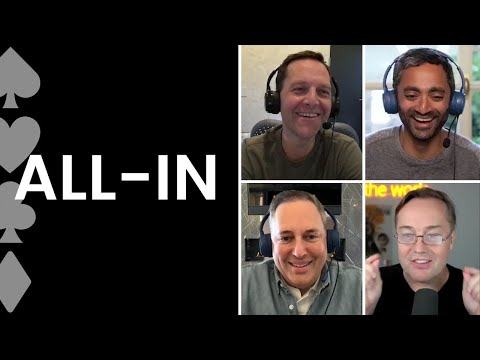
E28: Current state of public & private markets, Archegos debacle, US debt issues, wealth tax & more
Chamath Palihapitiya (host), David Sacks (host), David Friedberg (host), Jason Calacanis (host), Narrator, Narrator, Narrator, Narrator
In this episode of All-In Podcast, featuring Chamath Palihapitiya and David Sacks, E28: Current state of public & private markets, Archegos debacle, US debt issues, wealth tax & more explores sPAC mania, Archegos blowup, and looming debt drive policy battles The hosts dissect extreme froth in public and private markets, focusing on SPAC oversupply, PIPE fatigue, and hedge-fund-style leverage blowing up in the Archegos debacle. They contrast short-term, leveraged “year-to-date” risk-taking with longer-term, inception-based investing, and discuss how that dynamic drives violent market swings. In private markets, they describe seed and growth valuations roughly doubling, prompting some VCs to shift from new deals to doubling down on existing winners. The conversation then pivots to U.S. debt, Biden’s multi-trillion spending plans, corporate and potential wealth taxes (especially California’s proposal), and a broader tension between economic freedom, equality, and an increasingly risk-averse, expert-driven political culture.
SPAC mania, Archegos blowup, and looming debt drive policy battles
The hosts dissect extreme froth in public and private markets, focusing on SPAC oversupply, PIPE fatigue, and hedge-fund-style leverage blowing up in the Archegos debacle. They contrast short-term, leveraged “year-to-date” risk-taking with longer-term, inception-based investing, and discuss how that dynamic drives violent market swings. In private markets, they describe seed and growth valuations roughly doubling, prompting some VCs to shift from new deals to doubling down on existing winners. The conversation then pivots to U.S. debt, Biden’s multi-trillion spending plans, corporate and potential wealth taxes (especially California’s proposal), and a broader tension between economic freedom, equality, and an increasingly risk-averse, expert-driven political culture.
Key Takeaways
The SPAC market is oversaturated and terms are tightening sharply.
Hundreds of SPACs raised in 2020–Q1 2021 now face a two-year clock to do deals, leading to re-traded valuations, heavy discounts, and only a small fraction of the many PIPEs in market actually getting done; sponsors without real capital or reputation will be exposed.
Get the full analysis with uListen AI
Risk is being managed on short-term metrics, amplifying volatility.
Hedge funds often run strict, parametric ‘year-to-date’ risk, forcing automatic de-risking when names fall by set percentages; when layered with macro shocks like inflation fears or Archegos-style liquidations, this creates exit stampedes and outsized price swings that don’t reflect fundamentals.
Get the full analysis with uListen AI
Venture valuations have roughly doubled, pushing investors toward existing winners.
Hot, pre-revenue seed rounds now clear in the high-$20M–$30M caps for modest ownership, while later-stage SaaS and growth deals are also richly priced; some VCs are deliberately doing fewer new deals to instead raise bigger, opportunistic rounds for portfolio companies while capital is cheap.
Get the full analysis with uListen AI
Synthetic leverage and opaque derivatives can still blindside major banks.
Archegos used equity swaps and family-office exemptions to amass 5–10x leverage on concentrated positions without standard disclosure, leaving prime brokers holding multi-billion-dollar losses once margin calls hit—echoing LTCM-style notional exposure far beyond its equity base.
Get the full analysis with uListen AI
The U.S. is piling on debt in a non-emergency upswing, increasing future fragility.
With debt surpassing 100% of GDP and trillions more in COVID relief plus broad ‘infrastructure’ and family programs, the hosts argue low rates are masking the long-run burden; if inflation or rates rise, debt service could crowd out entitlements, defense, and public investment.
Get the full analysis with uListen AI
State-level wealth taxes are likely to backfire via capital and talent flight.
California’s proposed wealth tax—1% above $50M, 1. ...
Get the full analysis with uListen AI
Pushing equality via punitive taxes risks undermining innovation and long-run progress.
Friedberg frames a trade-off: maximum freedom yields maximum progress but unequal outcomes, while heavy redistribution raises equality at the cost of innovation; proposals to cap billionaires’ upside or treat capital gains like ordinary income could, in their view, stunt Amazon/Elon-scale value creation.
Get the full analysis with uListen AI
Notable Quotes
““I lost more money than I ever thought I would make. I could bail out a small country.””
— Chamath Palihapitiya
““We’re only 90 days into a two-year shot clock for hundreds of SPACs. You’re going to see some really crazy behavior into late 2022.””
— Chamath Palihapitiya
““My philosophy as a VC is that the market sets the price. I’m a price taker; my real decision is which deals I want to be in.””
— David Sacks
““Whenever you read a story about some rich person going broke, there’s always debt involved.””
— David Sacks
““Freedom produces progress, but progress is always asymmetric. Some people end up way further ahead, and that’s the tension we’re now trying to vote away.””
— David Friedberg
Questions Answered in This Episode
How sustainable is the current SPAC ecosystem, and what happens to public-market trust if a large wave of low-quality SPAC deals fails or liquidates?
The hosts dissect extreme froth in public and private markets, focusing on SPAC oversupply, PIPE fatigue, and hedge-fund-style leverage blowing up in the Archegos debacle. ...
Get the full analysis with uListen AI
Should regulators more tightly control hedge fund leverage and opaque instruments like total return swaps, or does that simply push risk into even darker corners of the system?
Get the full analysis with uListen AI
In an environment of doubled venture valuations, how should founders and investors think about dilution, round sizing, and the risk of overcapitalizing early?
Get the full analysis with uListen AI
Where is the right balance between fiscal stimulus and long-term debt sustainability when the economy is already rebounding strongly from a shock like COVID?
Get the full analysis with uListen AI
Would a federal wealth or aggressive capital gains tax meaningfully reduce inequality without crippling innovation, or are there better-targeted ways to expand opportunity and the safety net?
Get the full analysis with uListen AI
Transcript Preview
(singing) My name is David Sacks and I have a broomstick in my (censored) . That is why my voice is so deep.
(laughs)
I have never had friends in my life. Somebody be my friend who I don't pay.
(laughing)
What a mood we're in today, huh?
What a vibe.
Going all in. Let your winners ride. Rain Man, David Sacks. Going all in. And I said, we open sourced it to the fans and they've just gone crazy with it. Love you guys. Queen of Quinoa. Going all in.
Hey, everybody. Hey, everybody. Welcome to another episode of the All-In Podcast. With us today, the rotating cast of characters that you've come to know and love and follow on the Twitter, the Queen of Quinoa, David Friedberg is here, and The Rain Man, David Sacks, calling in from one remote location that is undisclosed, and The Dictator, Chamath Palihapitiya, with us again. Gentlemen, uh, how's everybody doing?
I'm punchy.
You're punchy?
I'm punchy.
Chamath is in a mood.
Is he in a mood?
I'm in a mood.
What's happening, Chamath?
Nothing, I just, uh, I just finished a workout, so I think I'm high on endorphins.
Oh, great.
How much money did you lose in the market today?
(laughing)
(laughing)
(laughing)
Wow. Sacks comes in at just a flagrant foul of the first play of the game? (laughs)
No, he, he said, he said he wasn't happy, so I was just, I was just hypothesizing about what-
No, no, no. I's and I am happy.
... maybe the cause-
I am happy. No, no, no, I am happy.
Okay.
I'm about to go on Easter vacation-
(laughs)
... uh, so I'm happy about that. Actually, can I just tell you-
You've accepted Jesus? (laughs)
No, I mean, can I just tell you, uh, March, March 2nd or whatever that day was, was an absolutely ludicrous day. We've kind of clawed it all back. We're doing pretty decently for the year again, and, uh, but I gotta say, my gosh, like, I've really learned to, uh, to, to, to deal with drawdowns in the last 30 days. It's been an amazing learning process. I'm, I'm a better person for it.
You did look pretty shell-shocked that episode.
(whistles) (laughs)
Dude, I, I, honestly, I mean, I, I lost more money than I ever thought I would make. I could bail out a small country, you know?
(laughs)
(laughs)
And it just, it just v- it just-
Vanished.
It just vanished. It just evaporated in a day. It was incredible. Then it came back and then, you know-
Came back.
... and that's been okay.
Well, what do we, what do we think is happening in the markets right now, in terms of retail investor participation and the number of SPACs that are coming into the market? I saw a statistic today that in Q1, there were 245 SPACs, uh, raised in Q1, or 250... That's on top of the 250 that were raised last year.
Install uListen to search the full transcript and get AI-powered insights
Get Full TranscriptGet more from every podcast
AI summaries, searchable transcripts, and fact-checking. Free forever.
Add to Chrome