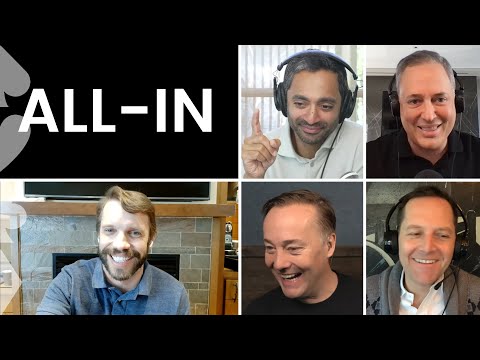
E66: $FB's big drop, Rogan/Spotify mess, Xi/Putin meetup & supply chain issues with Ryan Petersen
Jason Calacanis (host), Chamath Palihapitiya (host), David Sacks (host), David Friedberg (host), Ryan Petersen (guest), David Friedberg (host), Jason Calacanis (host), Chamath Palihapitiya (host)
In this episode of All-In Podcast, featuring Jason Calacanis and Chamath Palihapitiya, E66: $FB's big drop, Rogan/Spotify mess, Xi/Putin meetup & supply chain issues with Ryan Petersen explores supply Chains, Big Tech Shocks, Censorship Battles, And A New World Order The episode centers on a deep dive into global supply chain dysfunction with Flexport CEO Ryan Petersen, exploring how pandemic demand shifts, weak U.S. port infrastructure, labor structures, and looming regulation are compounding into long-term economic risk. The hosts and Petersen unpack why delays and shipping costs have exploded, how big firms are insulating themselves by integrating supply chains, and which policy levers could quickly improve port throughput. They then pivot to Facebook’s historic stock drop, debating structural threats from Apple’s privacy changes, TikTok, antitrust pressure, and Meta’s heavy bet on VR versus better-entrenched platform players like Apple and Google. The conversation widens into the Joe Rogan–Spotify controversy, the rise of de facto editorial power by platforms, and shifting public attitudes toward censorship and COVID policy, before closing on geopolitical realignment as China and Russia move closer together while U.S. strategic missteps erode American dominance.
Supply Chains, Big Tech Shocks, Censorship Battles, And A New World Order
The episode centers on a deep dive into global supply chain dysfunction with Flexport CEO Ryan Petersen, exploring how pandemic demand shifts, weak U.S. port infrastructure, labor structures, and looming regulation are compounding into long-term economic risk. The hosts and Petersen unpack why delays and shipping costs have exploded, how big firms are insulating themselves by integrating supply chains, and which policy levers could quickly improve port throughput. They then pivot to Facebook’s historic stock drop, debating structural threats from Apple’s privacy changes, TikTok, antitrust pressure, and Meta’s heavy bet on VR versus better-entrenched platform players like Apple and Google. The conversation widens into the Joe Rogan–Spotify controversy, the rise of de facto editorial power by platforms, and shifting public attitudes toward censorship and COVID policy, before closing on geopolitical realignment as China and Russia move closer together while U.S. strategic missteps erode American dominance.
Key Takeaways
U.S. ports are structurally inefficient, amplifying a persistent global supply chain crisis.
Petersen highlights that American ports operate with lower productivity than ports like Rotterdam and even Mombasa, due largely to outdated labor models, fragmented incentives, and resistance to automation, making a 20% import volume increase system-breaking instead of manageable.
Get the full analysis with uListen AI
Stable input volumes with rising delays signal systemic degradation, not just temporary congestion.
Container volumes are flat year-over-year but average door-to-door transit times have more than doubled (from ~50 to ~115 days), which in systems terms indicates growing internal friction and feedback loops that can trigger prolonged disruptions and economic spillovers.
Get the full analysis with uListen AI
Longer lead times are setting up a future demand–inventory mismatch and potential recessionary pressure.
Because firms must forecast demand over twice the time horizon, many will over-order; when consumer spend rotates back to services, mid-market and D2C brands could be stuck with expensive excess inventory, missed revenue, and working-capital stress that show up in earnings several quarters later.
Get the full analysis with uListen AI
Scale and vertical integration are becoming decisive competitive advantages in logistics-heavy businesses.
Large players like Apple, Walmart, Amazon, and Tesla are absorbing higher freight costs, chartering ships, and integrating logistics and manufacturing, while smaller companies are locked out by 5–10x freight price increases and inability to influence capacity, widening the gap between giants and everyone else.
Get the full analysis with uListen AI
Simple, targeted policy changes could meaningfully improve port throughput without huge new spending.
Examples include relaxing zoning to stack containers higher in truck yards, deploying ‘free-flow’ container pickup tech instead of rigid appointment systems, aligning incentives for night shifts, and proactive federal mediation ahead of West Coast union contract expiry—none of which require massive new infrastructure builds.
Get the full analysis with uListen AI
Meta’s combination of platform dependence, TikTok competition, and regulatory constraints is structurally risky.
The hosts argue Meta is uniquely exposed: Apple’s IDFA changes are cutting billions from ad revenue, TikTok is eroding engagement, and heavy antitrust scrutiny limits acquisitions—while investors now see its metaverse bet as a costly, speculative pivot that moved it from “defensive mega-cap” to “risky growth story.”
Get the full analysis with uListen AI
Platforms are de facto publishers, pushing them into unavoidable, highly politicized editorial roles.
The Rogan–Spotify debate illustrates that once platforms pay, program, or promote specific creators, they effectively exercise editorial judgment; they can’t simultaneously claim pure neutrality while users, governments, and advertisers demand action on misinformation, forcing companies into contested decisions about speech.
Get the full analysis with uListen AI
Notable Quotes
“When you have a complex system where the same amount of input’s coming in but the delay is getting longer and longer, that’s a very worrisome sign.”
— Ryan Petersen
“We could 10X the throughput of one of these ports overnight… it’s a matter of implementation, deployment, and how to get around a lot of people that don’t really want to see better running ports.”
— Ryan Petersen
“Big Tech will be the last to crack, but when they do, they are gonna get shot.”
— Chamath Palihapitiya (referencing Gavin Baker’s market observation)
“All of them wanted to be these democratization platforms. And now they’re finding that there is no way to avoid being treated like a publisher.”
— David Friedberg
“The wheel of censorship broke on Joe Rogan this week. They tried to Alex Jones him and it failed.”
— David Sacks
Questions Answered in This Episode
If simple operational and policy tweaks can unlock major port efficiency gains, what specifically is blocking their rapid adoption in the U.S.?
The episode centers on a deep dive into global supply chain dysfunction with Flexport CEO Ryan Petersen, exploring how pandemic demand shifts, weak U. ...
Get the full analysis with uListen AI
How should mid-sized and D2C brands rethink inventory, sourcing, and financing strategies in a world of 3–4 month lead times and volatile freight costs?
Get the full analysis with uListen AI
Given Meta’s dependence on other companies’ operating systems, what realistic strategic options does it have beyond doubling down on VR and AR?
Get the full analysis with uListen AI
Where should we draw the line between a platform’s responsibility to moderate harmful content and its obligation to protect open inquiry and dissenting scientific views?
Get the full analysis with uListen AI
How can the U.S. recalibrate foreign and industrial policy to avoid pushing Russia and China closer together while rebuilding domestic resilience in critical sectors like semiconductors and logistics?
Get the full analysis with uListen AI
Transcript Preview
The fact that Sachs' greatest moment in life was beating Peter Thiel in a multi-game chess. You ever see that picture of-
Yeah.
... of him with his arms raised and Sachs can't believe he-
That was pretty great. (laughs)
... beat Pet- I mean, tell us about that moment.
Nick, show that picture of Sachs. I mean, listen. Here's what I say. When I saw-
(laughs)
When I saw that picture, I had a couple thoughts. Number one, I've seen this picture somewhere else. And then number two is, oh my God, it was on NBC's To Catch a Predator.
(laughs)
I mean, I have never seen Sachs happier. I- like, the birth of his children-
Oh my God. What a nerd.
... pales in comparison to this moment.
I'll tell you, that was the day of PayPal's IPO, and so we did a party in the... It was like a keg party in the parking lot. That was the extent of the celebration. And Peter-
Wow.
... did a 10-game-
There's Roelof.
Yeah, he did a 10-game simultaneous, which means he's playing against te- 10 people at the same time. And he goes board to board, makes his move, and I was the only one out of the 10 that beat him. And somebody... I guess I had put money down.
Max Letchin on the left.
I had put money down. I put, like, $20 down or something on the game, which is a foolish thing to do against Peter 'cause he's, like, a chess master. And, uh, and I, somehow I won, and you can see I've got the money in my hands, raised up.
Look at the look on Peter Thiel's face.
Oh, he hates losing.
Look at the look on P- I mean, he's so angry. He, and he, but he's, he sees the joy in your face and he can't process it.
And look at Max. Max is to my right, and Roelof is to my left.
He, pure joy.
And they're so happy. Yeah. 'Cause-
Roelof, pu- pure joy.
Yeah. But P- this was a few seconds before Peter smashed all the pieces off the board. And, uh-
What?
Yeah.
He, t- he, he, you, he flipped the board?
He always does that when he loses, and, uh-
(gasps)
His motto is, when you call him a sore loser, he says, "Show me a good loser and I'll show you a loser." (laughs)
(laughs)
Wow, such a great line. But I just wanna also comment on the pleats on Sachs' pants and how high that waist is.
And- and the cell phone holster.
And Jason, you guys-
And the cell phone holster. (laughs)
The cell phone holster.
Oh my God, I didn't see. Zoom in on the cell phone holster.
Install uListen to search the full transcript and get AI-powered insights
Get Full TranscriptGet more from every podcast
AI summaries, searchable transcripts, and fact-checking. Free forever.
Add to Chrome