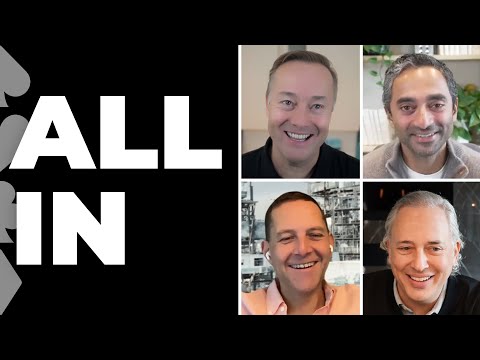
E157: Epic legal win, OpenAI's news deal, FCC targets Elon, the limits of free speech & more
Jason Calacanis (host), David Sacks (host), David Friedberg (host), Chamath Palihapitiya (host), Chamath Palihapitiya (host), Narrator, Narrator, Alex Jones (guest), Joe Rogan (guest), Narrator
In this episode of All-In Podcast, featuring Jason Calacanis and David Sacks, E157: Epic legal win, OpenAI's news deal, FCC targets Elon, the limits of free speech & more explores all-In breaks down app store antitrust, AI deals, Elon backlash, speech The episode moves from light banter into a substantive discussion of Epic Games’ antitrust win over Google’s Play Store, contrasting it with Epic’s loss against Apple and what app‑store monopolies mean for startups and consumers.
All-In breaks down app store antitrust, AI deals, Elon backlash, speech
The episode moves from light banter into a substantive discussion of Epic Games’ antitrust win over Google’s Play Store, contrasting it with Epic’s loss against Apple and what app‑store monopolies mean for startups and consumers.
They then unpack OpenAI’s licensing deal with Axel Springer, using it to distinguish between training on open web data versus licensing paywalled content, and to debate copyright, fair use, and AI’s impact on media economics.
A major segment examines whether U.S. agencies are politically targeting Elon Musk, focusing on the FCC’s revocation of Starlink subsidies, EV tax credits, and broader regulatory scrutiny across multiple agencies.
The group also wrestles with Alex Jones’ reinstatement on X, the limits of free speech versus platform responsibility, the campus free‑speech vs. DEI backlash (Harvard/Claudine Gay), and how to hire young talent when elite degrees signal less than they used to.
Key Takeaways
App stores function as de facto monopolies and are slowly extracting more value from developers.
Sacks argues Apple and Google’s app stores are monopolies within their ecosystems and duopolies overall; over time they steadily increase fees, rules, and ad spend requirements, squeezing SaaS and content businesses whose margins cannot support a flat 30% rake.
Get the full analysis with uListen AI
Epic’s victory against Google hinges on Android’s conduct, not the mere existence of a store fee.
Friedberg notes Android is technically open (side‑loading and third‑party stores allowed), but Epic argued Google’s default Play Store, security warnings, and sweetheart deals (e. ...
Get the full analysis with uListen AI
AI companies are beginning to license paywalled content while still leaning on fair use for open web data.
The Axel Springer and AP deals let OpenAI fetch and display current, paywalled news with summaries and links, which Friedberg frames as a retrieval and product-integration play, distinct from training models on freely accessible web data, which Sacks defends under fair use unless outputs are clearly plagiaristic.
Get the full analysis with uListen AI
Multiple U.S. agencies targeting Musk’s companies create the appearance of coordinated political retaliation.
Sacks cites the FCC canceling Starlink subsidies years before performance milestones, DOJ suits over refugee hiring at SpaceX, Tesla ‘glass house’ probes, EV tax credit reversals, and a long list of agencies (DOJ, FAA, FTC, NLRB, SDNY, Fish & Wildlife, FCC) as evidence of “harassment” following Biden’s remark that they would “look at this guy.”
Get the full analysis with uListen AI
Lifetime bans for speech are more dangerous than odious speech itself, the hosts argue.
While all four condemn Alex Jones’ Sandy Hook comments as disgusting, Sacks, Chamath, and Friedberg oppose permanent deplatforming: they favor policies modeled on U. ...
Get the full analysis with uListen AI
DEI regimes and selective outrage on campus are seen as hypocritical and unsustainable.
The panel views the Harvard/MIT/UPenn testimony and Claudine Gay’s treatment as evidence that elite institutions apply one set of speech standards to some groups (e. ...
Get the full analysis with uListen AI
Hiring should prioritize horsepower, motivation, and values fit over pedigree.
Friedberg outlines a four-part framework—raw cognitive ability, role‑relevant skills, demonstrated drive beyond system limits, and principles alignment—while Chamath advocates co‑op schools (like Waterloo) where companies can test students in real work settings before making offers, reducing reliance on elite-brand filtering.
Get the full analysis with uListen AI
Notable Quotes
“These app stores are absolute monopolies within their ecosystem, and Apple and Google Android are absolutely a duopoly within the mobile space.”
— David Sacks
“It's a very slippery slope and I don't think we're very capable of making these delineations. I can hold two thoughts in my head: Alex Jones should be able to say what he thinks, and it was disgusting and he should be ashamed of what he said.”
— Chamath Palihapitiya
“I do believe in the right to free speech. I’d rather have more free speech with people saying misinformation and saying awful, putrid things than one where a few people get to decide what everyone gets to hear.”
— David Friedberg
“When you create this censorship power, it’s like the ring of power. Those tools that Twitter created… attracted all these powerful, shadowy actors from the federal government.”
— David Sacks
“Identity politics and DEI, it’s just a dead end when you start judging people based on any criteria other than their character and performance in the world.”
— Jason Calacanis
Questions Answered in This Episode
If app stores were forced to allow true third-party app marketplaces on equal footing, how would that change startup business models and pricing strategies?
The episode moves from light banter into a substantive discussion of Epic Games’ antitrust win over Google’s Play Store, contrasting it with Epic’s loss against Apple and what app‑store monopolies mean for startups and consumers.
Get the full analysis with uListen AI
Where should the legal line be drawn between fair use for AI training and the need to license data, especially when training can economically substitute for the original work?
They then unpack OpenAI’s licensing deal with Axel Springer, using it to distinguish between training on open web data versus licensing paywalled content, and to debate copyright, fair use, and AI’s impact on media economics.
Get the full analysis with uListen AI
At what point does multi-agency scrutiny of a single entrepreneur or company become evidence of political retaliation rather than normal regulatory oversight?
A major segment examines whether U. ...
Get the full analysis with uListen AI
What is a workable, concrete speech policy for social platforms that protects both users from real harm and society from the creep of state-influenced censorship?
The group also wrestles with Alex Jones’ reinstatement on X, the limits of free speech versus platform responsibility, the campus free‑speech vs. ...
Get the full analysis with uListen AI
How can universities and employers replace overreliance on elite credentials with scalable ways to measure ‘horsepower’ and motivation without introducing new biases?
Get the full analysis with uListen AI
Transcript Preview
We're going mullet this week in honor of your, you're closest to mullet right now, Sacks. I see you trying to tuck the lettuce in.
(laughs)
It's not gonna work. We see it back there.
Well, I need the ponytail.
Whoa, you went full knot?
Where is this photo from?
Founding Father does this.
Do you have like a secret camera in his room? What is this? No, my- my kids took it.
(laughs) Oh my.
Are you really doing a douche knot?
One of my daughters was playing with my hair, she wants to see if she can make a ponytail with it.
Uh-huh.
So she made a ponytail and then took a photo.
(sighs) That's an elite-
So we fed it into ChatGPT to ask who it looked like and it said Thomas Jefferson.
(laughs)
Just a serious question, did you do a fit check with, with Tucker on that? Did you send him that and say, "Fit check?"
You know, not everything has to do with Tucker, J-Cal. The jokes gonna hold.
Well, look at the smile. (laughs) If you guys don't know what a fit check is, ask your daughters.
Oh, wait. What, what check?
A fit check. A fit check-
What is that?
... y- you take a picture of yourself, you send it to your friends and you say, "Fit check," and then they tell you if you look good for the day.
Oh, okay. It's kinda like, it's kinda like a wellness check, but-
But for fashion.
... for how you look? For fashion?
Yeah, yeah.
Oh, okay.
The wea- wear outfits-
Yeah, it's like when Friedberg sends you on, have anxiety about this.
The wellness check. (laughs)
And then we do a wellness check on Friedberg to see if he's gonna show up for the show.
Or we do a wellness check on you when Alex Jones comes back to Twitter.
I'm putting it out there right now. And Alex Jones is on the back half of the show, just to tease it. Just like I'm gonna tease these photos. I pulled the archives and here I am in 1984 with my mullet. That's a J-Cal mullet from 1984, in Staten Island, on the way to a Boy Scout trip. But I thought we would have a little fun.
(laughs)
Whoa.
Sacks actually has been, uh, working. He's got his hairstylist-
Whoa. (laughs)
Uh, yeah. Well, y- the gray looks like he-
He looks like a Lord of the Rings character, like an Elven warrior.
No, he looks like the Elven warrior.
Oh my God. Where's my bow and arrow?
I'm gonna ... exactly.
(laughs)
So when it, we'll punch that up but-
(laughs)
(laughs)
Install uListen to search the full transcript and get AI-powered insights
Get Full TranscriptGet more from every podcast
AI summaries, searchable transcripts, and fact-checking. Free forever.
Add to Chrome