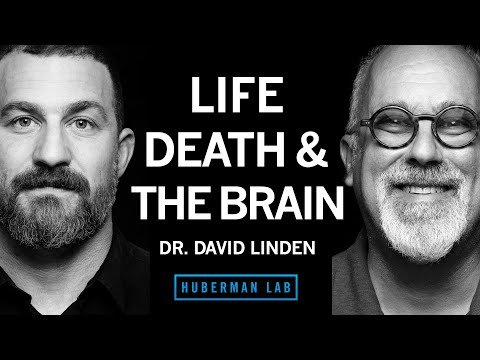
Life, Death & the Neuroscience of Your Unique Experience | Dr. David Linden
Andrew Huberman (host), Dr. David Linden (guest), Narrator
In this episode of Huberman Lab, featuring Andrew Huberman and Dr. David Linden, Life, Death & the Neuroscience of Your Unique Experience | Dr. David Linden explores neuroscientist Faces Mortality, Redefines Individuality, Touch, and Mind–Body Links Andrew Huberman interviews Johns Hopkins neuroscientist Dr. David Linden about the biology of sensual touch, human individuality, mind–body interactions, and Linden’s terminal heart cancer diagnosis. They discuss new findings on genital nerve endings, how genetics, experience, and developmental randomness shape perception and personality, and why the cerebellum is really a prediction machine. Linden explains emerging evidence linking inflammation, immune signals, and depression, and how practices like exercise and possibly meditation may work through concrete biological pathways. In the final third, he details discovering a rare heart cancer, outliving a grim prognosis, and how facing death has sharpened his gratitude, curiosity, and perspective on religion and the human brain’s drive to predict the future.
Neuroscientist Faces Mortality, Redefines Individuality, Touch, and Mind–Body Links
Andrew Huberman interviews Johns Hopkins neuroscientist Dr. David Linden about the biology of sensual touch, human individuality, mind–body interactions, and Linden’s terminal heart cancer diagnosis. They discuss new findings on genital nerve endings, how genetics, experience, and developmental randomness shape perception and personality, and why the cerebellum is really a prediction machine. Linden explains emerging evidence linking inflammation, immune signals, and depression, and how practices like exercise and possibly meditation may work through concrete biological pathways. In the final third, he details discovering a rare heart cancer, outliving a grim prognosis, and how facing death has sharpened his gratitude, curiosity, and perspective on religion and the human brain’s drive to predict the future.
Key Takeaways
The long‑mysterious neural basis of sexual genital sensation is finally being identified.
Krause corpuscles—specialized mechanosensory endings known since 1860 but poorly characterized—have now been shown in mice (Ginty lab preprint) to mediate sexual touch. ...
Get the full analysis with uListen AI
Perception is not a neutral readout of reality; it is inference shaped by genes, culture, and context.
Smell is a prime example: people differ functionally in about 30% of their ~400 odorant receptors. ...
Get the full analysis with uListen AI
Most human traits are co‑determined by genes, experience, and developmental randomness—not by “nature versus nurture.”
Linden argues for replacing “nature vs. ...
Get the full analysis with uListen AI
Heritability estimates are context‑dependent and family environment explains surprisingly little of core personality.
Twin studies and the Minnesota Study of Twins Reared Apart show that Big Five/OCEAN personality traits are ~50% heritable, but shared family environment accounts for almost none of the remaining variance; the rest is unique (non‑shared) experience and developmental noise. ...
Get the full analysis with uListen AI
Mind–body interactions have concrete biological mechanisms involving neurons, hormones, and immune signals.
Signals from body to brain travel via interoceptive nerves and blood‑borne molecules (hormones, cytokines); signals from brain to body travel via neural projections and hormone release. ...
Get the full analysis with uListen AI
The cerebellum is best understood as a prediction engine, not just a movement balancer.
Traditionally linked to motor coordination (gait, reaching, speech), the cerebellum is now known to project via thalamus to frontal and other cortical areas. ...
Get the full analysis with uListen AI
Facing a terminal diagnosis reshaped Linden’s emotional life around simultaneous anger and gratitude and clarified what matters.
Diagnosed in 2020 with a rare synovial sarcoma of the heart and given 6–18 months to live, he underwent harrowing open‑heart surgery, chemo, and radiation. ...
Get the full analysis with uListen AI
Notable Quotes
“Perception is not pure. Perception is inference.”
— David Linden
“Most of the variation in who you are is heritability interacting with experience filtered through the randomness of development.”
— David Linden
“The cerebellum started out for prediction related to motor control, and through evolution that basic computation has been applied to other non‑motor behaviors.”
— David Linden
“When we can’t imagine the world without us in it, then we are forced to concoct stories of the afterlife.”
— David Linden
“For me, the gratitude isn’t about the little things. The gratitude is about the very biggest things.”
— David Linden
Questions Answered in This Episode
You’ve described Krause corpuscles as central to genital sexual sensation in mice. What specific anatomical or functional studies would be needed to determine whether individual differences in these endings actually track with human differences in sexual preference or orgasm difficulty?
Andrew Huberman interviews Johns Hopkins neuroscientist Dr. ...
Get the full analysis with uListen AI
In the case of traits like IQ or height, where heritability collapses under deprivation, how should policymakers and educators realistically use heritability data without either over‑ or under‑stating the role of structural inequalities?
Get the full analysis with uListen AI
Your IL‑17 maternal immune activation example in mice suggests precise timing windows for risk. If we ever mapped comparable windows in humans, what ethical and clinical dilemmas would arise around advising pregnant people about everyday infections or vaccines?
Get the full analysis with uListen AI
You proposed that some cancers’ progression could theoretically be modulated by targeted mental practices via defined neural–immune pathways. If you had unlimited funding, how would you design the first rigorous trial to test a meditation or breathwork protocol against a tumor type with known neural innervation?
Get the full analysis with uListen AI
You emphasized that your deepest sense of loss is about leaving loved ones behind, not your own extinction. How, if at all, has that realization changed the way you mentor students and postdocs, knowing that your scientific “lineage” is another form of continuation?
Get the full analysis with uListen AI
Transcript Preview
(music plays) Welcome to the Huberman Lab Podcast, where we discuss science and science-based tools for everyday life. I'm Andrew Huberman, and I'm a professor of neurobiology and ophthalmology at Stanford School of Medicine. Today my guest is Dr. David Linden. Dr. David Linden is a professor of neuroscience at Johns Hopkins School of Medicine. His laboratory has studied neuroplasticity, that is, how connections in the brain change in response to experience. Much of that work focused on a structure called the cerebellum, which is also sometimes referred to as the mini-brain because it looks like a mini-brain in the bottom and back of the human brain, and it's responsible for an enormous number of basic functions that we use in everyday life, including our motor behavior, that is, our ability to walk and talk, but also dance, play instruments. And it's responsible for an enormous number of basic functions that we use in everyday life, including our sense of balance, our ability to learn new motor behaviors, as well as our sense of timing. Today, we will discuss the cerebellum and what it does, but Dr. David Linden will also teach us about the important sense of touch as well as what makes us different as individuals. The reason today's discussion encompasses so many important topics is that Dr. David Linden's laboratory has focused on many of those topics, and he is also the author of five excellent popular books about neuroscience that focus on, for instance, our sense of pleasure and where it originates from and what controls it in the brain, as well as our sense of touch. And today, we start off our discussion by talking about the recent discovery of a set of neurons that have been known about for a long period of time but that only recently have been characterized that are involved in sensual touch in particular, and it's a fascinating conversation, I assure you. In addition to that, Dr. David Linden informs us about what makes us individuals, how each and every one of us perceives the same things differently, and it's an absolutely fascinating conversation which tells you, for instance, why some of you think a smell is putrid, indeed smells like vomit, whereas others perhaps are not bothered by that smell, and why others still are attracted to that smell or something that you look at or something that you hear. We also talk about nature versus nurture and how we come to be who we are, not just through our genes and epigenetics, but also through our early childhood experience and adult experience. And then in the latter third of our conversation, we shift to talking about the so-called mind/body connection and the science underlying how our thoughts inform our bodily health, or lack thereof, as well as how the organs of our body control the chemicals, hormones, and thoughts within our brain. Then we shift to discussing Dr. David Linden himself and the fact that in 2020 he was diagnosed with a form of heart cancer that led his physicians to tell him that he had six to 12 months to live. Now, obviously because he was in our studio to record this conversation, he has outlived that prognosis, but he lives day-to-day with the knowledge that his death may very well come soon, although it isn't clear exactly when that day will come, of course. He tells us how the initial prognosis of his cancer as well as outliving that prognosis has informed his day-to-day life as well as his thinking and his relationships, and that leads to a very direct and, frankly, emotional conversation that includes advice on how all of us can get the most out of our daily living and out of our overall life. It's an extremely powerful conversation that I believe everyone, regardless of age or health status, can benefit from, and it's one that makes clear that not only is Dr. David Linden a spectacular scientist, but also a spectacular educator, a spectacular popular writer, a spectacular family man, including husband and father and friend to many people and his colleagues, but he is also a courageous and spectacularly generous human being. Before we begin, I'd like to emphasize that this podcast is separate from my teaching and research roles at Stanford. It is, however, part of my desire and effort to bring zero cost to consumer information about science and science-related tools to the general public. In keeping with that theme, I'd like to thank the sponsors of today's podcast. Our first sponsor is ROKA. ROKA makes eyeglasses and sunglasses that are the absolute highest quality. The company was founded by two all-American swimmers from Stanford, and everything about ROKA eyeglasses and sunglasses were designed with performance in mind. I've spent a lifetime working on the biology of the visual system, and I can tell you that your visual system has to contend with an enormous number of challenges in order for you to be able to see clearly. ROKA understands those challenges, and the biology of the visual system such that they design sunglasses and eyeglasses that always allow you to see with crystal clarity. Now initially, ROKA eyeglasses and sunglasses were designed for sports performance, and as a consequence, all of their glasses are designed to be very lightweight and to not slip off your face if you get sweaty. However, the design of the glasses include some that are specifically for sport and others whose aesthetic really allows you to use them for sport as well as out to dinner or to work, et cetera, and that's how I use them. If you'd like to try ROKA eyeglasses and sunglasses, you can go to roka.com, that's R-O-K-A .com, and enter the code Huberman to save 20% off your first order. Again, that's ROKA, R-O-K-A .com and enter the code Huberman at checkout.Today's episode is also brought to us by Levels. Levels is a program that lets you see how different foods and behaviors affect your health by giving you real-time feedback on your diet using a continuous glucose monitor. One of the most important factors impacting your immediate and long-term health is the way that your body manages its blood glucose or sometimes referred to as blood sugar levels. To maintain energy and focus throughout the day, you want to keep your blood glucose steady without big spikes or dips. Using Levels, you can monitor how different types of foods and different food combinations as well as food timing and things like exercise combine to impact your blood glucose levels. I started using Levels a little over a year ago and it gave me a lot of insight into how specific foods were spiking my blood sugar and then leaving me feeling tired for several hours afterwards, as well as how the spacing of exercise and my meals was impacting my overall energy. And in doing so, it really allowed me to optimize how I eat, what I eat, when I exercise, and so on such that my blood glucose levels and energy levels are stable throughout the day. If you're interested in learning more about Levels and trying a continuous glucose monitor yourself, go to levels.link/huberman. Right now, Levels is offering an additional two free months of membership. Again, that's levels.link, L-I-N-K/huberman to get two free months of membership. We are always striving to make the Huberman Lab Podcast better and to that end, we need your help. Over the next month, we are going to be carrying out a survey. The purpose of the survey is to improve the Huberman Lab Podcast according to your feedback. We put together a brief survey to understand what you love about the podcast, hopefully you love a few things at least or maybe just one thing, as well as what you think could be improved, or perhaps the many things that you think could be improved about the Huberman Lab Podcast. Basically what we are asking is to get your feedback so that we can improve any and all things about the Huberman Lab Podcast. The survey does not take long and every single response will be reviewed. As a thank you for completing the survey, we are offering two months free of the Huberman Lab Premium Channel. If you're already a member of the Huberman Lab Premium Channel, do not worry. You will get an additional two free months for carrying out this survey. You can find the link to the survey in the show notes for this podcast episode and on our website hubermanlab.com. So if you would be so kind as to take a few minutes to fill out the survey and help us continue with bringing you the best possible content here at the Huberman Lab Podcast and as always, thank you for your interest in science. And now for my discussion with Dr. David Linden. Professor Linden, welcome.
Install uListen to search the full transcript and get AI-powered insights
Get Full TranscriptGet more from every podcast
AI summaries, searchable transcripts, and fact-checking. Free forever.
Add to Chrome