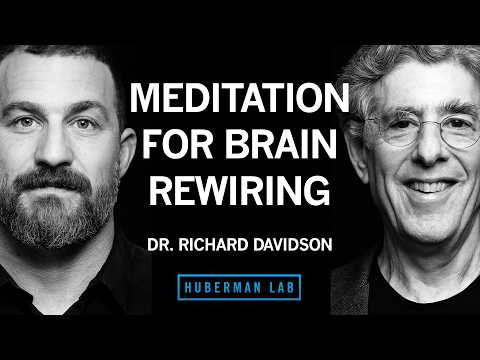
Science-Based Meditation Tools to Improve Your Brain & Health | Dr. Richard Davidson
Dr. Richard Davidson (guest), Andrew Huberman (host)
In this episode of Huberman Lab, featuring Dr. Richard Davidson and Andrew Huberman, Science-Based Meditation Tools to Improve Your Brain & Health | Dr. Richard Davidson explores five-minute daily meditation: measurable brain, mood, and health improvements Davidson distinguishes transient brain ‘states’ from enduring ‘traits,’ arguing repeated states (e.g., meditation) can shift baseline emotional thresholds over time.
Five-minute daily meditation: measurable brain, mood, and health improvements
Davidson distinguishes transient brain ‘states’ from enduring ‘traits,’ arguing repeated states (e.g., meditation) can shift baseline emotional thresholds over time.
Randomized trials show that just 5 minutes/day for ~30 days can reduce stress, anxiety, and depression symptoms, increase flourishing, and even lower inflammatory markers like IL-6.
Meditation is reframed as training meta-awareness—learning to notice mental ‘chaos’ and discomfort (the “lactate of the mind”) without being hijacked by it.
Different meditation types (focused attention, open monitoring, compassion/loving-kindness) engage different neural patterns and goals, so “meditation” should not be treated as a single intervention.
The episode connects meditation to modern challenges—sleep, pain regulation, digital distraction, and self-control—while previewing emerging work combining meditation with sleep-targeted neuromodulation.
Flourishing is presented as learnable and contagious via four pillars—awareness, connection, insight, and purpose—with simple daily practices to cultivate each.
Key Takeaways
Consistency beats intensity for building meditation traits.
Davidson’s core prescription is to choose the smallest daily dose you will actually do—often 5 minutes—and practice every day, because repetition converts state changes into lasting traits.
Get the full analysis with uListen AI
Expect anxiety early; it’s a sign the practice is working.
Beginners often show a reliable first-week increase in anxiety as they notice mental chaos; Davidson likens this discomfort to exercise burn—“the lactate of the mind”—that drives adaptation.
Get the full analysis with uListen AI
Meditation isn’t about clearing the mind; it’s about relating differently to thoughts.
Open monitoring trains awareness of whatever arises (including planning, rumination, sleepiness) without immediately fixing or suppressing it, shifting from ‘doing’ to ‘being’.
Get the full analysis with uListen AI
Meta-awareness is the foundational skill for change and self-control.
Meta-awareness—knowing what your mind is doing (like “waking up” from mindless reading)—is trainable and supported by networks including prefrontal cortex, anterior cingulate, and insula.
Get the full analysis with uListen AI
Brief meditation can produce measurable biological changes.
Davidson reports RCT evidence that 5 minutes/day for ~28–30 days reduces depression/anxiety/stress symptoms, raises flourishing scores, lowers IL-6, and shows brain/connectivity and microbiome changes.
Get the full analysis with uListen AI
Early-stage practice can be done formally or during routine activities.
For beginners, Davidson’s data suggest comparable benefits whether meditating seated or while walking/commuting/dishwashing, reducing friction and improving adherence.
Get the full analysis with uListen AI
Use ‘social zeitgebers’ to lock meditation into daily life.
Pair practices with consistent cues like meals, commuting, or chores (e. ...
Get the full analysis with uListen AI
Compassion practices can change empathy-related brain responses and behavior.
A brief loving-kindness/compassion protocol (loved one → self → stranger → difficult person) is linked to increased temporoparietal junction responses to others’ distress and measurable increases in altruism and reduced implicit bias.
Get the full analysis with uListen AI
Meditation can reduce the emotional suffering around pain more than the raw sensation.
Imaging work distinguishes sensory pain signatures from emotional reactivity; long-term and especially retreat-style practice primarily transforms the secondary, distress-producing response.
Get the full analysis with uListen AI
Flourishing can spread to others through your regulation and presence.
In an RCT with 832 educators using ~5 minutes/day wellbeing training, students taught by trained teachers showed higher standardized math scores—suggesting downstream benefits from calmer, more connected classroom environments.
Get the full analysis with uListen AI
Digital distraction is partly an attention-capture problem that requires ‘no-go’ training.
Davidson emphasizes device presence can impair interactions and cognition, and proposes deliberate phone restraint as a self-control practice; he frames tech as neutral but requiring “digital hygiene.”},{
Get the full analysis with uListen AI
Be cautious about psychedelics for general self-optimization without strong guidance and integration.
Davidson supports psychedelic research for clinical distress (e. ...
Get the full analysis with uListen AI
Notable Quotes
“The after is the before for the next during.”
— Dr. Richard Davidson
“It’s not about getting rid of thoughts… our minds and our brains are built to generate thoughts.”
— Dr. Richard Davidson
“It’s the lactate of the mind.”
— Dr. Richard Davidson
“Undistracted non-meditation… that’s said to be the highest form of meditation.”
— Dr. Richard Davidson
“A wandering mind is an unhappy mind.”
— Dr. Richard Davidson (citing Killingsworth & Gilbert study)
Questions Answered in This Episode
What exactly is the 5-minutes/day practice—focused attention on breath, open monitoring, or a sequence—and how should beginners choose?
Davidson distinguishes transient brain ‘states’ from enduring ‘traits,’ arguing repeated states (e. ...
Get the full analysis with uListen AI
If first-week anxiety is expected, what are the concrete cues that it’s ‘productive lactate’ versus a sign to modify the practice or seek clinical support?
Randomized trials show that just 5 minutes/day for ~30 days can reduce stress, anxiety, and depression symptoms, increase flourishing, and even lower inflammatory markers like IL-6.
Get the full analysis with uListen AI
Which outcomes change fastest with Richie’s 5 (mood, stress reactivity, inflammation, sleep, attention), and what is the typical timeline for each?
Meditation is reframed as training meta-awareness—learning to notice mental ‘chaos’ and discomfort (the “lactate of the mind”) without being hijacked by it.
Get the full analysis with uListen AI
What are the clearest brain-based markers that a meditation ‘state’ is becoming a ‘trait’ (e.g., connectivity changes, default mode regulation, pain reactivity)?
Different meditation types (focused attention, open monitoring, compassion/loving-kindness) engage different neural patterns and goals, so “meditation” should not be treated as a single intervention.
Get the full analysis with uListen AI
How should someone decide between focused attention and open monitoring if their main goal is stress reduction versus creativity versus better relationships?
The episode connects meditation to modern challenges—sleep, pain regulation, digital distraction, and self-control—while previewing emerging work combining meditation with sleep-targeted neuromodulation.
Get the full analysis with uListen AI
Transcript Preview
We actually have really good data on this that at least for beginning meditators, if you do it for thirty days and you do it just five minutes a day, you will see a significant reduction in symptoms of depression, symptoms of anxiety, and symptoms of stress. We've shown that repeatedly in randomized controlled trials. You'll see an increase on measures of well-being or flourishing, and we can talk about what those actually mean. You can even see, just with this amount of practice, a reduction in IL-6. IL-6 is a pro-inflammatory cytokine.
[on-hold music] Welcome to the Huberman Lab Podcast, where we discuss science and science-based tools for everyday life. I'm Andrew Huberman, and I'm a professor of neurobiology and ophthalmology at Stanford School of Medicine. My guest today is Dr. Richie Davidson. Dr. Richie Davidson is a professor of psychology and psychiatry at the University of Wisconsin–Madison. He is a pioneer in the study of how meditation impacts the brain, both during meditations, but also how it changes your brain over time, what we refer to as neuroplasticity. Today, we discuss the incredible health and neuroplasticity benefits that come from regular meditation, including very brief meditations of just five minutes per day. Dr. Davidson also dispels many common myths about meditation. For example, contrary to what most people believe, the point of meditation is not to clear your mind or to feel inner peace during the meditation, but rather to observe your thoughts and any stress you might experience during the meditation. And in doing so, it's kind of like the final hard repetitions of resistance exercise or the burn you might feel during cardio, which comes from lactate. In that sense, the stress you feel during meditation and your ability to observe it acts as a sort of lactate of the mind that in turn makes you adapt. It makes you more stress resilient, focused, and peaceful outside of the meditation. Dr. Davidson also explains how your brain changes during different types of meditation, such as open monitoring meditation or eyes open meditation, walking versus seated, and standing meditations, and more. I've been doing meditation over many years, but this conversation with Dr. Richie Davidson changed my daily routine. Afterwards, I immediately started implementing a five-minute-per-day meditation of the sort that Dr. Davidson describes specifically for stress resilience. And I have to say, it's had a profound impact on my levels of mental clarity, focus, and sleep, and stress, just as he explains. In fact, it's proved to be one of the most beneficial practices I've taken on, especially on days when I wake up with tons to do, a little bit stressed or a lot stressed, and if I didn't sleep quite as well as I would've liked. So today you're going to hear about the incredible science of meditation, the brain and bodily changes that occur, but also how you can rewire your brain using meditation. Dr. Richie Davidson is a true pioneer in this field, being one of the first to bring brain imaging and studies of mindfulness and meditation to the West. He has, of course, authored some of the most impactful research papers on these topics, but also popular books, including a new book coming out later this month entitled Born to Flourish: How to Thrive in a Challenging World, which I myself look forward to reading. Before we begin, I'd like to emphasize that this podcast is separate from my teaching and research roles at Stanford. It is, however, part of my desire and effort to bring zero cost to consumer information about science and science-related tools to the general public. In keeping with that theme, today's episode does include sponsors. And now for my discussion with Dr. Richie Davidson. Dr. Richie Davidson, welcome.
Install uListen to search the full transcript and get AI-powered insights
Get Full TranscriptGet more from every podcast
AI summaries, searchable transcripts, and fact-checking. Free forever.
Add to Chrome