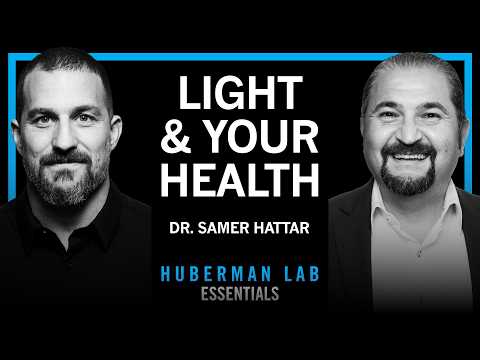
Essentials: Timing Light for Better Sleep, Energy & Mood | Dr. Samer Hattar
Andrew Huberman (host), Samer Hattar (guest)
In this episode of Huberman Lab, featuring Andrew Huberman and Samer Hattar, Essentials: Timing Light for Better Sleep, Energy & Mood | Dr. Samer Hattar explores harness Morning Light: Reset Sleep, Mood, Appetite, and Energy Daily Neuroscientist Dr. Samer Hattar explains how light controls human circadian rhythms, mood, metabolism, and cognition through specialized retinal cells that act independently of conscious vision.
Harness Morning Light: Reset Sleep, Mood, Appetite, and Energy Daily
Neuroscientist Dr. Samer Hattar explains how light controls human circadian rhythms, mood, metabolism, and cognition through specialized retinal cells that act independently of conscious vision.
Morning sunlight aligns our internal clock to exactly 24 hours, stabilizing sleep, mental health, energy, and appetite, while mistimed artificial light can effectively create chronic jet lag without travel.
Hattar presents a “tripartite model” in which sleep homeostasis, circadian timing, and direct environmental/light inputs jointly shape sleep, mood, and behavior—meaning light timing is as crucial as sleep quantity.
He translates this science into practical protocols: daily morning outdoor light, dim and warm/low light at night, regular mealtimes matched to one’s clock, and strategic light avoidance or exposure for jet lag and seasonal mood issues.
Key Takeaways
View bright outdoor light every morning to lock your clock to 24 hours.
Human circadian rhythm averages about 24. ...
Get the full analysis with uListen AI
Keep evenings dim and avoid direct bright light to protect sleep and mood.
After sunset, let light gradually decrease. ...
Get the full analysis with uListen AI
Regular mealtimes, aligned with your active phase, reinforce circadian health and appetite control.
Food timing is a powerful cue for the internal clock. ...
Get the full analysis with uListen AI
Mis-timed light can damage mood and cognition even if sleep length looks “normal.”
Hattar’s Nature paper showed that the timing of light—independent of sleep-wake schedule—can directly alter stress pathways and learning/memory circuits. ...
Get the full analysis with uListen AI
You can be severely jet lagged without flying—by living in misaligned light environments.
Staying indoors, waking late, and using bright screens late into the night can push your internal “day” to start at 11 AM instead of sunrise, making conventional bedtimes feel biologically early. ...
Get the full analysis with uListen AI
To shift time zones or schedules, time your light exposure relative to your *body’s* clock, not the clock on the wall.
Light before your internal temperature minimum (usually ~2 hours before regular wake time) delays your clock; light after that advances it. ...
Get the full analysis with uListen AI
Societal timing (early workdays, daylight saving time) can conflict with biology and magnify sleep and mood issues.
Late chronotypes are often pathologized or discriminated against, yet much of ‘lateness’ may be learned and reinforced by light behavior rather than genes alone. ...
Get the full analysis with uListen AI
Notable Quotes
“Don’t take a pill, take a photon.”
— Dr. Samer Hattar
“You could be severely jet lagged without traveling simply by staying in, being on your phone too much, not getting the sunlight.”
— Dr. Samer Hattar
“The minute they would remove their eyes, they start having cyclical sleep problems… indicating that now they are not entraining to the light-dark cycle.”
— Dr. Samer Hattar
“This system is really about daily. You might want to compensate with some extra time if you miss a day or two.”
— Dr. Samer Hattar
“I really agree with you that I think part of the reason I’m continuing to be able to do this is that I really think about it and I make sure that I keep everything aligned.”
— Dr. Samer Hattar
Questions Answered in This Episode
Given your tripartite model, how would you prioritize interventions for someone who sleeps 7–8 hours but still feels depressed and unfocused: adjust light timing first, sleep schedule, or stress/environmental factors?
Neuroscientist Dr. ...
Get the full analysis with uListen AI
You mentioned that much of ‘late chronotype’ may be shaped by light behavior; what experimental protocol would you recommend to distinguish a truly genetic night owl from someone who’s simply misaligned by habits and screens?
Morning sunlight aligns our internal clock to exactly 24 hours, stabilizing sleep, mental health, energy, and appetite, while mistimed artificial light can effectively create chronic jet lag without travel.
Get the full analysis with uListen AI
In your Nature paper on light, stress, and learning, were there specific wavelengths or intensities of light that were especially harmful or protective for mood and cognition—and how could those findings be translated into practical lighting design at home or work?
Hattar presents a “tripartite model” in which sleep homeostasis, circadian timing, and direct environmental/light inputs jointly shape sleep, mood, and behavior—meaning light timing is as crucial as sleep quantity.
Get the full analysis with uListen AI
For shift workers who must stay awake under bright artificial light at biologically ‘wrong’ times, what concrete lighting and meal-timing strategies would you recommend to minimize long-term metabolic and mental health damage?
He translates this science into practical protocols: daily morning outdoor light, dim and warm/low light at night, regular mealtimes matched to one’s clock, and strategic light avoidance or exposure for jet lag and seasonal mood issues.
Get the full analysis with uListen AI
Your critique of daylight saving time suggests strong biological costs; what specific population-level health outcomes (e.g., cardiovascular events, accidents, depression rates) do you predict would improve most if society abolished clock changes and respected solar time more closely?
Get the full analysis with uListen AI
Transcript Preview
Welcome to Huberman Lab Essentials, where we revisit past episodes for the most potent and actionable science-based tools for mental health, physical health and performance. I'm Andrew Huberman, and I'm a professor of neurobiology and ophthalmology at Stanford School of Medicine. Today, I have the pleasure of introducing Dr. Samer Hattar as my guest on the Huberman Lab Podcast. And now, my conversation with Dr. Samer Hattar. Samer, thanks for sitting down with me.
My pleasure.
You are best known in scientific circles for your work on how light impacts mood, learning, feeding, hunger, sleep, and these sorts of topics. So, maybe you could just wade us into what the relationship is between light and these things like mood and hunger, etc.
Sure. So, I mean, you do appreciate the effect of light for vision. So, when you wake up in a beautiful area, beautiful ocean, light is essential. The sunrise, the sunset. So, that's your conscious perception of light but light has a completely different aspect that is independent of conscious vision and that's how it regulates many important functions in your body. I think the best that is well studied and well known is your circadian clock. And the word circadian comes from the word circa, which is approximate, and Dien is day, so it's an approximate day. Why is it an approximate day? Because if I put you or any other human being who have a normal circadian clock in a constant conditions with no information about feeding time, about sleep time, about what time it is outside, you still have a daily rhythm, but it's not exactly 24 hours, so it will shift out of the solar day because it's not exactly 24 hours and hence the name circadian.
How does that rhythm show up in the tissues of our body?
It shows up at every level that we know and we studied. It shows up at the level of the cell, it shows up at the level of the tissue and it shows up at your behavior. The most obvious for you is your sleep-wake cycle. You sleep and, uh, you're awake and sleep at a 24-hour rhythms. The period length of the sleep rhythm on average is 24.2 hours, so you'll be drifting 0.2 hours every day out of the solar day if you don't get the sunlight.
Oh.
So, this, the sunlight adjusts that approximate day to an exact day, so now your behavior is adjusted to the light-dark environment or the solar day. It's part of the brain that is not consciously driven, so you actually do not know when it happens or when it doesn't happen and that what we'll get into when I tell you why light affects your mood and why sometimes people don't know how to deal with light to improve their mood, for example.
What's the relevance? I mean, why should we care about that short difference?
So, let's do the math. If you shift out 0.2 hours a day, in five days, you're shifting out one hour. So, you're literally one hour off in your social behavior in five days. In 10 days, you're two hours off. And if you're an organism that is living in the wild shifting out of the right phase of the cycle, you could either miss food or you could become food. So, it's really essential for survival. I think it's one of the strongest aspect of survival for animals to have the anticipation and the adjustment to the solar cycle.
Install uListen to search the full transcript and get AI-powered insights
Get Full TranscriptGet more from every podcast
AI summaries, searchable transcripts, and fact-checking. Free forever.
Add to Chrome