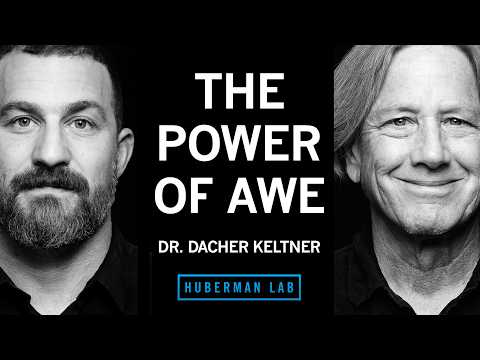
Cultivating Awe & Emotional Connection in Daily Life | Dr. Dacher Keltner
Dr. Dacher Keltner (guest), Andrew Huberman (host)
In this episode of Huberman Lab, featuring Dr. Dacher Keltner and Andrew Huberman, Cultivating Awe & Emotional Connection in Daily Life | Dr. Dacher Keltner explores how awe shapes health, connection, and meaning in modern life Keltner argues awe is measurable and trainable, and is linked to better health markers including reduced inflammation, higher vagal tone, less pain in older adults, and even reduced long COVID symptoms with brief daily exposure.
How awe shapes health, connection, and meaning in modern life
Keltner argues awe is measurable and trainable, and is linked to better health markers including reduced inflammation, higher vagal tone, less pain in older adults, and even reduced long COVID symptoms with brief daily exposure.
The conversation reframes awe as a perceptual and cognitive shift—often from “small to vast” (and back)—that quiets self-focus, changes time perception, and increases prosociality and feelings of belonging.
They review how emotion science has expanded beyond Ekman’s “basic six” faces toward a broader taxonomy (~20 expressions) supported by cross-cultural, large-scale computational analyses of real-world video.
Group experiences—music, sports, mosh pits, martial arts, communal rituals—can synchronize physiology and attention, producing “collective effervescence” and reinforcing identity, values, and cooperation.
They identify major inhibitors of awe (narcissism, chronic self-focus, algorithmic online life) and discuss “awe design” for cities and communities as a practical antidote to loneliness and fragmentation.
Key Takeaways
Awe isn’t ineffable—it’s measurable and reproducible.
Keltner cites identifiable markers such as the “whoa” vocalization, facial expression, goosebumps, vagal tone shifts, and brain network changes (e. ...
Get the full analysis with uListen AI
A reliable trigger for awe is shifting perception from ‘small to vast.’
They repeatedly return to horizon/vista transitions and attentional widening as core mechanics of awe—whether in nature, music, big ideas, or suddenly seeing one’s work as part of something larger.
Get the full analysis with uListen AI
The ‘Awe Walk’ is a simple weekly practice with meaningful outcomes.
Protocol: slow down, deepen breathing, go somewhere novel/surprising, and deliberately alternate attention from small details (leaf, light points, one child’s laugh) to larger patterns (canopy, sky, chorus of laughter). ...
Get the full analysis with uListen AI
Brief daily awe exposure may offer clinically relevant benefits.
Keltner claims even “a minute of awe a day” reduced long COVID symptoms in studied participants, and links awe to reduced inflammation and elevated vagal tone—supporting the idea of ‘prescribing’ nature/music as adjunctive care.
Get the full analysis with uListen AI
Collective experiences can synchronize bodies and minds, amplifying awe.
Concerts, sports events, chanting/dancing, and even mosh pits can align heart rates and neural rhythms, creating fast bonding and a sense of shared identity—Durkheim’s ‘collective effervescence.’
Get the full analysis with uListen AI
Embarrassment and teasing can strengthen groups when they stay playful and inclusive.
Embarrassment signals commitment to shared norms; in Keltner’s fraternity teasing studies, teasing that was humorous and norm-reinforcing (not humiliating) increased liking and made skilled ‘benevolent teasers’ more popular, while bullying functioned to exclude.
Get the full analysis with uListen AI
The biggest awe-killer is chronic self-focus—often reinforced by modern media.
They describe awe as ‘quieting the self’ (Emerson’s ‘all mean egotism vanishes’) and contrast it with environments and substances that intensify me-ness; social media is criticized for shrinking attention, speeding experience, fragmenting memory, and privileging conflict over shared meaning.
Get the full analysis with uListen AI
Notable Quotes
“Awe is good for reduced inflammation, elevated vagal tone, reduced long COVID symptoms… just a minute of awe a day reduce long COVID symptoms.”
— Dr. Dacher Keltner
“We can measure awe really well… the vocalization, ‘whoa,’… the facial expression… vagal tone… goosebumps is a good part of the awe response.”
— Dr. Dacher Keltner
“Standing on the bare ground… all mean egotism vanishes.”
— Dr. Dacher Keltner (quoting Ralph Waldo Emerson)
“What killed the collective of music?… cocaine… ’cause cocaine’s all about me. It’s the me drug.”
— Andrew Huberman
“Words are tattered fragments. They barely touch the real thing.”
— Dr. Dacher Keltner (quoting William James)
Questions Answered in This Episode
What were the exact methods and outcome measures in the ‘one minute of awe a day’ long COVID study (sample size, controls, symptom scales, duration)?
Keltner argues awe is measurable and trainable, and is linked to better health markers including reduced inflammation, higher vagal tone, less pain in older adults, and even reduced long COVID symptoms with brief daily exposure.
Get the full analysis with uListen AI
In your view, which components of awe are causal for health benefits: vagal activation, reduced rumination/default-mode activity, social connection, or the ‘small-to-vast’ perceptual shift?
The conversation reframes awe as a perceptual and cognitive shift—often from “small to vast” (and back)—that quiets self-focus, changes time perception, and increases prosociality and feelings of belonging.
Get the full analysis with uListen AI
How do you operationally distinguish ‘healthy teasing’ from bullying in a way that could be taught to schools, teams, or workplaces? What are the behavioral red lines?
They review how emotion science has expanded beyond Ekman’s “basic six” faces toward a broader taxonomy (~20 expressions) supported by cross-cultural, large-scale computational analyses of real-world video.
Get the full analysis with uListen AI
If 75% of facial-expression patterns overlap across cultures in your large AI-coded dataset, where does the remaining 25% variability show up most—display rules, contexts, or different emotion concepts?
Group experiences—music, sports, mosh pits, martial arts, communal rituals—can synchronize physiology and attention, producing “collective effervescence” and reinforcing identity, values, and cooperation.
Get the full analysis with uListen AI
Huberman’s ‘space-time bridging’ exercise resembles your ‘small-to-vast’ framing—what experiments would you run to test whether the *transition* (small→vast→small) matters more than either state alone?
They identify major inhibitors of awe (narcissism, chronic self-focus, algorithmic online life) and discuss “awe design” for cities and communities as a practical antidote to loneliness and fragmentation.
Get the full analysis with uListen AI
Transcript Preview
Awe is good for reduced inflammation, elevated vagal tone, reduced long COVID symptoms. We have people with long COVID, just a minute of awe a day reduce long COVID symptoms. It's good news, right? And, and there's so much science on it that I just f- now I think medical doctors are starting to think like, "I'm going to prescribe nature. I'll prescribe music through awe," right, um, as a mechanism.
[on-hold music] Welcome to the Huberman Lab Podcast, where we discuss science and science-based tools for everyday life. I'm Andrew Huberman, and I'm a professor of neurobiology and ophthalmology at Stanford School of Medicine. My guest today is Dr. Dacher Keltner. Dr. Dacher Keltner is a professor of psychology and the co-director of the Greater Good Science Center at the University of California, Berkeley. Dacher is an expert in the science of emotions and their role in social dynamics and bonding. Today, we discuss his fascinating work on the science of emotions, including the role of teasing in social bonding, the role of embarrassment in social bonding, and his fascinating work on awe and the things that lead to awe. As he describes, awe is not elusive. It happens when we shift our perception from a very small scale to a very large scale or back again, such as when we suddenly reach a new horizon or visual vista. Today, you'll understand what all of that really means, and more importantly, how you can create this incredible thing that we call awe in everyday life. We also talk about the critical aspect of human bonding in groups and the things that both establish and inhibit deep human bonds. So today is a very practical as well as conceptual conversation that no doubt will change the way that you think about your life every day and think about opportunities for awe every day. As you'll soon see, Dacher Keltner is a truly special scientist, known for his incredible rigor and creativity in the study of emotions, but also continually offering you, the public, ways to be and feel genuinely better and to get more out of life. It was a true honor and pleasure to host him. Before we begin, I'd like to emphasize that this podcast is separate from my teaching and research roles at Stanford. It is, however, part of my desire and effort to bring zero cost to consumer information about science and science-related tools to the general public. In keeping with that theme, today's episode does include sponsors. And now for my discussion with Dr. Dacher Keltner. Dr. Dacher Keltner, welcome.
Good to be with you, Andrew.
Awe.
[chuckles] Yeah.
We all intuitively know what it is, and yet we also don't know how to articulate it.
Yeah.
I want to say the words overwhelmed, excited. I get the physical sensation of a lift.
Yeah.
I don't think anyone ever said the word awe and then collapsed-
No. That's interesting
... into a turtle position.
That's right.
Install uListen to search the full transcript and get AI-powered insights
Get Full TranscriptGet more from every podcast
AI summaries, searchable transcripts, and fact-checking. Free forever.
Add to Chrome