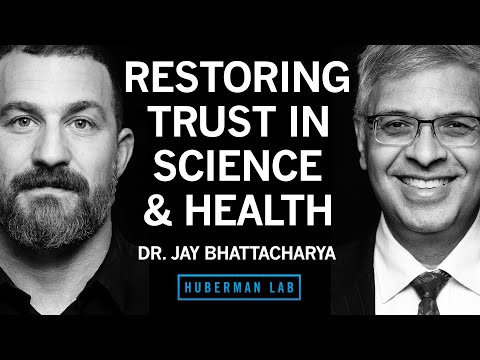
Improving Science & Restoring Trust in Public Health | Dr. Jay Bhattacharya
Dr. Jay Bhattacharya (guest), Andrew Huberman (host), Narrator, Narrator, Narrator
In this episode of Huberman Lab, featuring Dr. Jay Bhattacharya and Andrew Huberman, Improving Science & Restoring Trust in Public Health | Dr. Jay Bhattacharya explores nIH director confronts COVID failures, replication crisis and autism Andrew Huberman interviews Dr. Jay Bhattacharya, newly appointed NIH director, about why U.S. health and life expectancy are stagnating despite massive biomedical investment. Bhattacharya argues that COVID policies—especially lockdowns, school closures, mandates, and censorship—badly damaged public trust and often departed from solid evidence. He outlines a reform agenda for NIH: protecting basic science, funding bolder and earlier‑career work, directly addressing the replication crisis, and creating open, rigorous inquiry into contentious topics like vaccines and autism. Throughout, he emphasizes shifting incentives away from careerism and ideological conformity toward truth-seeking that measurably improves health and longevity for all Americans.
NIH director confronts COVID failures, replication crisis and autism
Andrew Huberman interviews Dr. Jay Bhattacharya, newly appointed NIH director, about why U.S. health and life expectancy are stagnating despite massive biomedical investment. Bhattacharya argues that COVID policies—especially lockdowns, school closures, mandates, and censorship—badly damaged public trust and often departed from solid evidence. He outlines a reform agenda for NIH: protecting basic science, funding bolder and earlier‑career work, directly addressing the replication crisis, and creating open, rigorous inquiry into contentious topics like vaccines and autism. Throughout, he emphasizes shifting incentives away from careerism and ideological conformity toward truth-seeking that measurably improves health and longevity for all Americans.
Key Takeaways
U.S. health outcomes are lagging despite huge NIH investment
American life expectancy has been flat since 2012 and fell sharply during COVID, unlike many European countries and Sweden, indicating that current research and health policy portfolios are not translating into population‑level gains in health and longevity.
Get the full analysis with uListen AI
Basic science will remain central, but incentives must shift toward impact
Bhattacharya insists he will not gut basic research, yet wants NIH funding decisions to emphasize scientific importance and health impact, and to support early‑career, high‑risk projects rather than only safe, incremental work by established labs.
Get the full analysis with uListen AI
The replication crisis stems from incentives, not just bad actors
Most published biomedical findings are likely false or non‑robust, not primarily due to fraud but because scientists are rewarded for volume and citations, not for sharing data, enabling replication, or publishing negative results.
Get the full analysis with uListen AI
NIH will actively fund and publish replication and negative findings
Bhattacharya outlines a plan to create major grants for replication studies, launch a dedicated high‑profile NIH journal for replications and null results, and build metrics that reward pro‑social scientific behaviors like data sharing and cooperation with replication efforts.
Get the full analysis with uListen AI
Lockdowns, school closures, and mandates were poorly evidenced and harmful
He argues evidence by mid‑2020 already showed school closures had little COVID benefit and large educational and mental health harms, particularly for disadvantaged children, and that mandates and censorship of dissent eroded trust while failing to stop spread.
Get the full analysis with uListen AI
COVID vaccines helped some groups but were oversold and misused
Early RCTs showed short‑term reduction in symptomatic infection but were underpowered for mortality and never tested transmission; Bhattacharya supports vaccinating older high‑risk people, but opposes blanket mandates and believes some groups (e. ...
Get the full analysis with uListen AI
NIH will launch a broad, unbiased program on autism causes
Recognizing parental concern and scientific uncertainty, he is creating a major initiative to study autism etiology—across vaccines, environment, prenatal factors, microbiome and more—using rigorous, replicated methods and in partnership with autistic people and their families, without pre‑judging answers.
Get the full analysis with uListen AI
Notable Quotes
““Most of what we think we know from the biomedical literature is probably not true.””
— Jay Bhattacharya
““We essentially turned the unvaccinated into an unclean class as a matter of public policy.””
— Jay Bhattacharya
““If you’re in favor of vaccines, you should not treat them as a religion.””
— Jay Bhattacharya
““Science in the Soviet Union under Lysenko wasn’t science. You couldn’t say Mendelian genetics was real.””
— Jay Bhattacharya
““I would like to make the lives of scientists who disagree with me easier.””
— Jay Bhattacharya
Questions Answered in This Episode
How realistic is Bhattacharya’s plan to change scientific incentives given entrenched academic and funding structures?
Andrew Huberman interviews Dr. ...
Get the full analysis with uListen AI
What concrete metrics could NIH adopt to fairly reward replication work and pro‑social behaviors without gaming?
Get the full analysis with uListen AI
How should policymakers balance urgent public health action with the need for open scientific dissent in a future pandemic?
Get the full analysis with uListen AI
What kinds of study designs and datasets will be necessary to credibly investigate autism’s etiology, including but not limited to vaccines?
Get the full analysis with uListen AI
If U.S. drug prices are equalized with Europe’s, how might that reshape global R&D priorities and access to new therapies over the next decade?
Get the full analysis with uListen AI
Transcript Preview
Since 2012, there's been no increase in American life expectancy. From 2012 to 2019, literally, uh, it was, it was, uh, well not literally, al- almost entirely flat life expectancy a- uh, whereas the European countries have advances in life expectancy during that period. During the pandemic life expectancy dropped very sharply in the United States and only s- just last year did it come back up to 2019 levels. Uh, in Sweden, it, the life expectancy dropped in 2020 for, uh, and then came right back up in, by 2021, 2022 to the previous trend of increasing life expectancy. Whatever those investments we're making as a nation in research are not actually translating into meeting the mission of the NIH, which is to advance health and longevity of the American people.
'Cause they kept saying, "We don't care." And so it's almost like big segments of the public feel like they caught us in something and, as scientists, and we won't admit it. And they're not just pissed off, they're kind of, like, done. They, I hear it all the time. And again, this isn't the health and wellness supplement-taking, you know, uh, you know, anti-woke crowd. This is a big segment of the population that is like, "I don't wanna hear about it. I don't care if labs get funded. I wanna know why we were lied to or the scientific community can't admit fault." I just wanted to land that message for them because in part I'm here for them and get your thoughts on, you know, what you think about, let's start with lockdowns, masks, and vaccines, just to keep it easy, and what do you think the scientific community needs to say in light of those to restore trust?
So first let me just say I don't think I'm the NIH director unless that were true. Unless what you said is true, I'm, uh, otherwise I'm not the NIH director. So I was a very vocal advocate, uh, against the lockdowns, against the mask mandates, against the vaccine mandates, uh, and against the sort of anti-scientific, uh, uh, bent of public health throughout the pandemic. Uh, I've also a- argued that the scientific institutions of this country should, should come clean about our involvement in very dangerous research that potentially caused the pandemic.
The so-called lab leak hypothesis.
Yeah.
Welcome to the Huberman Lab Podcast, where we discuss science and science-based tools for everyday life. (instrumental music plays) I'm Andrew Huberman and I'm a professor of neurobiology and ophthalmology at Stanford School of Medicine. My guest today is Dr. Jay Bhattacharya. Dr. Jay Bhattacharya is a medical doctor and a PhD and the director of the National Institutes of Health. Prior to that, he was a professor of medicine at Stanford University. And I should mention that he did all of his formal academic training at Stanford, his undergraduate, master's, PhD, and medical school training. Today we discuss the past, the present, and the future of publicly funded research in the United States. The National Institutes of Health is considered throughout the world the crown jewel of basic and medical research, explicitly because the basic and clinical research that it has funded has led to more treatments and cures for disease than any other scientific enterprise. Basic research is focused on making discoveries without any particular treatment or disease in mind when that work is done. It is absolutely clear, however, that basic research provides the knowledge base from which all treatments and cures for diseases are eventually made. Today, Dr. Bhattacharya shares his vision of which aspects of NIH are especially effective and which need revising and improvement. We discuss how scientific ideas are evaluated for funding and what can be done to create more funding for more ambitious projects leading to treatments and cures. This is a very timely issue because despite its strength, the NIH has gained a reputation over the last two decades for favoring safer and less bold work, and therefore leading to fewer discoveries. We also discuss what will be done about the so-called replication crisis. The replication crisis is, as the name suggests, the inability for certain findings to be replicated. Dr. Bhattacharya shares with us new initiatives soon to take place that are designed to verify findings early and to incentivize replication so the knowledge base built by NIH science is accurate. As some of you may know, Dr. Bhattacharya stepped into a very public role during the COVID-19 pandemic when he co-authored the so-called Great Barrington Declaration, which argued against lockdowns. He was also quite vocal against mask mandates, and he addressed vaccine efficacy versus safety, especially for young people. Those stances, of course, were very controversial and he explains the logic for his stance on those topics. That discussion leads into a very direct conversation about vaccines more generally, not just COVID-19 vaccines, but also measles, mumps, rubella vaccines, and the very public and controversial issue taking place right now about vaccines and autism. We also discuss drug prices and why Americans pay 10 times or more for the same prescription drugs sold in other countries and the relationship of that to public health. I want to emphasize that the issues we discuss today will impact everybody. If you're a scientist, they certainly impact you. If you're a physician, they impact you. And if you're young, if you're old, if you're a patient, if you're healthy, if you're American or if you're outside the United States, they will impact you. Dr. Bhattacharya was incredibly generous with his time and his answers, directly answering every single question I asked. Nothing was cut. As a consequence, it's a lengthy podcast, but I felt it was very important to get into the nuance of these issues so that you, the listener, can get real clarity on where things stand and where they are headed. As a final point, my graduate student training, my postdoctoral training, and my laboratory, first at the University of California San Diego and then at Stanford where it is now, were funded by the NIH. So you'll notice throughout today's episode that I'm very impassioned by the issues at hand. At the same time, I strive to include questions that I keep hearing from my followers on social media and from listeners of the Huberman Lab Podcast. Some of those come from ardent supporters of the NIH, and others, as you'll see, are more skeptical or even critical of the NIH. I strive to represent all those voices during today's conversation. I certainly have my own opinions and stance on many of those issues and I do voice some of those throughout today's episode, but again, I try to be thorough and broad encompassing. As you'll see, Dr. Bhattacharya cares deeply about basic science and the future of medicine and health in this country and throughout the world. He is our appointed leader in this science discovery public health enterprise and I'm grateful to him for taking the time to share his vision and for his willingness to listen to the many and wide range of voices, including those critical on these literally life-sustaining topics.Before we begin, I'd like to emphasize that this podcast is separate from my teaching and research roles at Stanford. It is, however, part of my desire and effort to bring zero cost to consumer information about science and science-related tools to the general public. In keeping with that theme, this episode does include sponsors. And now for my discussion with Dr. Jay Bhattacharya. Dr. Jay Bhattacharya, welcome.
Install uListen to search the full transcript and get AI-powered insights
Get Full TranscriptGet more from every podcast
AI summaries, searchable transcripts, and fact-checking. Free forever.
Add to Chrome