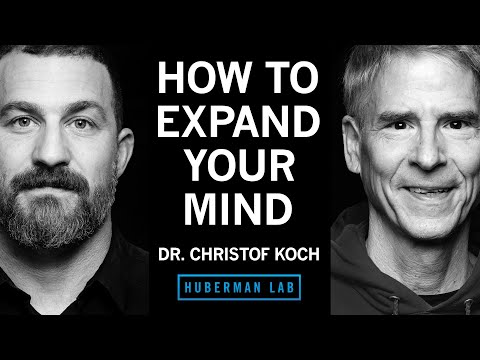
How to Expand Your Consciousness | Dr. Christof Koch
Andrew Huberman (host), Christof Koch (guest), Narrator, Narrator, Narrator
In this episode of Huberman Lab, featuring Andrew Huberman and Christof Koch, How to Expand Your Consciousness | Dr. Christof Koch explores neuroscientist Christof Koch Redefines Consciousness, Self, and Human Possibility Andrew Huberman and Christof Koch explore consciousness from first principles: what it is, how it differs from self-consciousness and behavior, and where in the brain it seems to arise. Koch explains consciousness as the raw fact of experience—seeing, feeling, loving, fearing—rather than thinking or doing, and emphasizes how easily people conflate it with intelligence or self-reflection.
Neuroscientist Christof Koch Redefines Consciousness, Self, and Human Possibility
Andrew Huberman and Christof Koch explore consciousness from first principles: what it is, how it differs from self-consciousness and behavior, and where in the brain it seems to arise. Koch explains consciousness as the raw fact of experience—seeing, feeling, loving, fearing—rather than thinking or doing, and emphasizes how easily people conflate it with intelligence or self-reflection.
They dive into altered states—sleep, dreams, meditation, flow, derealization, and psychedelics—showing how each reveals specific aspects of how mind and brain relate, including that consciousness can exist without a sense of self, space, or time. Koch describes clinical tools that can now detect "covert consciousness" in behaviorally unresponsive patients, with major implications for end-of-life decisions.
Using ideas like the "perception box" and Bayesian priors, they examine how experience, culture, and memory shape our reality and our sense of self, and how targeted experiences (VR, therapy, psychedelics, contemplative practices) can transform those priors. The conversation extends to collective issues—youth mental health, social media, cynicism versus curiosity, AI, and the erosion of shared narratives.
Koch closes with his current metaphysical view, informed by powerful 5-MeO-DMT and mystical experiences: that consciousness is fundamental, the physical may be derivative, and that when we die, our individual persona is lost but consciousness "returns" to a larger mental reality. He argues for a life of curiosity, compassion, and active reshaping of our perception boxes—for personal mental health and the future of society.
Key Takeaways
Consciousness is the fact of experience, not thinking or behavior.
Koch defines consciousness simply as "what it feels like" to see, hear, love, fear, dream, or dread. ...
Get the full analysis with uListen AI
Self-consciousness is only one (important) subset of consciousness and can disappear while consciousness persists.
Most laypeople equate consciousness with being aware of oneself—knowing your name, history, mortality. ...
Get the full analysis with uListen AI
There is now a quantifiable neural “threshold” for human consciousness with major clinical implications.
Using transcranial magnetic stimulation plus high-density EEG, researchers can knock the cortex and measure how complex the brain’s echo response is (Perturbational Complexity Index, PCI, 0–1). ...
Get the full analysis with uListen AI
Your “perception box” and Bayesian priors shape reality—and they are modifiable.
Koch and collaborator Elisabeth Auckock describe each person’s "perception box": the set of priors and interpretive habits built from culture, history, beliefs, and experiences. ...
Get the full analysis with uListen AI
Transforming consciousness and alleviating suffering requires belief in change and deliberate work.
Koch repeatedly emphasizes that people can reshape their outlook—even after trauma, addiction, or long-standing patterns—through therapies (CBT, MDMA-assisted work, AA, contemplative practice, VR, etc. ...
Get the full analysis with uListen AI
Altered states reveal that consciousness doesn’t require self, space, or time.
Koch’s 5-MeO-DMT experience featured complete loss of "Christof," no body, no space, no time—only an intense point of "icy bright" light, terror, and ecstasy. ...
Get the full analysis with uListen AI
Cynicism is psychologically corrosive; curiosity and compassion are protective and pro-plasticity.
They argue that rising cynicism—fueled by social media, political polarization, and the culture of "cancelling" heroes—undermines mental health and capacity for change. ...
Get the full analysis with uListen AI
Notable Quotes
“Without consciousness, you don’t exist for yourself.”
— Christof Koch
“We always live in the gravitational field of planet ego.”
— Christof Koch
“Behavior is not required for consciousness, and consciousness is not required for behavior.”
— Christof Koch
“I died. Christof was gone. There was no voice, no body… only light, terror, and ecstasy.”
— Christof Koch
“In almost every condition, you can change your outlook on life if you really want to.”
— Christof Koch
Questions Answered in This Episode
You described a sharp PCI threshold for consciousness at 0.31—what kinds of cases or states, if any, fall right around that boundary and challenge its reliability (e.g., locked-in syndrome, light anesthesia, severe dementia)?
Andrew Huberman and Christof Koch explore consciousness from first principles: what it is, how it differs from self-consciousness and behavior, and where in the brain it seems to arise. ...
Get the full analysis with uListen AI
In your 5-MeO-DMT experience, you report mind without self, space, or time—what specific neural mechanisms or networks do you think are being suppressed or activated to produce that pure state of "light, terror, and ecstasy"?
They dive into altered states—sleep, dreams, meditation, flow, derealization, and psychedelics—showing how each reveals specific aspects of how mind and brain relate, including that consciousness can exist without a sense of self, space, or time. ...
Get the full analysis with uListen AI
The VR racism experiment profoundly altered Andrew’s perception box in 10 minutes; if you could design a similar high-impact VR protocol to reduce political polarization or moral absolutism, what concrete features would it need?
Using ideas like the "perception box" and Bayesian priors, they examine how experience, culture, and memory shape our reality and our sense of self, and how targeted experiences (VR, therapy, psychedelics, contemplative practices) can transform those priors. ...
Get the full analysis with uListen AI
Given your shift toward idealism after mystical experiences, how would you now reinterpret your earlier work with Francis Crick on the neural correlates of consciousness—do you see it as mapping the hardware of something fundamentally mental?
Koch closes with his current metaphysical view, informed by powerful 5-MeO-DMT and mystical experiences: that consciousness is fundamental, the physical may be derivative, and that when we die, our individual persona is lost but consciousness "returns" to a larger mental reality. ...
Get the full analysis with uListen AI
You warn that cynicism blocks therapeutic change and societal repair; what daily, practical practices do you personally use—or would you prescribe—to cultivate curiosity and resist cynicism in the face of social media, political conflict, and personal setbacks?
Get the full analysis with uListen AI
Transcript Preview
Welcome to the Huberman Lab Podcast, where we discuss science and science-based tools for everyday life. I'm Andrew Huberman, and I'm a professor of neurobiology and ophthalmology at Stanford School of Medicine. My guest today is Dr. Christof Koch. Dr. Christof Koch is a neuroscientist and investigator at the Allen Institute for Brain Science and a chief scientist at the Tiny Blue Dot Foundation. He is considered one of the great pioneers and luminaries of modern neuroscience. Christof's research has spanned how we perceive the world around us, how different states of mind arise and shape our experience of life, and most notably, consciousness. I joined the field of neuroscience way back in the 1990s, and even way back then, Christof's name and his work was considered seminal for our understanding of brain and human experience. And over the subsequent 30 years, he has continued to do incredible, groundbreaking work. Today, we discuss consciousness, what it is, literally, at the level of quantifiable brain mechanisms, and how understanding consciousness at that level can help you experience life more richly and allow you to place deeper meaning on everything from a typical morning, to grief and loss, to your greatest and most awe-inspiring moments. Christof also explains how our individual experiences and memories place us each into a unique, what he calls perception box, which is what shapes your outlook on life, and in many cases, your quality of life, including your mental and physical health. And he explains how you can change your perception box through what we call neuroplasticity, which is the modification of brain circuits. We also discuss what flow states, psychedelics such as DMT and other psychedelics, meditation, sleep, and dreaming tell you about how your mind works and the nature of consciousness. And we don't just discuss consciousness at the level of individuals. We discuss the collective consciousness of humankind. So if you're somebody that's interested in the brain and mind, what it means to be human, how to evolve and improve your mind, today's discussion will address all of that. Oh, and we also discuss dogs, cats, Jennifer Aniston, and the meaning of life. So get ready. This is a very special episode of the Huberman Lab Podcast that I'm certain by the time it finishes will have you thinking differently about your life, and dare I say, with a bit more optimism. Before we begin, I'd like to emphasize that this podcast is separate from my teaching and research roles at Stanford. It is, however, part of my desire and effort to bring zero cost to consumer information about science and science-related tools to the general public. In keeping with that theme, today's episode does include sponsors. And now for my discussion with Dr. Christof Koch. Dr. Christof Koch, welcome.
Thank you for having me, Andrew. It's been a pleasure. It's been a, more than a decade, 12 years since we last interacted.
Yeah. I've always enjoyed our interactions, and one of the reasons is that you're always into something super interesting, big, big questions, and evolving fast all the time, all at once. So, I think most people have heard the word consciousness. They perhaps have pondered consciousness. But, at least to my mind, it's not a very well-defined word. So when you talk about wanting to understand consciousness or about a being having consciousness or being in a moment of consciousness versus say, a rock, which I'm presuming doesn't have consciousness, what are we talking about? And here we could be using biological language, psychological language, or philosophical language. Please include all of it because-
Install uListen to search the full transcript and get AI-powered insights
Get Full TranscriptGet more from every podcast
AI summaries, searchable transcripts, and fact-checking. Free forever.
Add to Chrome