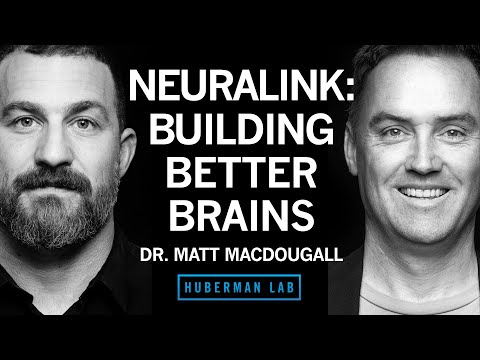
Neuralink & Technologies to Enhance Human Brains | Dr. Matthew MacDougall
Andrew Huberman (host), Dr. Matthew MacDougall (guest)
In this episode of Huberman Lab, featuring Andrew Huberman and Dr. Matthew MacDougall, Neuralink & Technologies to Enhance Human Brains | Dr. Matthew MacDougall explores neuralink’s Surgical Future: Merging Brains, Machines, And Human Potential Andrew Huberman interviews neurosurgeon and Neuralink Head of Neurosurgery Dr. Matthew MacDougall about how brain function, brain surgery, and brain–machine interfaces intersect. MacDougall explains how neurosurgeons understand the brain as modular, fragile, and remarkably plastic, illustrating this with dramatic cases of frontal lobe damage and deep brain lesions. They outline Neuralink’s near‑term clinical mission—restoring digital communication and, eventually, body control to people with spinal cord injury—using ultra‑fine electrodes robotically implanted into motor cortex and, later, spinal cord. The conversation also explores ethical animal research, implanted peripheral devices, long‑term visions of cognitive augmentation and “telepathic” communication, and practical steps people can take to protect and improve brain health.
Neuralink’s Surgical Future: Merging Brains, Machines, And Human Potential
Andrew Huberman interviews neurosurgeon and Neuralink Head of Neurosurgery Dr. Matthew MacDougall about how brain function, brain surgery, and brain–machine interfaces intersect. MacDougall explains how neurosurgeons understand the brain as modular, fragile, and remarkably plastic, illustrating this with dramatic cases of frontal lobe damage and deep brain lesions. They outline Neuralink’s near‑term clinical mission—restoring digital communication and, eventually, body control to people with spinal cord injury—using ultra‑fine electrodes robotically implanted into motor cortex and, later, spinal cord. The conversation also explores ethical animal research, implanted peripheral devices, long‑term visions of cognitive augmentation and “telepathic” communication, and practical steps people can take to protect and improve brain health.
Key Takeaways
Neurosurgeons see the brain as modular: small lesions can erase specific functions.
MacDougall describes patients whose discrete brain damage cleanly removes particular capacities—such as a young man with bilateral frontal lobe damage who permanently lost impulse control. ...
Get the full analysis with uListen AI
Neuralink’s near‑term focus is restoring digital agency to people with paralysis, not superhuman abilities.
The first clinical indication targets people with high‑level spinal cord injuries who are cognitively intact but cannot move their limbs. ...
Get the full analysis with uListen AI
Robots are essential for next‑generation brain implants because human hands are not precise enough.
Neuralink’s implant requires inserting dozens to hundreds of ultra‑fine electrode “threads” around dense surface blood vessels into precise cortical depths. ...
Get the full analysis with uListen AI
Broadly boosting neuroplasticity is likely to come more from pharmacology than from focal stimulation.
MacDougall argues that ‘opening plasticity’ across the brain requires modulating vast numbers of synapses simultaneously, which drugs like classical psychedelics can in principle do via neuromodulators (e. ...
Get the full analysis with uListen AI
High‑bandwidth brain–machine interfaces will rely on adaptive software learning in tandem with human users.
Neuralink trains its decoding algorithms in monkeys by having them play video games for smoothie rewards, achieving record information bit‑rates for cursor control. ...
Get the full analysis with uListen AI
Neuralink’s animal research is constrained, highly monitored, and designed to maximize animal agency.
They use pigs mainly as an anatomical and safety platform (skull and tissue similarity) and monkeys for functional decoding. ...
Get the full analysis with uListen AI
Everyday choices—especially alcohol intake—have large, cumulative effects on brain structure and health.
From clinical experience near San Francisco’s Tenderloin, MacDougall frequently sees brains of chronic heavy drinkers that are dramatically atrophied, “small walnuts inside their empty skulls. ...
Get the full analysis with uListen AI
Notable Quotes
“Thinking about the brain as this three‑pound lump of meat trapped in a prison of the skull, it seems almost magical that it could create a human set of behaviors and a life merely from electrical impulses.”
— Dr. Matthew MacDougall
“Our goal is to place this implant into motor cortex and have that person be able to control a computer as if they had their hands on a mouse and a keyboard, even though they aren’t moving their hands.”
— Dr. Matthew MacDougall
“Humans run out of motor skills sufficient to do this job. We are required, in this case, to lean on robots to do this incredibly precise placement of electrodes into the right area of the brain.”
— Dr. Matthew MacDougall
“Neuralink and I think Tesla and SpaceX before it end up being these blank canvases that people project their hopes and fears onto.”
— Dr. Matthew MacDougall
“We just want to help people. We want to make things better.”
— Dr. Matthew MacDougall
Questions Answered in This Episode
In your spinal cord stimulation roadmap, how specifically do you plan to map complex multi‑joint movements (like walking up stairs) from cortical signals into patterned spinal cord stimulation, and what are the main unsolved decoding challenges there?
Andrew Huberman interviews neurosurgeon and Neuralink Head of Neurosurgery Dr. ...
Get the full analysis with uListen AI
You draw a strong distinction between what pharmacologic agents can do for global plasticity versus focal stimulation—do you see a future where Neuralink explicitly combines implants with psychedelics or other drugs in the same patients, and how would you design those protocols safely?
Get the full analysis with uListen AI
For your high‑bit‑rate monkey cursor control, what kinds of encoding schemes and learning algorithms turned out to be most effective, and did you observe any surprising neural strategies (e.g., using non‑hand areas) that changed your implant targeting plans?
Get the full analysis with uListen AI
You emphasized that animals at Neuralink are never water‑deprived and can opt out of tasks; given that this dramatically slows training compared to standard academic labs, what concrete scientific or engineering advances did you have to make to still achieve record performance under those ethical constraints?
Get the full analysis with uListen AI
On the human augmentation side, how would you prevent or mitigate abuses of direct brain‑to‑brain or AI‑to‑brain communication—such as coercive data extraction, subtle persuasion, or unconsented ‘broadcasting’—and what technical safeguards do you think must be built into Neuralink‑like systems from the outset?
Get the full analysis with uListen AI
Transcript Preview
Welcome to the Huberman Lab podcast, where we discuss science and science-based tools for everyday life. I'm Andrew Huberman, and I'm a professor of neurobiology and ophthalmology at Stanford School of Medicine. Today my guest is Dr. Matthew McDougall. Dr. Matthew McDougall is the head neurosurgeon at Neuralink. Neuralink is a company whose goal is to develop technologies to overcome specific clinical challenges of the brain and nervous system, as well as to improve upon brain design, that is, to improve the way that brains currently function by augmenting memory, by augmenting cognition, and by improving communication between humans and between machines and humans. These are all, of course, tremendous goals, and Neuralink is uniquely poised to accomplish these goals because they are approaching these challenges by combining both existing knowledge of brain function from the fields of neuroscience and neurosurgery with robotics, machine learning, computer science, and the development of novel devices in order to change the ways that human brains work for the better. Today's conversation with Dr. Matthew McDougall is a truly special one because I and many others in science and medicine consider neurosurgeons the astronauts of neuroscience and the brain, that is, they go where others have simply not gone before and are in a position to discover incredibly novel things about how the human brain works because they are literally in there probing, and cutting, stimulating, et cetera, and able to monitor how people's cognition, and behavior, and speech changes as the brain itself is changed structurally and functionally. Today's discussion with Dr. McDougall will teach you how the brain works through the lens of a neurosurgeon. It will also teach you about Neuralink-specific perspective about which challenges of brain function and disease are immediately tractable, which ones they are working on now, that is, as well as where they see the future of augmenting brain function for sake of treating disease and for simply making brains work better. Today's discussion also gets into the realm of devicing the peripheral nervous system. In fact, one thing that you'll learn is that Dr. McDougall has a radio receiver implanted in the periphery of his own body. He did this not to overcome any specific clinical challenge, but to overcome a number of daily everyday life challenges and in some ways to demonstrate the powerful utility of combining novel machines, novel devices with what we call our nervous system and different objects and technologies within the world. I know that might sound a little bit mysterious, but you'll soon learn exactly what I'm referring to, and by the way, he also implanted his family members with similar devices. So while all of this might sound a little bit like science fiction, this is truly science reality. These experiments, both the implantation of specific devices and the attempt to overcome specific movement disorders such as Parkinson's and other disorders of deep brain function, as well as to augment the human brain and make it work far better than it ever has in the course of human evolution, are experiments and things that are happening now at Neuralink. Dr. McDougall also generously takes us under the hood, so to speak, of what's happening at Neuralink, explaining exactly the sorts of experiments that they are doing and have planned, how they are approaching those experiments. We get into an extensive conversation about the utility of animal versus human research in probing brain function, and in devicing and improving the human brain, and in overcoming disease in terms of neurosurgery and Neuralink's goals. By the end of today's episode you will have a much clearer understanding of how human brains work and how they can be improved by robotics and engineering, and you'll have a very clear picture of what Neuralink is doing toward these goals. Dr. McDougall did his medical training at the University of California San Diego and at Stanford University School of Medicine, and of course is now at Neuralink. So he is in a unique stance to teach us about human brain function and dysfunction and to explain to us what the past, present, and future of brain augmentation is really all about. Before we begin, I'd like to emphasize that this podcast is separate from my teaching and research roles at Stanford. It is, however, part of my desire and effort to bring zero cost to consumer information about science and science-related tools to the general public. In keeping with that theme, I'd like to thank the sponsors of today's podcast. Our first sponsor is HVMN Ketone IQ. HVMN Ketone IQ increases blood ketones, and I want to be very clear that I, like most people, have heard of the ketogenic diet, but I, like most people, do not follow a ketogenic diet, that is, I'm not in ketosis. However, most people don't realize that you can still benefit from increasing your blood ketones, which is what HVMN Ketone IQ does. I take Ketone IQ prior to doing really focused cognitive work, so I take it once in the afternoon any time I'm going to prepare for a podcast or do a podcast or if I'm going to, uh, do some research or focus on a grant, anything that requires a high level of cognitive demand, and that's because ketones are the brain's preferred use of fuel even if you're not following a ketogenic diet. If you'd like to try Ketone IQ, you can go to HVMN.com/huberman to save 20% off your order. Again, that's HVMN.com/huberman to save 20%. Today's episode is also brought to us by Levels. Levels is a program that lets you see how different foods and activities affect your health by giving you real-time feedback on your diet using a continuous glucose monitor. Nowadays, there's a lot of excitement about continuous glucose monitors, and Levels allows you to assess how what you eat and what combinations of foods you eat, and exercise, and sleep, and things like alcohol, should you indulge in alcohol and things of that sort, how those impact your blood glucose. Now, it's very important that the cells of your body, and in particular, the cells of your nervous system, not experience levels of blood glucose that are too high or too low, so-called hyperglycemia or hypoglycemia. What Levels allows its users to do is to understand how their specific routines, food intake patterns, exercise, et cetera, impact their blood sugar levels. I, like most people who use Levels, find that there's a lot to learn and a lot to be gained by understanding these blood glucose patterns. If you're interested in learning more about Levels and trying a continuous glucose monitor yourself, you can go to levels.link/huberman. Right now, Levels is offering an additional two free months of membership. Again, that's levels.link, L-I-N-K, /huberman to get two free months of membership. Today's episode is also brought to us by Thesis. Thesis makes custom nootropics, and as many of you have perhaps heard me say before, I am not a fan of the word "nootropics" because it literally means smart drugs, and the brain has neural circuits for focus, it has neural circuits for creativity, it has neural circuits for task switching, it does not have neural circuits for, quote-unquote, "smart drugs."... being smart. Thesis understands this and has designed custom nootropics, each of which is designed to place your brain and body into a specific state ideal for a particular type of work or physical effort such as creativity, or focus, or clarity. If you'd like to try Thesis Nootropics, you simply go to their website, you fill out a brief quiz and they will design a custom starter pack so that you can assess which things work for you more or less well. And then they'll iterate with you over the course of the next few weeks or months to come up with the ideal nootropic kit for your needs. To get your own personalized nootropic starter kit go online to takethesis.com/huberman. You can take that three-minute quiz and they'll send you four different formulas to try in your first month. Again, that's takethesis.com/huberman and use the code Huberman at checkout to get 10% off your first box. And now for my discussion with Dr. Matthew McDougall. Dr. McDougall, welcome.
Install uListen to search the full transcript and get AI-powered insights
Get Full TranscriptGet more from every podcast
AI summaries, searchable transcripts, and fact-checking. Free forever.
Add to Chrome