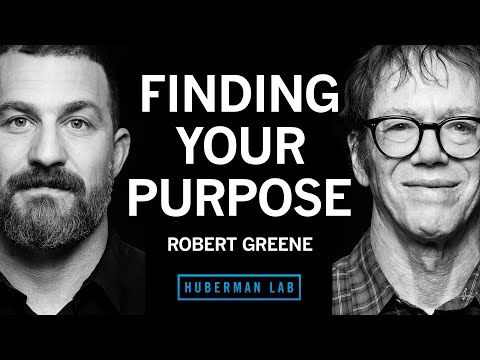
A Process for Finding & Achieving Your Unique Purpose | Robert Greene
Andrew Huberman (host), Robert Greene (guest), Narrator, Narrator, Narrator
In this episode of Huberman Lab, featuring Andrew Huberman and Robert Greene, A Process for Finding & Achieving Your Unique Purpose | Robert Greene explores discovering Purpose, Power, Love, And Self Through Life’s Crucibles Andrew Huberman and author Robert Greene discuss how to identify and pursue one's unique life purpose, grounding it in childhood inclinations, emotional “impulse voices,” and different forms of intelligence. They explore the psychology of power and seduction, emphasizing subtle influence, defenses against manipulation, and the necessity of self-awareness to navigate social dynamics. Greene also introduces his upcoming work on the sublime, love, and the “daemon” (inner voice), contrasting real versus false transcendence and critiquing modern hijackers of attention like social media, pornography, and AI. Finally, Greene shares lessons from his near-fatal stroke, illustrating neuroplasticity, urgency, gratitude, and how proximity to death can radically clarify what truly matters.
Discovering Purpose, Power, Love, And Self Through Life’s Crucibles
Andrew Huberman and author Robert Greene discuss how to identify and pursue one's unique life purpose, grounding it in childhood inclinations, emotional “impulse voices,” and different forms of intelligence. They explore the psychology of power and seduction, emphasizing subtle influence, defenses against manipulation, and the necessity of self-awareness to navigate social dynamics. Greene also introduces his upcoming work on the sublime, love, and the “daemon” (inner voice), contrasting real versus false transcendence and critiquing modern hijackers of attention like social media, pornography, and AI. Finally, Greene shares lessons from his near-fatal stroke, illustrating neuroplasticity, urgency, gratitude, and how proximity to death can radically clarify what truly matters.
Key Takeaways
Your unique purpose is rooted in early, emotional childhood inclinations.
Greene argues that each person is born with a singular “grain” or inclination—toward words, patterns, movement, social interaction, etc. ...
Get the full analysis with uListen AI
Emotional engagement radically accelerates learning and resilience.
Greene contrasts years of formal French study with one month in Paris where he needed the language to relate to his girlfriend and survive daily life; emotional stakes made learning several times faster. ...
Get the full analysis with uListen AI
Cultivate real sublime experiences instead of chasing false transcendence.
In his forthcoming book, Greene defines the sublime as experiences at the threshold of ordinary human limits—near-death, cosmic awe, deep love, profound childhood memories, encounters with animals, history, or the brain itself. ...
Get the full analysis with uListen AI
Power is about realistic influence and defense, not domination.
Greene reframes power as the deeply human need to affect our environment and relationships; feeling powerless is psychologically crushing. ...
Get the full analysis with uListen AI
Seduction is mutual vulnerability and influence, not just trickery.
Greene roots seduction in early experiences: parents “seduce” the child with voice, attention, unpredictability, and story. ...
Get the full analysis with uListen AI
Deep, lasting relationships require convergence in character-level values, not just attraction.
For long-term partnership, Greene emphasizes shared underlying values—toward animals, money, comfort vs. ...
Get the full analysis with uListen AI
Nonverbal communication is a powerful, underused intelligence.
Humans evolved for far longer without language than with it, so our brains are wired to decode expressions, posture, gaze, micro-expressions, and tone. ...
Get the full analysis with uListen AI
Near-death and limitation can radically clarify life, purpose, and time.
Greene’s stroke nearly killed him and left him partially paralyzed on one side. ...
Get the full analysis with uListen AI
Notable Quotes
“When you find that sense of purpose, when you find what I call your life’s task, everything has a direction… It’s actually the most exciting thing that can ever happen to you.”
— Robert Greene
“The real sublime has to come from within. The false sublime comes from outside—drugs, alcohol, shopping, online rage. It feels like transcendence, but it’s not based on anything real, so you need more and more of it.”
— Robert Greene
“We worship technology. What we really should worship is the human brain, which is the greatest creation in the known universe… We’ve barely scratched the surface of what we can use it for.”
— Robert Greene
“Put an army on death ground and it will fight until it wins. You need to put yourself on death ground. You need to feel that barometric pressure, because that’s the reality.”
— Robert Greene
“I totally took my life for granted. I never sat back and thought, ‘Wow, this is wonderful; how grateful it is.’ I tell people: when you’re out walking the dog, think of me. I can’t walk the dog.”
— Robert Greene
Questions Answered in This Episode
You describe a process of ‘archaeology’ to rediscover childhood inclinations—what are the most concrete exercises you’d recommend someone in their 30s or 40s do over a week to start that dig seriously?
Andrew Huberman and author Robert Greene discuss how to identify and pursue one's unique life purpose, grounding it in childhood inclinations, emotional “impulse voices,” and different forms of intelligence. ...
Get the full analysis with uListen AI
In your framework of real vs. false sublime, how would you classify intense experiences from psychedelics or extreme sports—can they ever be truly sublime, or are they inherently counterfeit because they’re externally triggered?
Get the full analysis with uListen AI
When power dynamics are unavoidable in workplaces, what are three specific, observable nonverbal cues that someone is being subtly undermined or outmaneuvered, and how should they respond tactically in the moment?
Get the full analysis with uListen AI
You argue for vulnerability and ‘love sublime’ in an era of hookup culture and porn—what stepwise path would you suggest for a young person who has only known casual, app-based dating to decondition themselves and become capable of deep attachment?
Get the full analysis with uListen AI
Given your concerns about AI dulling our thinking, how would you design an educational curriculum that uses AI minimally but still prepares students for a world in which AI is ubiquitous—what would you absolutely forbid and what would you encourage?
Get the full analysis with uListen AI
Transcript Preview
Welcome to the Huberman Lab Podcast, where we discuss science and science-based tools for everyday life. (instrumental music) I'm Andrew Huberman, and I'm a professor of neurobiology and ophthalmology at Stanford School of Medicine. My guest today is Robert Greene. Robert Greene is an author who has written more than five best-selling books, including The 48 Laws of Power, The Laws of Human Nature, and Mastery. He did his bachelor's training at the University of California, Berkeley, and the University of Wisconsin at Madison. Robert Greene's books are both unique and important for several reasons, not the least of which is that they explore the interaction between the psychology of self, self-exploration, and the psychology of human interaction, all rooted in history and modern culture, and at the same time, in a way that pertains to everybody. I first learned about Robert's work from reading the book Mastery, which, to my mind, is a brilliant exploration and a practical tool for how to think about and pursue one's purpose. Whenever I'm asked for book suggestions, I always include Mastery in my top three recommendations. During today's discussion, we cover a wide range of topics, including how to find and pursue and achieve one's purpose. We talk about the selection of a life partner, as well as romantic and other types of relationships. We also discuss the topics of motivation and urgency, and this concept of deathground, which arose during our discussion of Robert's recent stroke. Robert's stroke rendered him certain limitations, but also has allowed him to explore how to write, how to exercise, indeed, how to interface with life in general in new ways that allow him to continue to expand his sense of purpose. I'm certain that by the end of today's episode, you will have gleaned tremendous amounts of new knowledge that will allow you to navigate forward along the path to your purpose, perhaps find your purpose if you feel you haven't done that yet, as well as to greatly enhance your relationship with yourself, with others, and indeed, to the world around you. Before we begin, I'd like to emphasize that this podcast is separate from my teaching and research roles at Stanford. It is, however, part of my desire and effort to bring zero-cost to consumer information about science and science-related tools to the general public. In keeping with that theme, I'd like to thank the sponsors of today's podcast. Our first sponsor is ROKA. ROKA makes eyeglasses and sunglasses that are of the absolute highest quality. Now, I've spent a lifetime working on the biology of the visual system, and I can tell you that your visual system has to contend with an enormous number of challenges in order for you to be able to see clearly. ROKA understands those challenges and has designed their eyeglasses and sunglasses accordingly so that you always see with crystal clarity. ROKA eyeglasses and sunglasses are designed with a new technology called Float Fit, which allows them to fit perfectly and not move around even when you're active. In fact, whenever I'm wearing my ROKA eyeglasses or sunglasses, I usually forget that I'm wearing them. I happen to wear ROKA eyeglasses at night when I drive or if I'm reading at night, and I wear ROKA sunglasses during the daytime if it's very bright, especially if I'm driving into sunlight. If you'd like to try ROKA eyeglasses or sunglasses, you can go to roka.com, that's R-O-K-A dot-com, and enter the code Huberman for 20% off your first order. Again, that's R-O-K-A dot-com, and enter the code Huberman at checkout. Today's episode is also brought to us by Helix Sleep. Helix Sleep makes mattresses and pillows that are tailored to your unique sleep needs. Now, sleep is the foundation of mental health, physical health, and performance. When we are sleeping well and enough, mental health, physical health, and performance all stand to be at their best. One of the key things to getting a great night's sleep is to make sure that your mattress is tailored to your unique sleep needs. Helix Sleep has a brief two-minute quiz that if you go to their website, you take that quiz and answer questions such as, do you tend to sleep on your back, your side, or your stomach? Do you tend to r-run hot or cold in the middle of the night? Maybe you don't know the answers to those questions, and that's fine. At the end of that two-minute quiz, they will match you to a mattress that's ideal for your sleep needs. I sleep on the Dusk, D-U-S-K, mattress, and when I started sleeping on a Dusk mattress about two years ago, my sleep immediately improved. So if you're interested in upgrading your mattress, go to helixsleep.com/huberman, take their two-minute sleep quiz, and they'll match you to a customized mattress for you. And you'll get up to $350 off any mattress order and two free pillows. Again, if interested, go to helixsleep.com/huberman for up to $350 off and two free pillows. Today's episode is also brought to us by Waking Up. Waking Up is a meditation app that includes hundreds of meditation programs, mindfulness trainings, yoga nidra sessions, and NSDR, non-sleep deep rest, protocols. I started using the Waking Up app a few years ago, because even though I've been doing regular meditation since my teens, and I started doing yoga nidra about a decade ago, my dad mentioned to me that he had found an app, turned out to be the Waking Up app, which could teach you meditations of different durations and that had a lot of different types of meditations to place the brain and body into different states, and that he liked it very much. So, I gave the Waking Up app a try and I, too, found it to be extremely useful, because sometimes I only have a few minutes to meditate, other times I have longer to meditate. And indeed, I love the fact that I can explore different types of meditation to bring about different levels of understanding about consciousness, but also to place my brain and body into lots of different kinds of states depending on which meditation I do. I also love that the Waking Up app has lots of different types of yoga nidra sessions. For those of you who don't know, yoga nidra is a process of lying very still but keeping an active mind. It's very different than most meditations, and there's excellent scientific data to show that yoga nidra and something similar to it, called non-sleep deep rest, or NSDR, can greatly restore levels of cognitive and physical energy, even with just a short 10-minute session. If you'd like to try the Waking Up app, you can go to wakingup.com/huberman and access a free 30-day trial. Again, that's wakingup.com/huberman to access a free 30-day trial. And now for my discussion with Robert Greene. Robert, I'm so happy you're here.
Install uListen to search the full transcript and get AI-powered insights
Get Full TranscriptGet more from every podcast
AI summaries, searchable transcripts, and fact-checking. Free forever.
Add to Chrome