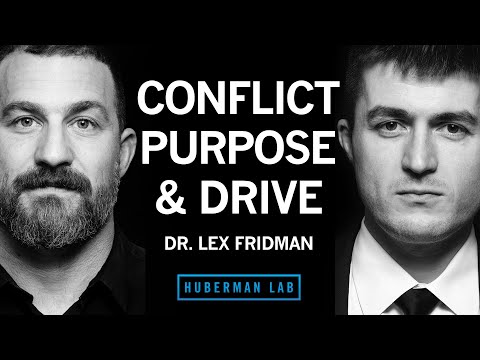
Navigating Conflict, Finding Purpose & Maintaining Drive | Dr Lex Fridman
Andrew Huberman (host), Lex Fridman (guest), Narrator, Narrator
In this episode of Huberman Lab, featuring Andrew Huberman and Lex Fridman, Navigating Conflict, Finding Purpose & Maintaining Drive | Dr Lex Fridman explores lex Fridman On War, Truth, Robots, Love, And Relentless Work Andrew Huberman hosts Lex Fridman for an unusually personal, wide-ranging conversation spanning Lex’s recent time in war‑torn Ukraine, the nature of propaganda and generational hate, and his gratitude for the stability of life in the United States.
Lex Fridman On War, Truth, Robots, Love, And Relentless Work
Andrew Huberman hosts Lex Fridman for an unusually personal, wide-ranging conversation spanning Lex’s recent time in war‑torn Ukraine, the nature of propaganda and generational hate, and his gratitude for the stability of life in the United States.
They discuss how war reshapes what people value, the way information wars now rival physical wars, and why large institutions—from pharma to social media platforms—can do harm even when populated by well‑intentioned individuals.
Lex also reflects on his role as a podcaster and scientist, his long‑standing calling to build social robots and possibly launch an AI company, and offers stark advice to young people about sacrificing their 20s to obsessive hard work.
Throughout, themes of love, loneliness, masculinity, risk, and purpose recur, culminating in Lex reading Robert Frost’s poem about choosing life and unfinished promises, which he uses as his own anchor during dark periods.
Key Takeaways
War exposes what truly matters: people, not possessions.
Lex describes talking with Ukrainian civilians who had lost homes, archives, and entire community histories, yet focused almost exclusively on gratitude that loved ones were still alive. ...
Get the full analysis with uListen AI
Modern war is as much an information war as a kinetic one.
Across Russia, Ukraine, and the West, Lex sees populations convinced they’re seeing through propaganda while in fact being deeply shaped by it. ...
Get the full analysis with uListen AI
Institutions can do harm even when individual insiders are well‑intentioned.
Speaking about Pfizer, NIH scientists, and tech platforms, Lex stresses that most people he meets inside big organizations are smart, conscientious, and genuinely trying to do good. ...
Get the full analysis with uListen AI
Science communication and peer review need to evolve toward openness and speed.
Lex and Andrew critique formal peer review as slow, narrow, and often poorly executed unpaid labor. ...
Get the full analysis with uListen AI
Lex feels a genuine 'calling' to build social robots, not just a passing interest.
Lex describes a lifelong fascination with the 'magic' of connection—initially between humans, and later between humans and machines. ...
Get the full analysis with uListen AI
Pursuing a startup means closing many dopamine 'hatches' and embracing likely failure.
Despite his success and comfort with podcasting and research, Lex says he lacks the 'guts'—so far—to shut down or drastically reduce them to focus on a high‑risk AI/social media startup. ...
Get the full analysis with uListen AI
Lex’s advice to young people: in your 20s, sacrifice and work obsessively on one thing.
Contrary to mainstream work‑life balance advice, Lex urges people in their 20s to choose one pursuit they care deeply about and work harder on it than anything else in their life, accepting that it might 'destroy' them. ...
Get the full analysis with uListen AI
Notable Quotes
“When you lose everything, it makes you realize what really matters, which is the people in your life.”
— Lex Fridman
“War doesn’t just kill people. It creates generational hate.”
— Lex Fridman
“All the people inside a company can be good, and yet the company can be doing evil.”
— Lex Fridman
“In your 20s, find one thing you’re passionate about and work harder at that than you’ve worked at anything else in your life—and if it destroys you, it destroys you.”
— Lex Fridman
“The woods are lovely, dark and deep, but I have promises to keep… and miles to go before I sleep.”
— Lex Fridman (reading Robert Frost)
Questions Answered in This Episode
In Ukraine, when civilians told you they could 'never forgive' Russians, did you ever hear any concrete ideas—from them or officials—for how reconciliation might even be possible two or three generations from now?
Andrew Huberman hosts Lex Fridman for an unusually personal, wide-ranging conversation spanning Lex’s recent time in war‑torn Ukraine, the nature of propaganda and generational hate, and his gratitude for the stability of life in the United States.
Get the full analysis with uListen AI
You’ve said good people inside Pfizer or social media companies can still collectively do harm; if you launched your own AI/social platform, what specific structural safeguards would you implement from day one to avoid repeating those systemic failures?
They discuss how war reshapes what people value, the way information wars now rival physical wars, and why large institutions—from pharma to social media platforms—can do harm even when populated by well‑intentioned individuals.
Get the full analysis with uListen AI
Given your strong advice that people in their 20s should work obsessively on one thing, how do you reconcile that with your own current hesitation to sacrifice podcasting and teaching in order to fully pursue your robotics startup calling?
Lex also reflects on his role as a podcaster and scientist, his long‑standing calling to build social robots and possibly launch an AI company, and offers stark advice to young people about sacrificing their 20s to obsessive hard work.
Get the full analysis with uListen AI
When you consider speaking with figures like Andrew Tate or Donald Trump, where do you personally draw the line between 'difficult but necessary conversations' and guests whose amplification would cause more social harm than insight—what exact criteria would make you say no?
Throughout, themes of love, loneliness, masculinity, risk, and purpose recur, culminating in Lex reading Robert Frost’s poem about choosing life and unfinished promises, which he uses as his own anchor during dark periods.
Get the full analysis with uListen AI
You’ve described the 'magic' you feel around robots and your belief that people will form deep bonds with them; what are the biggest psychological risks you foresee (e.g., attachment, dependence, loneliness), and how would you design those robots and their AI to protect, not exploit, those human vulnerabilities?
Get the full analysis with uListen AI
Transcript Preview
(instrumental music) Welcome to the Huberman Lab Podcast, where we discuss science and science-based tools for everyday life. I'm Andrew Huberman, and I'm a professor of neurobiology and ophthalmology at Stanford School of Medicine. Today my guest is Dr. Lex Fridman. Dr. Lex Fridman is an expert in electrical and computer engineering, artificial intelligence, and robotics. He is also the host of The Lex Fridman Podcast, which initially started as a podcast focused on technology and science of various kinds, including computer science and physics, but rapidly evolved to include guests and other topics as a matter of focus, including sport. For instance, Dr. Lex Fridman is a black belt in Brazilian jiu-jitsu and he's had numerous guests on who come from the fields of Brazilian jiu-jitsu, both from the coaching side and from the competitor side. He also has shown an active interest in topics such as chess and essentially anything that involves intense activation and engagement of the mind and/or body. In fact, The Lex Fridman Podcast has evolved to take on very difficult topics such as mental health, he's had various psychiatrists and other guests on that relate to mental health and mental illness, as well as guests focused on geopolitics and some of the more controversial issues that face our times. He's had comedians, he's had scientists, he's had friends, he's had enemies on his podcast. Lex has a phenomenal, I would say a one in an eight billion ability to find these people, make them comfortable, and in that comfort, both try to understand them and to confront them and to push them so that we all learn. All of which is to say that Lex Fridman is no longer just an accomplished scientist. He certainly is that, but he has also become one of the more preeminent thought leaders on the planet, and if there's anything that really captures the essence of Lex Fridman, it's his love of learning, his desire to share with us the human experience and to broaden that experience so that we all may benefit. In many ways our discussion during today's episode captures the many facets of Lex Fridman, although no conversation, of course, could capture them all. We sit down to the conversation just days after Lex returned from Ukraine, where he deliberately placed himself into the tension of that environment in order to understand the geopolitics of the region and to understand exactly what was happening at the level of the ground and the people there. You may notice that he carries quite a lot of both emotion and knowledge and understanding, and yet in a very classic Lex Fridman way, you'll notice that he's able to zoom out of his own experience around any number of different topics and view them through a variety of lenses so that first of all everyone feel included, but most of all so that everyone learns something new, that is, to gain new perspective. Our discussion also ventures into the waters of social media and how that landscape is changing the way that science and technology are communicated. We also get into the topics of motivation, drive, and purpose, both finding it and executing on that drive and purpose. I should mention that this is episode 100 of the Huberman Lab Podcast, and I would be remiss if I did not tell you that there would be no Huberman Lab Podcast were it not for Lex Fridman. I was a fan of The Lex Fridman Podcast long before I was ever invited onto the podcast as a guest, and after our first recording, Lex was the one that suggested that I start a podcast. He only gave me two pieces of advice. The first piece of advice was, start a podcast, and the second piece of advice was that I not just make it me blabbing into the microphone and staring at the camera. So I can safely say that I at least followed half of his advice and that I am ever grateful for Lex both as a friend, a colleague in science, and now fellow podcaster for making the suggestion that we start this podcast. I already mentioned a few of the topics covered on today's podcast, but I can assure you that there is far more to the person that many of us know as Lex Fridman. If you are somebody interested in artificial intelligence, engineering, or robotics, today's discussion is most certainly for you. And if you are not but you are somebody who is interested in world politics and more importantly the human experience, both the individual and the collective human experience, Lex shares what can only be described as incredible insights into what he views as the human experience and what is optimal in order to derive from our time on this planet. Before we begin, I'd like to emphasize that this podcast is separate from my teaching and research roles at Stanford. It is, however, part of my desire and effort to bring zero-cost-to-consumer information about science and science-related tools to the general public. In keeping with that theme, I'd like to thank the sponsors of today's podcast. Our first sponsor is LMNT. LMNT is an electrolyte drink with everything you need and nothing you don't. That means the electrolytes, sodium, potassium, and magnesium, are in LMNT in the correct ratios, but that it has no sugar. As I mentioned before on the podcast, electrolytes are critical to the function of every cell in the body, and especially the cells in your brain, meaning the neurons or nerve cells. Indeed, the ability for nerve cells to be active and communicate with one another critically depends on sodium, potassium, and magnesium. You can get electrolytes from a variety of sources, but it's often hard to get them in the proper ratios, even from food. So if you're somebody who's exercising a lot and sweating, or if you're somebody following, for instance, a low-carbohydrate or even a semi-low-carbohydrate diet, that will cause you to excrete electrolytes. I tend to have my LMNT first thing in the morning when I wake up, or within the first few hours of waking, any time while or after I'm exercising or I've sweat a lot such as exiting the sauna. If you'd like to try LMNT, you can go to DrinkLMNT, that's L-M-N-T.com/huberman to claim a free LMNT sample pack with your purchase. Again, that's Drink LMNT, L-M-N-T.com/huberman to cla- a free sample pack. Today's episode is also brought to us by Levels. Levels is a program that lets you see how different foods affect your health by giving you real-time feedback on your diet using a continuous glucose monitor. Now blood glucose or blood sugar is a critical aspect of your immediate and long-term health, and indeed, your feelings of vigor and mental clarity and wellbeing at any moment. One of the key things is to know how different foods and food combinations and timing of food intake is impacting blood glucose, and with Levels, you're able to assess all of that in real time.I tried Levels and what it taught me, for instance, was that I can eat certain foods at certain times of day, but if I eat them at other times of day, I get a blood sugar crash. It also taught me, for instance, how to space my exercise and my food intake. Turns out for me, exercising fasted is far more beneficial. That's something I learned using Levels and it's completely transformed not just the spacing and timing of my diet and exercise, but also use of things like the sauna and other activities. It's been a tremendous learning for me that's really shaped an enormous number of factors in my life that have led to me feeling far more vigorous, with far more mental focus and physical strength and endurance. So if you're interested in learning more about Levels and trying a continuous glucose monitor yourself, go to levels.link/huberman. Again, that's levels.link, L-I-N-K, /huberman. Today's episode is also brought to us by Eight Sleep. Eight Sleep makes smart mattress covers with cooling, heating, and sleep tracking capacity. I've talked many times on this podcast about the critical relationship between sleep and body temperature. That is, in order to fall asleep and stay deeply asleep throughout the night, our body temperature needs to drop by about one to three degrees. And conversely, when we wake up in the morning, that is in large part because of our body heating up by one to three degrees. Now, people have different core body temperatures and they tend to run colder or hotter throughout the night. Eight Sleep allows you to adjust the temperature of your sleeping environment so that you have the optimal temperature that gets you the best night's sleep. I started sleeping on an Eight Sleep mattress cover about eight months ago and it has completely transformed my sleep. I sleep so much deeper, I wake up far less during the middle of the night, if at all, and I wake up feeling far better than I ever have, even after the same amount of sleep. If you want to try Eight Sleep, you can go to eightsleep.com/huberman to save up to $400 off their Sleep Fit Holiday Bundle, which includes their new Pod 3 cover. Eight Sleep currently ships in the USA, Canada, United Kingdom, select countries in the EU, and Australia. Again, that's eightsleep.com/huberman. And now for my discussion with Dr. Lex Fridman. Welcome back. (laughs)
Install uListen to search the full transcript and get AI-powered insights
Get Full TranscriptGet more from every podcast
AI summaries, searchable transcripts, and fact-checking. Free forever.
Add to Chrome