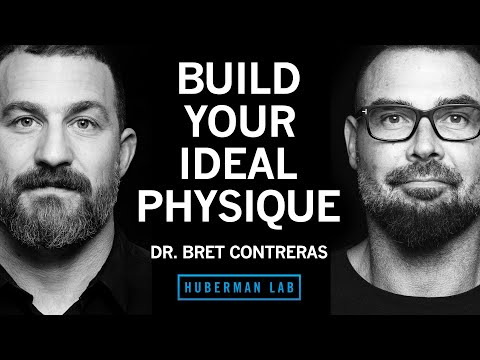
Build Your Ideal Physique | Dr. Bret Contreras
Andrew Huberman (host), Bret Contreras (guest), Narrator
In this episode of Huberman Lab, featuring Andrew Huberman and Bret Contreras, Build Your Ideal Physique | Dr. Bret Contreras explores scientist Glute Guy Reveals Precise Blueprint For Lifelong Muscle Growth Andrew Huberman and Dr. Bret Contreras (“The Glute Guy”) lay out a complete, science-based system for building muscle and strength while staying pain‑free over decades of training.
Scientist Glute Guy Reveals Precise Blueprint For Lifelong Muscle Growth
Andrew Huberman and Dr. Bret Contreras (“The Glute Guy”) lay out a complete, science-based system for building muscle and strength while staying pain‑free over decades of training.
They explain how often to train, how many sets to do, how to apply progressive overload realistically over years, and how to customize programs to emphasize specific body parts—especially glutes—without overtraining.
Contreras details his “rule of thirds” for glute training vectors, how to train 2–3x per week per muscle, how to determine and respect your maximum recoverable volume (MRV), and how to use short specialization phases to fix lagging areas.
They also cover recovery, deloads, genetics, training after 40, pregnancy training, recomping (building muscle while losing fat), and practical solutions for stubborn areas like calves, glutes, and arms.
Key Takeaways
Train Each Muscle At Least Twice Weekly, But Don’t Chase Exhaustion
Beginners can grow on as little as two full‑body sessions per week, with 2–3 hard sets per exercise. ...
Get the full analysis with uListen AI
Progressive Overload Is Non‑Negotiable, But Not Linearly Forever
The primary driver of hypertrophy is progressive overload—placing more tension on a muscle over time via more load or more reps with comparable form and range of motion. ...
Get the full analysis with uListen AI
Respect Your Maximum Recoverable Volume (MRV) To Avoid Spinning Your Wheels
MRV is the highest training volume and effort you can sustain while still getting stronger and growing. ...
Get the full analysis with uListen AI
Use The Glute ‘Rule of Thirds’ For Maximal Shape With Less Leg Growth
The glute max and medius respond best when trained from three vectors: (1) vertical/axial (squats, lunges, split squats, RDLs), which heavily load the stretch but also grow quads and hamstrings; (2) horizontal/anteroposterior (hip thrusts, glute bridges, back extensions, 45° hypers), which emphasize the shortened/squeezed position and cause less damage; and (3) lateral/rotational (seated hip abduction, band abduction, specific glute med variations), which target upper/side glutes with minimal soreness. ...
Get the full analysis with uListen AI
Short Specialization Phases Are The Smart Way To Fix Lagging Muscles
You cannot maximally specialize every muscle at once. ...
Get the full analysis with uListen AI
Mind–Muscle Connection And Form Quality Matter, But So Do Numbers
Contreras emphasizes a “yin and yang” of external and internal focus. ...
Get the full analysis with uListen AI
You Can Grow Muscle While Leaning Out—Huge Bulks And Cuts Are Optional
Contreras’ coaching experience and several studies support “recomping”: building muscle and losing fat simultaneously, especially in beginners, detrained individuals, and people with higher body fat. ...
Get the full analysis with uListen AI
Notable Quotes
“You get so much of your results from the first working set you do. After that, the returns are not linear.”
— Bret Contreras
“If your program is working, you’re getting stronger over time. If you’re not getting stronger, you’re just going through the motions.”
— Bret Contreras
“It’s hard to build muscle. It’s easy to maintain it.”
— Bret Contreras
“Most people don’t fizzle out because their program isn’t optimal. They fizzle out because their training isn’t sustainable for their real life.”
— Bret Contreras
“You can’t grow muscle in an imaginary space. Once you’re lean enough, everyone has hip dips.”
— Bret Contreras
Questions Answered in This Episode
For someone who struggles with recovery but wants to maximize glute growth, how would you specifically structure a 2‑day‑per‑week program using your rule‑of‑thirds approach, including exact exercises and set/rep targets?
Andrew Huberman and Dr. ...
Get the full analysis with uListen AI
You showed that heavy axial lifts like squats and deadlifts are ‘too good’ and can eat up recovery—how would you apply that same idea to upper body programming for someone whose shoulders or elbows are chronically irritated?
They explain how often to train, how many sets to do, how to apply progressive overload realistically over years, and how to customize programs to emphasize specific body parts—especially glutes—without overtraining.
Get the full analysis with uListen AI
In your experience with clients who ‘recomp’ at maintenance calories, what early warning signs suggest someone should temporarily shift into a small surplus or deficit instead of staying at maintenance?
Contreras details his “rule of thirds” for glute training vectors, how to train 2–3x per week per muscle, how to determine and respect your maximum recoverable volume (MRV), and how to use short specialization phases to fix lagging areas.
Get the full analysis with uListen AI
Given the data on extreme high‑volume phases (>30 sets/week) producing additional growth but being unsustainable, how would you safely design a 4‑week glute or arm ‘blast’ for an advanced lifter without pushing them into overuse injury?
They also cover recovery, deloads, genetics, training after 40, pregnancy training, recomping (building muscle while losing fat), and practical solutions for stubborn areas like calves, glutes, and arms.
Get the full analysis with uListen AI
You’ve described strong genetic differences in responsiveness to training (e.g., satellite cell dynamics, recovery genes). If cheap genetic testing became highly accurate for these traits, would you actually change how you coach individuals, or would that risk becoming a self‑fulfilling limitation for so‑called ‘non‑responders’?
Get the full analysis with uListen AI
Transcript Preview
Welcome to the Huberman Lab Podcast, where we discuss science and science-based tools for everyday life. I'm Andrew Huberman, and I'm a professor of neurobiology and ophthalmology at Stanford School of Medicine. My guest today is Dr. Brett Contreras. Dr. Brett Contreras holds a doctorate degree in sports science and is a certified strength and conditioning specialist. He has over three decades of experience training everyday people, athletes, and coaches on how to get stronger and develop larger muscles. These days, Brett is best known as the Glute Guy for his pioneering of exercises for women and men to strengthen and build their glutes in order to be able to move better, prevent and heal pain and injuries, and of course, for aesthetic reasons. Today's discussion is a very important one because anyone interested in their immediate and long-term health needs to resistance train. The science is extremely clear on that. However, there are a lot of questions about how best to resistance train. Today, Brett clarifies how often to resistance train, what movements to do, and how to make continual progress and, in particular, how to build a resistance training program that is tailored to your unique aesthetic and performance goals. For example, we discuss how to prioritize the growth and strengthening of your glutes or arms or shoulders or calves or back, basically whichever body part or parts you need to emphasize while not losing progress in other areas and, in many cases, while still making progress in other areas. We also explain how to gain muscle while getting leaner, why the speed of your weight movements probably matters less than selecting the proper variety of movements to target all parts of a muscle, and Brett explains exactly which movements you should do in each workout to ensure well-rounded development of the various muscle groups including, of course, the glutes. Dr. Brett Contreras is considered one of the most trusted voices in this entire space, and that's because he's highly credentialed, meaning he knows the science inside out. He also has trained thousands of people, and he gets them spectacular results. In fact, the before and afters of his clients are nothing short of extraordinary. So if you currently resistance train or you want to start resistance training and perhaps you're one of those people who's wary about getting too big or you want to just grow one part of your legs and not another or just your glutes but not have larger legs or maybe if you just want to be bigger overall, today Dr. Brett Contreras shares the knowledge that anyone, novice or experienced, can incorporate into their fitness routine to achieve better results faster. Before we begin, I'd like to emphasize that this podcast is separate from my teaching and research roles at Stanford. It is, however, part of my desire and effort to bring zero-cost-to-consumer information about science and science-related tools to the general public. In keeping with that theme, today's episode does include sponsors. And now for my discussion with Dr. Brett Contreras. Dr. Brett Contreras, welcome.
Install uListen to search the full transcript and get AI-powered insights
Get Full TranscriptGet more from every podcast
AI summaries, searchable transcripts, and fact-checking. Free forever.
Add to Chrome