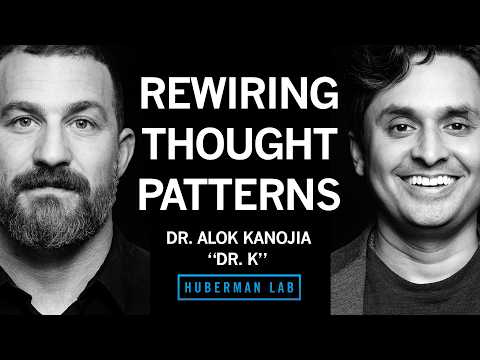
Unlearn Negative Thoughts & Behaviors Patterns | Dr. Alok Kanojia (Healthy Gamer)
Dr. Alok Kanojia (guest), Andrew Huberman (host)
In this episode of Huberman Lab, featuring Dr. Alok Kanojia and Andrew Huberman, Unlearn Negative Thoughts & Behaviors Patterns | Dr. Alok Kanojia (Healthy Gamer) explores rewiring the mind: unlearning ego-driven patterns through contemplative tools, psychology Dr. Alok Kanojia (Dr. K) argues that lasting change comes less from willpower and more from changing underlying tendencies—core beliefs, self-concept, and ego structures—so healthier behaviors become natural rather than forced.
Rewiring the mind: unlearning ego-driven patterns through contemplative tools, psychology
Dr. Alok Kanojia (Dr. K) argues that lasting change comes less from willpower and more from changing underlying tendencies—core beliefs, self-concept, and ego structures—so healthier behaviors become natural rather than forced.
He contrasts Western psychological models (largely inferred from speech/behavior) with Eastern contemplative models built on internal observation, emphasizing practices that help people observe thoughts and loosen identification with emotions and roles.
They connect rising anxiety, mood issues, and social dysfunction to declining distress tolerance and intolerance of uncertainty, amplified by the internet’s arousal-driven engagement loops and comparison culture.
The episode offers practical tools: labeling emotions, cultivating “additional emotions,” Shunya (void) meditation, Yoga Nidra with sankalpa (deep intention), and guidelines for healthier social media use—plus discussion of porn, dating, and emerging AI mental-health risks like sycophancy-driven paranoia/psychosis.
Key Takeaways
Stop fighting behaviors; change the tendency underneath.
Dr. ...
Get the full analysis with uListen AI
Distress tolerance grows through feeling and interpreting emotions—not suppressing them.
He frames distress tolerance as (1) labeling emotions to downshift limbic intensity, (2) cultivating additional emotions/perspectives (positive within negative and caution within positive), and (3) extracting the information/motivation signal in emotion rather than letting it drive behavior.
Get the full analysis with uListen AI
Talking about feelings is not the same as being aware of them.
The episode critiques “therapy speak” as easily hijacked by ego and manipulation (e. ...
Get the full analysis with uListen AI
Ambiguity in social interaction is a feature, not a bug.
Flirting is designed to preserve plausible deniability; neutral observers detect flirting poorly (~20–40%). ...
Get the full analysis with uListen AI
The internet trains the brain on emotional arousal cycles that exhaust and dysregulate us.
Dr. ...
Get the full analysis with uListen AI
Ego is any identity-content after “I am…”; comparison-based goals reliably create suffering.
He defines ego as roles/labels (profession, relationship status, “winner/loser”) and warns that comparison is inherently unsatisfying because the goalposts move—especially on social media where judgment is constant and “danger scanning” locks onto criticism.
Get the full analysis with uListen AI
Shunya (void) practice builds resilience by creating distance from mind and emotion.
Shunya meditation trains attention on “emptiness” (e. ...
Get the full analysis with uListen AI
Samskaras are psychological scar-tissue; Yoga Nidra can ‘edit’ deeper programming.
Samskaras are lingering emotional learnings that once protected but later maladapt (e. ...
Get the full analysis with uListen AI
Affirmations often fail; belief change requires the right state for plasticity.
Both emphasize that repeating phrases is not how neuroplasticity works. ...
Get the full analysis with uListen AI
Healthy social media use depends on timing, state, and standards—not just minutes/day.
He recommends avoiding social media when emotionally vulnerable, and avoiding it near bedtime to prevent missing the ‘sleep window’ (in-bed procrastination). ...
Get the full analysis with uListen AI
Porn risk is shifting from stimulus to relationship: parasocial porn is a new intensity.
Beyond higher-intensity visuals and early exposure, he flags OnlyFans-style interaction as activating social/attachment circuits, escalating into emotional affairs and dependence. ...
Get the full analysis with uListen AI
Many ‘stuck’ young men need understanding, not shame: diagnosis before treatment.
He describes ‘failure to launch’ as often rooted in not knowing how one’s motivation/emotions work. ...
Get the full analysis with uListen AI
Notable Quotes
“Everyone's focused on changing behavior… why not just change the tendency?”
— Dr. Alok Kanojia (Dr. K)
“My job is not to make people feel safe. My job is to make people safe.”
— MIT Chief of Security (as recounted by Dr. K)
“Distress tolerance… is the opposite [of suppression]—it’s accepting your emotions.”
— Dr. Alok Kanojia (Dr. K)
“Ego is anything… when you say, ‘I am dot, dot, dot.’”
— Dr. Alok Kanojia (Dr. K)
“We’ve forgotten what normal people look like.”
— Dr. Alok Kanojia (Dr. K)
Questions Answered in This Episode
Distress tolerance: Can you give a step-by-step example using anger in a relationship—what exact words to use, and how to ‘cultivate additional emotions’ without suppressing the anger?
Dr. ...
Get the full analysis with uListen AI
Shunya practice: What are the main risks (dissociation, depersonalization, anxiety spikes), and who should avoid void-focused meditation or do it only with guidance?
He contrasts Western psychological models (largely inferred from speech/behavior) with Eastern contemplative models built on internal observation, emphasizing practices that help people observe thoughts and loosen identification with emotions and roles.
Get the full analysis with uListen AI
Sankalpa vs affirmations: What markers tell someone they’re in the correct ‘edit mode’ for belief change (Nidra) versus just doing surface repetition?
They connect rising anxiety, mood issues, and social dysfunction to declining distress tolerance and intolerance of uncertainty, amplified by the internet’s arousal-driven engagement loops and comparison culture.
Get the full analysis with uListen AI
Samskaras: How do you distinguish a ‘scar-tissue adaptation’ that should be unlearned from a legitimate protective boundary that should remain?
The episode offers practical tools: labeling emotions, cultivating “additional emotions,” Shunya (void) meditation, Yoga Nidra with sankalpa (deep intention), and guidelines for healthier social media use—plus discussion of porn, dating, and emerging AI mental-health risks like sycophancy-driven paranoia/psychosis.
Get the full analysis with uListen AI
Dating ambiguity: If mixed signals are normal, what are the concrete rules for escalating/withdrawing so you don’t become creepy or overinterpret?
Get the full analysis with uListen AI
Transcript Preview
Everyone's focused on changing behavior. Everyone's focused on increasing willpower to overcome this tendency. And it's like, why not just change the tendency? That sounds so simple, but that's literally what we do in psychotherapy every day when we come in and someone has a narcissistic personality disorder. This is personality. This is who they are. And we can psychotherapize them to be someone else, for their natural thoughts to change, for the way that they see the world to change, for their behaviors to change on its own. It doesn't require... Willpower is necessary when you are trying to not be narcissistic. It is not necessary when you are no longer narcissistic. So we've done it in psychotherapy. We know that if your self-esteem changes, if your sense of being changes, treatment-refractory depression will change. Trauma, PTSD will change.
Welcome to the Huberman Lab Podcast, where we discuss science and science-based tools for everyday life. [music] I'm Andrew Huberman, and I'm a professor of neurobiology and ophthalmology at Stanford School of Medicine. My guest today is Dr. Alok Kanojia, also known as Dr. K. Dr. K is a psychiatrist and online mental health educator. He has a very unique background, having trained and earned his medical degree in the United States, but also having studied as a monk for seven years. Today, we discuss powerful tools for increasing your self-understanding and mental health and for rewiring your nervous system, specifically how you can unlearn unhealthy thought patterns and behaviors and replace them with ones that truly serve you and those around you. Much of today's discussion centers around differences between Eastern and Western concepts of things like the ego and what makes up our self-concept. That portion of the conversation will no doubt have you rethinking why you do what you do in virtually everything, and he provides a roadmap for clearly defining your best goals and for increasing things like your energy and drive, not through hacks, but by tapping into deep intrinsic motivation. In fact, throughout today's episode, Dr. K explains specific practices that you can use to help rewire your nervous system, resolve traumas, and come to a much clearer understanding of how best to apply your efforts in work, school, and relationships. We also discuss social media, dating and relationships, addiction, and pornography. So there are a lot of topics covered. And I have to say, this is a conversation unlike any other that I've had on or off the podcast. Dr. K offers a completely new perspective on how to resolve common struggles that we all face. And in doing so, he offers a lot of practical tools, so this should be a very valuable conversation for anyone wishing to better understand themselves at the theoretical and psychological level, but also who wishes to implement specific tools to improve some or all aspects of their life. Before we begin, I'd like to emphasize that this podcast is separate from my teaching and research roles at Stanford. It is, however, part of my desire and effort to bring zero cost to consumer information about science and science-related tools to the general public. In keeping with that theme, today's episode does include sponsors. And now for my discussion with Dr. Alok Kanojia. Dr. K, welcome.
Install uListen to search the full transcript and get AI-powered insights
Get Full TranscriptGet more from every podcast
AI summaries, searchable transcripts, and fact-checking. Free forever.
Add to Chrome