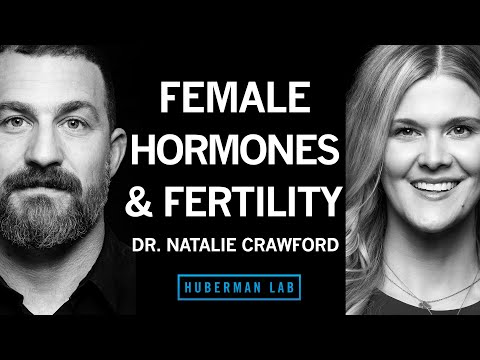
Female Hormone Health, Fertility & Vitality | Dr. Natalie Crawford
Andrew Huberman (host), Dr. Natalie Crawford (guest)
In this episode of Huberman Lab, featuring Andrew Huberman and Dr. Natalie Crawford, Female Hormone Health, Fertility & Vitality | Dr. Natalie Crawford explores mastering Female Fertility: Hormones, Egg Freezing, and Lifelong Health Dr. Andrew Huberman and reproductive endocrinologist Dr. Natalie Crawford present a comprehensive, lifespan overview of female reproductive biology—from fetal development and puberty through fertility, IVF, and menopause.
Mastering Female Fertility: Hormones, Egg Freezing, and Lifelong Health
Dr. Andrew Huberman and reproductive endocrinologist Dr. Natalie Crawford present a comprehensive, lifespan overview of female reproductive biology—from fetal development and puberty through fertility, IVF, and menopause.
They explain how ovarian reserve is established in utero, how eggs are steadily lost regardless of birth control use, and why timing of puberty and cycle patterns matter for fertility but not for the age of menopause.
The conversation demystifies egg freezing and IVF, clarifies major misconceptions about hormonal contraception, and lays out evidence-based guidance on nutrition, supplements, and lifestyle for optimizing egg and sperm quality.
They also cover male factors (testosterone use, heat, cannabis, age), the importance of hormone replacement around menopause, and ethical and technical issues in modern reproductive medicine.
Key Takeaways
Egg loss is constant and egg freezing does NOT deplete your reserve
Females have 6–7 million eggs at ~20 weeks of fetal life and lose them continuously from before birth through menopause. ...
Get the full analysis with uListen AI
Cycle regularity is a critical vital sign of female health and ovarian reserve
A normal cycle ranges roughly 21–35 days, but for any given woman it should be predictably consistent within a few days. ...
Get the full analysis with uListen AI
Hormonal contraception does not cause infertility but can mask problems and distort tests
Combined oral contraceptives (pill) prevent ovulation by suppressing FSH/LH but do not alter the underlying rate of egg loss. ...
Get the full analysis with uListen AI
AMH and antral follicle count are actionable data, even though not ‘officially’ recommended
Anti-Müllerian hormone (AMH) reflects how many follicles are leaving the vault each month and thus indirectly your ovarian reserve. ...
Get the full analysis with uListen AI
Age is the dominant determinant of egg quality; embryo testing improves efficiency
With age, not only does egg number fall, but meiotic spindle integrity deteriorates, causing increasing aneuploidy rates. ...
Get the full analysis with uListen AI
Lifestyle, diet, and key supplements measurably influence egg and sperm quality
Chronic inflammation and toxins (cigarettes, vaping, cannabis, heavy alcohol, highly processed meats, excess added sugar, artificial sweeteners) are consistently linked to poorer sperm and egg quality, higher miscarriage rates, and lower IVF success. ...
Get the full analysis with uListen AI
Male factors are crucial: testosterone, cannabis, heat, and age meaningfully affect sperm
Exogenous testosterone suppresses FSH/LH and can completely halt spermatogenesis; recovery is incomplete in up to 25% of long-term users. ...
Get the full analysis with uListen AI
Notable Quotes
“Your ovaries are on a pathway that you can't change. Those eggs are coming out of the vault regardless of if you're on birth control pills, you're pregnant, or we do IVF.”
— Dr. Natalie Crawford
“Your period is a vital sign. The regularity at which it comes is telling us if your hormones are all communicating in a normal fashion, or if something could potentially be off.”
— Dr. Natalie Crawford
“The recommendation is not to screen for clotting disorders before prescribing the pill… but if anyone in your family has ever had a blood clot, you should 100% get worked up for clotting disorders before taking estrogen.”
— Dr. Natalie Crawford
“Finding out you have low ovarian reserve at a young age is going to cause 'undue stress'—that’s the argument. But it’s actionable stress. You can actually do something about it.”
— Dr. Andrew Huberman
“We want you not just to live longer. We want you to be healthy longer… intervening at menopause with hormone replacement is about quality of life and longevity.”
— Dr. Natalie Crawford
Questions Answered in This Episode
For a woman in her late 20s or early 30s with a seemingly normal 28–30 day cycle, what specific lab values (AMH, FSH, estradiol) and antral follicle count numbers would you consider an early warning that she should accelerate childbearing or seriously consider egg freezing?
Dr. ...
Get the full analysis with uListen AI
You mentioned that long-term pill use can suppress AMH readings by up to 30%. In your clinic, how long do you typically have patients stay off hormonal contraception before retesting AMH and AFC to get a true sense of ovarian reserve?
They explain how ovarian reserve is established in utero, how eggs are steadily lost regardless of birth control use, and why timing of puberty and cycle patterns matter for fertility but not for the age of menopause.
Get the full analysis with uListen AI
For a couple where the male partner has normal semen parameters but high sperm DNA fragmentation, what does your full treatment algorithm look like—from lifestyle/supplement changes to diagnostic workup (e.g., varicocele, infections) to decisions about ICSI, TESE (testicular extraction), or timing of IVF cycles?
The conversation demystifies egg freezing and IVF, clarifies major misconceptions about hormonal contraception, and lays out evidence-based guidance on nutrition, supplements, and lifestyle for optimizing egg and sperm quality.
Get the full analysis with uListen AI
Given the data on earlier menarche, environmental toxins, and increasing rates of low ovarian reserve, what concrete policy or public health changes would you most like to see (e.g., regulating endocrine disruptors, changing OBGYN preventive care guidelines to include routine AMH screening at a certain age)?
They also cover male factors (testosterone use, heat, cannabis, age), the importance of hormone replacement around menopause, and ethical and technical issues in modern reproductive medicine.
Get the full analysis with uListen AI
For a woman entering perimenopause who is hesitant about hormone replacement because of the legacy of the Women’s Health Initiative, how do you practically walk her through an individualized risk–benefit analysis (breast cancer risk, clot risk, cognitive benefits, bone health) and design a starter HRT protocol she can feel comfortable trying?
Get the full analysis with uListen AI
Transcript Preview
(uptempo music) Welcome to the Huberman Lab Podcast, where we discuss science and science-based tools for everyday life. I'm Andrew Huberman, and I'm a professor of neurobiology and ophthalmology at Stanford School of Medicine. My guest today is Dr. Natalie Crawford. Dr. Natalie Crawford is a medical doctor specializing in obstetrics and gynecology, reproductive endocrinology, and infertility. She also holds a degree in nutrition science. Dr. Crawford runs a clinical practice, seeing patients daily, as well as being actively involved in public education, both through social media and through her popular podcast entitled As a Woman. Today, Dr. Crawford teaches us about all aspects of female hormones and hormone health and fertility, beginning as far back as in utero, when we were still in our mother's womb, and extending as far forward as menopause. We discuss topics such as the timing of puberty and what the timing of puberty in girls means for their fertility, and we discuss birth control, both hormonal and non-hormonal forms of birth control, and how birth control may or may not relate to long-term fertility and different aspects of female health. We also talk extensively about measuring fertility, that is, egg count. We also talk about egg retrieval, AKA freezing one's eggs, as well as in vitro fertilization. And we also take a deep dive into the popular and important topics of nutrition and supplementation as they relate to fertility, as they relate to pregnancy, but also how they relate to female hormone health generally. Indeed, Dr. Crawford provides us with a masterclass on female hormones and fertility, one that I know that all women ought to benefit from and that men would benefit from listening to as well. Before we begin, I'd like to emphasize that this podcast is separate from my teaching and research roles at Stanford. It is, however, part of my desire and effort to bring zero-cost-to-consumer information about science and science-related tools to the general public. In keeping with that theme, I'd like to thank the sponsors of today's podcast. Our first sponsor is Maui Nui Venison. Maui Nui Venison is the most nutrient-dense and delicious red meat available. I've spoken before on this podcast, in solo episodes and with guests, about the need to get approximately one gram of high-quality protein per pound of body weight each day for optimal nutrition. Now, there are many different ways that one can do that, but a key thing is to make sure that you're not doing that by ingesting excessive calories. Maui Nui Venison has the highest density of quality protein per calorie, and it achieves that in delicious things like ground meats, venison steaks, jerky, and bone broth. I particularly like the ground venison. I make those into venison burgers probably five times a week or more. I also like the jerky for its convenience, especially when I'm traveling or I'm especially busy with work and know that I'm getting an extremely nutrient-dense, high-quality source of protein. If you'd like to try Maui Nui Venison, you can go to mauinuivenison.com/huberman and get 20% off your first order. Again, that's mauinuivenison.com/huberman to get 20% off. Today's episode is also brought to us by Helix Sleep. Helix Sleep makes mattresses and pillows that are tailored to your unique sleep needs. Now, sleep is the foundation of mental health, physical health, and performance. When we are sleeping well and enough, mental health, physical health, and performance all stand to be at their best. One of the key things to getting a great night's sleep is to make sure that your mattress is tailored to your unique sleep needs. Helix Sleep has a brief two-minute quiz that if you go to their website, you take that quiz and answer questions such as, do you tend to sleep on your back, your side, or your stomach? Do you tend to run hot or cold in the middle of the night? Maybe you don't know the answers to those questions, and that's fine. At the end of that two-minute quiz, they will match you to a mattress that's ideal for your sleep needs. I sleep on the Dusk, D-U-S-K, mattress, and when I started sleeping on a Dusk mattress about two years ago, my sleep immediately improved. So if you're interested in upgrading your mattress, go to helixsleep.com/huberman, take their two-minute sleep quiz, and they'll match you to a customized mattress for you. And you'll get up to $350 off any mattress order and two free pillows. Again, if interested, go to helixsleep.com/huberman for up to $350 off and two free pillows. I'm pleased to announce that we will be hosting four live events in Australia, each of which is entitled The Brain Body Contract, during which I will share science and science-related tools for mental health, physical health, and performance. There will also be a live question-and-answer session. We have limited tickets still available for the event in Melbourne on February 10th, as well as the event in Brisbane on February 24th. Our event in Sydney at the Sydney Opera House sold out very quickly, so as a consequence, we've now scheduled a second event in Sydney at the Aware Super Theatre on February 18th. To access tickets to any of these events, you can go to hubermanlab.com/events and use the code HUBERMAN at checkout. I hope to see you there, and as always, thank you for your interest in science. And now for my discussion with Dr. Natalie Crawford. Dr. Crawford, welcome.
Install uListen to search the full transcript and get AI-powered insights
Get Full TranscriptGet more from every podcast
AI summaries, searchable transcripts, and fact-checking. Free forever.
Add to Chrome