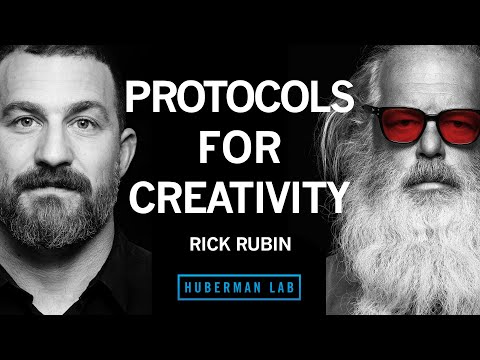
Protocols to Access Creative Energy and Process | Rick Rubin
Andrew Huberman (host), Rick Rubin (guest)
In this episode of Huberman Lab, featuring Andrew Huberman and Rick Rubin, Protocols to Access Creative Energy and Process | Rick Rubin explores rick Rubin Reveals Daily Rituals And Mindsets To Unlock Creativity Andrew Huberman hosts producer Rick Rubin for a highly practical, Q&A-driven deep dive into creativity, process, and daily protocols. Rubin details how breathing, meditation, light exposure, movement, and boundaries support his sensitivity and creative output. He reframes writer’s block, outcome-obsession, and “the industry” as mental constructs that undermine authentic work, emphasizing devotion to the process over results. Across stories of artists from Johnny Cash to the Geto Boys, and topics from diet to wrestling to dreams, Rubin shows creativity as a way of being rather than a technique.
Rick Rubin Reveals Daily Rituals And Mindsets To Unlock Creativity
Andrew Huberman hosts producer Rick Rubin for a highly practical, Q&A-driven deep dive into creativity, process, and daily protocols. Rubin details how breathing, meditation, light exposure, movement, and boundaries support his sensitivity and creative output. He reframes writer’s block, outcome-obsession, and “the industry” as mental constructs that undermine authentic work, emphasizing devotion to the process over results. Across stories of artists from Johnny Cash to the Geto Boys, and topics from diet to wrestling to dreams, Rubin shows creativity as a way of being rather than a technique.
Key Takeaways
Use coherence breathing to improve heart rate variability and emotional regulation.
Rubin practices six breaths per minute (in and out at a slow, even cadence) for 10–20 minutes daily, often with eyes closed. ...
Get the full analysis with uListen AI
Treat creative work like a private diary entry to dissolve writer’s block.
Rubin argues that “blocks” usually come from self‑judgment or fear of others’ judgment, not a lack of ideas. ...
Get the full analysis with uListen AI
Avoid thinking about outcomes while creating; save that for after it’s finished.
Rubin is explicit that focusing on impact, sales, or reception during the creative process undermines the work. ...
Get the full analysis with uListen AI
Engineer your environment—especially light and stimulation—to protect sensitivity and sleep.
Rubin sees himself as unusually sensitive and deliberately designs a “monk-like” life: minimal products, natural foods, lots of sun exposure, wired or even air-tube headphones, and red-lens glasses plus red-only lighting after sunset. ...
Get the full analysis with uListen AI
Let multiple projects compete for ‘universal support’ instead of forcing one through.
Rubin often has many ideas and projects at different stages. ...
Get the full analysis with uListen AI
Separate making art from managing business, money, and industry expectations.
Despite his stature, Rubin avoids the financial/contract side entirely, delegating negotiations and logistics to others. ...
Get the full analysis with uListen AI
Cultivate openness and personal evolution; update your practices as evidence and experience change.
Rubin repeatedly emphasizes that he “knows nothing” and constantly experiments: decades as an unhealthy vegan led him to high-protein omnivory and substantial weight loss; once drawn to the energy of New York, he now prefers jungle/forest quiet; he’s curious (but cautious) about psychedelics. ...
Get the full analysis with uListen AI
Notable Quotes
“There are no blocks. The blocks are all based on dealing with a different force or a different perception that is made up.”
— Rick Rubin
“Everything we make can be a personal reflection of who we are in that moment of time. It doesn’t have to be the greatest you could ever do.”
— Rick Rubin
“The outcome happens… and that part that happens after it is completely out of your control. Putting any energy into that part… is a waste of time.”
— Rick Rubin
“I try to live in as natural a way as possible… I use hardly any products of any kind that aren’t just something that grows or lives on the planet.”
— Rick Rubin
“If someone’s not telling the truth, then each person is experiencing a different understanding of the world. You’re living in two different worlds.”
— Rick Rubin
Questions Answered in This Episode
When you notice a project ‘losing the universe’s support,’ what specific signals or feelings tell you it’s time to pause rather than push through?
Andrew Huberman hosts producer Rick Rubin for a highly practical, Q&A-driven deep dive into creativity, process, and daily protocols. ...
Get the full analysis with uListen AI
You distinguish between horror movies that negatively affect you and extreme or ‘dangerous’ art you produce or support; how do you tell the difference between harmful stimulation and productive discomfort in your own consumption?
Get the full analysis with uListen AI
Your advice is to ignore outcome while creating, yet artists still need to make a living—how do you counsel someone whose financial survival currently depends on algorithm trends and short-form virality?
Get the full analysis with uListen AI
You’ve revised major beliefs before (e.g., on veganism, sun exposure); can you describe a recent instance where you realized a long-held creative belief was wrong and how that changed your practice?
Get the full analysis with uListen AI
If you were to design a minimal, week-long ‘creative reset’ protocol for someone burned out and addicted to their phone, what exact daily structure—light, movement, media, and making—would you prescribe?
Get the full analysis with uListen AI
Transcript Preview
(Upbeat music) Welcome to the Huberman Lab Podcast, where we discuss science and science-based tools for everyday life. I'm Andrew Huberman, and I'm a professor of neurobiology and ophthalmology at Stanford School of Medicine. My guest today is Rick Rubin. Rick Rubin is a world-renowned music producer, having worked with an enormous number of incredible artists, producing, for instance, Red Hot Chili Peppers, Beastie Boys, Jay-Z, Johnny Cash, Adele, Lady Gaga, Tom Petty, and of course, Slayer. This last year, Rick also authored his first book, which is a truly incredible exploration into the creative process. His book is entitled The Creative Act: A Way Of Being. Rick has appeared once before on the Huberman Lab Podcast, and during that appearance, he offered to answer listeners' and viewers' questions. Those questions were put in the comment section on YouTube, and we received thousands of them. So today, Rick answers your questions about the creative process. I also took note of the feedback that when Rick previously appeared on the Huberman Lab Podcast, that perhaps I spoke a bit more than the audience would have preferred. So today, I refrain from speaking too much and try and give as much airtime as possible to Rick in order to directly answer your questions. You'll notice that today's discussion gets really into the practical aspects of the creative process. The most frequent questions that I received for Rick were ones in which people really wanted to understand what his specific process is each and every day as well as when he's producing music or other forms of art. And of course, people wanted to know what they should do specifically, from the time they wake up until the time they go to sleep, even whether or not they should take note of their dreams, et cetera. We get into all of that. So today's discussion is very different from the one I held with Rick previously, and at least to my knowledge, from any of the other interviews or discussions that Rick has had publicly. Before we begin, I'd like to emphasize that this podcast is separate from my teaching and research roles at Stanford. It is, however, part of my desire and effort to bring zero-cost-to-consumer information about science and science-related tools to the general public. In keeping with that theme, I'd like to thank the sponsors of today's podcast. Our first sponsor is Maui Nui Venison. Maui Nui Venison is the most nutrient-dense and delicious red meat available. I've spoken before on this podcast, and there's general consensus that most people should strive to consume approximately one gram of protein per pound of body weight. Now, when one strives to do that, it's important to maximize the quality of that protein intake to the calorie ratio, because you don't want to consume an excess of calories when trying to get that one gram of protein per pound of body weight. Maui Nui Venison has an extremely high-quality protein-to-calorie ratio, so it makes getting that one gram of protein per pound of body weight extremely easy. It's also delicious. Personally, I like the ground venison. I also like the venison steaks. And then for convenience, when I'm on the road, I like the jerky. The jerky is a very high protein-to-calorie ratio, so it has as much as 10 grams of protein per jerky stick, and it has something like only like 55 calories. So again, making it very easy to get enough protein without consuming excess calories. If you would like to try Maui Nui Venison, you can go to mauinuivenison.com/huberman to get 20% off your first order. Again, that's mauinuivenison.com/huberman to get 20% off. Today's episode is also brought to us by Eight Sleep. Eight Sleep makes smart mattress covers with cooling, heating, and sleep tracking capacity. I've spoken many times before on this podcast about the fact that sleep is the foundation of mental health, physical health, and performance. Now, a key component of getting a great night's sleep is that in order to fall and stay deeply asleep, your body temperature actually has to drop by about one to three degrees, and in order to wake up feeling refreshed and energized, your body temperature actually has to increase by about one to three degrees. One of the best ways to make sure that those temperature changes occur at the appropriate times, at the beginning and throughout and at the end of your night when you wake up, is to control the temperature of your sleeping environment. And that's what Eight Sleep allows you to do. It allows you to program the temperature of your mattress and sleeping environment such that you fall and stay deeply asleep easily and wake up each morning feeling incredibly refreshed and energized. I've been sleeping on an Eight Sleep mattress cover for almost three years now, and it has dramatically improved the quality of my sleep, so much so that when I travel and I'm at a hotel or an Airbnb and I don't have access to my Eight Sleep, I very much look forward to getting home because my sleep is always better when I sleep on my Eight Sleep mattress cover. If you'd like to try Eight Sleep, you can go to eightsleep.com/huberman to get $150 off their Pod 3 mattress cover. Eight Sleep currently ships in the USA, Canada, UK, select countries in the EU, and Australia. Again, that's eightsleep.com/huberman. Today's episode is also brought to us by Waking Up. Waking Up is a meditation app that offers hundreds of meditation programs, mindfulness training, and yoga nidra, which is sometimes referred to as NSDR. I'm a longtime fan of meditation. I started meditating when I was back in my teens, and I started doing a daily 10 or 20-minute meditation. And I kept that up for a number of years, but then it became more sporadic, and then eventually I stopped, and then I'd start again, and then I'd stop. What I found with the Waking Up app is that it makes it very easy to take on a meditation practice and to do meditation, if not every day, very close to every day. And that, we know, based on a lot of research, has an outsized positive effect on everything from stress regulation to sleep. You come up with better ideas, so indeed, meditation can make you more creative, more focused, and on and on. And then about 10 years ago, I got introduced to yoga nidra or NSDR, non-sleep deep rest, which is a practice of laying completely still while keeping the mind very active. So you're relaxing but keeping your mind active. And I use NSDR essentially every single day. I'll do it anywhere from 10 to 30 minutes, and I find it to be incredibly restorative. It really resets my ability to think and to engage in physical activity. And with Waking Up, I can select different lengths of meditations, different lengths of yoga nidras or NSDRs so that I keep up my practice. If you'd like to try Waking Up, you can go to wakingup.com/huberman to try a completely free 30-day trial. Again, that's wakingup.com/huberman to try a free 30-day trial.And now for my discussion about protocols for creativity with Rick Rubin. Rick Rubin, welcome back.
Install uListen to search the full transcript and get AI-powered insights
Get Full TranscriptGet more from every podcast
AI summaries, searchable transcripts, and fact-checking. Free forever.
Add to Chrome