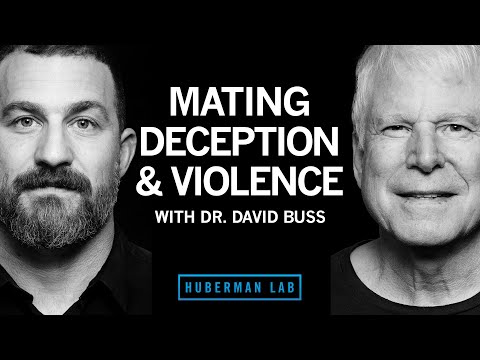
How Humans Select & Keep Romantic Partners in Short & Long Term | Dr. David Buss
Andrew Huberman (host), David Buss (guest)
In this episode of Huberman Lab, featuring Andrew Huberman and David Buss, How Humans Select & Keep Romantic Partners in Short & Long Term | Dr. David Buss explores evolutionary Rules Behind Love, Lust, Cheating, and Jealousy Revealed Andrew Huberman interviews evolutionary psychologist Dr. David Buss about the deep evolutionary logic underlying human mating: how we choose partners, why we cheat, and how jealousy and violence can emerge. They distinguish short‑term versus long‑term mating strategies and outline what men and women reliably prioritize in each. Buss explains universal patterns (status, resources, youth, physical attractiveness, kindness, emotional stability) alongside cultural variation and modern distortions from online dating and pornography. The conversation also covers infidelity motives, stalking, intimate partner violence, dark‑triad traits, and how to make wiser, more stable mate choices.
Evolutionary Rules Behind Love, Lust, Cheating, and Jealousy Revealed
Andrew Huberman interviews evolutionary psychologist Dr. David Buss about the deep evolutionary logic underlying human mating: how we choose partners, why we cheat, and how jealousy and violence can emerge. They distinguish short‑term versus long‑term mating strategies and outline what men and women reliably prioritize in each. Buss explains universal patterns (status, resources, youth, physical attractiveness, kindness, emotional stability) alongside cultural variation and modern distortions from online dating and pornography. The conversation also covers infidelity motives, stalking, intimate partner violence, dark‑triad traits, and how to make wiser, more stable mate choices.
Key Takeaways
Long‑term and short‑term mating activate different preference profiles.
For long‑term partners, both sexes strongly value intelligence, kindness, mutual attraction/love, health, dependability, and emotional stability. ...
Get the full analysis with uListen AI
Status and the “attention structure” are central to mate value.
Status—who commands attention from others—shapes both attractiveness and competition. ...
Get the full analysis with uListen AI
Deception in mating is targeted to what the other sex wants.
On dating apps, men typically inflate income (~20%) and height (~2 inches), while women underreport weight (~15 pounds) and use flattering/older photos. ...
Get the full analysis with uListen AI
Male and female infidelity are common but driven by different motives.
Kinsey‑era data (imperfect but indicative) suggest roughly a quarter of married women and about half of married men have been unfaithful at least once. ...
Get the full analysis with uListen AI
Jealousy is an evolved mate‑retention system, not mere pathology.
Once long‑term pair‑bonding evolves, there must be mechanisms to defend investments. ...
Get the full analysis with uListen AI
Dark Triad personalities drive disproportionate sexual harm.
Narcissism (grandiosity, entitlement), Machiavellianism (manipulative exploitation), and psychopathy (low empathy) often cluster in a subset of mostly men. ...
Get the full analysis with uListen AI
Modern cultural innovations both exploit and channel evolved drives.
Online dating amplifies visual cues and opportunities for deception while stripping ancestral context (shared networks, reputational knowledge). ...
Get the full analysis with uListen AI
Notable Quotes
“Jealousy is an evolved emotion that serves several adaptive functions… once you have the evolution of long‑term mating, you need a defense to preserve the investment you’ve made.”
— David Buss
“It’s not just that men are these superficial creatures who evaluate women on the basis of appearance. There is an underlying logic to why they do so.”
— David Buss
“Successful deception is facilitated by self‑deception. If you really believe you’re a ten in mate value, you’ll be more successful convincing other people that you are.”
— David Buss
“Most of the time [stalking] doesn’t work, but one of the scariest things is that sometimes it does.”
— David Buss
“We can’t change our evolved sexual psychology. What we can do is activate certain elements of it and keep others quiescent.”
— David Buss
Questions Answered in This Episode
For women who are dissatisfied in a long‑term relationship but don’t want to pursue affairs, what evidence‑based strategies best support either improving the current relationship or making a clean, low‑conflict exit?
Andrew Huberman interviews evolutionary psychologist Dr. ...
Get the full analysis with uListen AI
Given the powerful role of the ‘attention structure’ in status and attraction, how can individuals in low‑visibility careers ethically increase their perceived status without resorting to dark‑triad style manipulation?
Get the full analysis with uListen AI
Your mate‑switching hypothesis for female infidelity challenges the popular dual‑mating narrative; what specific new data (e.g., large‑scale genetic or ovulatory‑shift studies) would be most decisive in testing between these models?
Get the full analysis with uListen AI
How can someone practically distinguish between normal protective jealousy and early warning signs of dangerous controlling behavior that may escalate toward intimate partner violence?
Get the full analysis with uListen AI
If modern pornography is rewiring some men’s arousal toward consumption rather than participation, what concrete interventions—behavioral, social, or technological—do you think are most realistic for helping them reorient to real‑world partners?
Get the full analysis with uListen AI
Transcript Preview
(uptempo music) Welcome to the Huberman Lab Podcast, where we discuss science and science-based tools for everyday life. I'm Andrew Huberman, and I'm a professor of neurobiology and ophthalmology at Stanford School of Medicine. My guest today is Dr. David Buss. Dr. Buss is a professor of psychology at the University of Texas Austin, and he is one of the founding members and luminaries in the field of evolutionary psychology. Dr. Buss's laboratory is responsible for understanding the strategies that humans use to select mates in the short and long term, and he is an expert in sex differences in mating strategy. His laboratory has explored, for instance, why women cheat on their spouses or their long-term partners, as well as why men tend to cheat on their spouses and long-term partners. He's also explored a number of things related to the courtship dance that we call dating and securing a mate, including the use of deception related to proclamations of love, or promises of finances or sexual activity. Dr. Buss's laboratory has also evaluated how status is assessed, meaning how we evaluate our own worth and our potential as a mate, and who is, let's just say, within range of a potential mate, both in the short and long term. For instance, today we talk about how people don't just make direct assessments of their own and other people's value as a potential mate, but also using the assessments of others to indirectly determine whether or not they stand a chance or not in securing somebody as a short or long-term mate. His laboratory has also focused on some of the complicated and varied emotions related to mating, love, and relationships, such as lust and jealousy. And he's extensively explored something called mate poaching, or the various strategies that men and women use to make sure that the person that they want to be with or the person they are with is not with anyone else or seeking anyone else and, indeed, that other people don't seek their mate. Dr. Buss's work also relates to how biological influences such as ovulation or time within the menstrual cycle influences mate selection or tendency to have sex or not with a potential short or long-term mate. And more recent work from Dr. Buss's laboratory focuses on the darker aspects of mating and sexual behavior in humans, including stalking and sexual violence. Today, we discuss all those topics. We also discuss some of the strategies that humans can use to make healthy mate selection choices and, for those that are already in committed relationships, to ensure healthy progression of those committed relationships. In addition to publishing dozens of landmark scientific studies, Dr. Buss has authored many important books. A few of those include The Evolution of Desire and Why Women Have Sex. And his most recent book is the one that I'm reading now, which is called When Men Behave Badly: The Hidden Roots of Sexual Deception, Harassment, and Assault, and it's an absolutely fascinating read. It has endorsements from Dr. Robert Sapolsky, professor at Stanford, who's been on this podcast as a guest before, as well as Steven Pinker and Jonathan Haidt, who wrote The Coddling of the American Mind. It's a really important book, I believe, and one that doesn't just get into the darker aspects of human mating behavior and violence, but also strategies that people can take to ensure healthy mating behavior and relationships. There's so much rumor, speculation, and outright fabrication of ideas about why humans select particular mates in the short and long term, what men and women do differently, and so on. What I love about Dr. Buss's work is that it's grounded in laboratory studies that are highly quantitative using rigorous statistics, and so throughout today's discussion you'll notice that I'm rapt with attention, trying to extract as much information as I can from Dr. Buss about the real science of human mate selection and mating strategy. I'm certain that everyone will take away extremely valuable knowledge that they can use in existing or future relationships from this discussion with Dr. Buss. Before we begin, I'd like to emphasize that this podcast is separate from my teaching and research roles at Stanford. It is, however, part of my desire and effort to bring zero-cost-to-consumer information about science and science-related tools to the general public. In keeping with that theme, I'd like to thank the sponsors of today's podcast. Our first sponsor is ROKA. ROKA makes eyeglasses and sunglasses that are of the absolute highest quality. I've spent a lifetime working on the visual system, and I can tell you that the cells and connections of our brain and visual system have to contend with an enormous number of challenges in order to see clearly. For instance, when you go from a brightly lit environment to a dimmer environment or into a shadow, your visual system has to adjust. The problem with a lot of sunglasses and eyeglasses out there is that they don't work well with those adjustments. ROKA has overcome those challenges, and as a consequence, no matter what environment you're in, you see with crystal clarity. ROKA eyeglasses and sunglasses are also terrific because they are extremely lightweight, so you don't even notice that they're on your face. And they can be worn when working or for school or just walking about, but also when running or cycling, and indeed, if you get sweaty, they won't slip off your face. That's a terrific feature. But they can be worn to do anything. I wear readers at night and sometimes when I drive at night, and a wonderful thing about ROKA eyeglasses and sunglasses is that unlike a lot of other performance glasses out there that make people look like cyborgs or make it look like you're definitely off to exercise, ROKA eyeglasses and sunglasses have a range of terrific aesthetics that you could wear anywhere. If you'd like to try ROKA eyeglasses, you can go to roka.com, that's R-O-K-A .com, and enter the code Huberman to save 20% off your first order. That's ROKA, R-O-K-A, .com and enter the code Huberman at checkout. Today's podcast is also brought to us by InsideTracker. InsideTracker is a personalized nutrition platform that analyzes data from your blood and DNA to help you better understand your body and help you reach your health goals.I've long been a believer in getting regular blood work done, for the simple reason that many of the factors that strongly impact your immediate and long-term health can only be assessed from a quality blood test. And nowadays, with the advent of modern DNA tests, you can get additional information about how your body and your nervous system work, your immune system, in ways that can inform better health choices. The problem with a lot of blood and DNA tests out there is that you don't get any information about what to do with the data that you get. InsideTracker solves that problem. They have a very easy to use dashboard, so when you get your numbers back, it can direct you towards specific nutrition, supplementation, or lifestyle changes that you can make in order to bring the numbers for given hormones, metabolic factors, immune factors, into the range that's ideal for you. If you'd like to try InsideTracker, go to insidetracker.com/huberman to get 25% off any of InsideTracker's plans. That's insidetracker.com/huberman to get 25% off. Today's episode is also brought to us by Headspace. Headspace is a meditation app that's supported by 25 peer-reviewed published studies, and benefits from over 600,000 five-star reviews. There is now a plethora of scientific data pointing to the fact that a regular meditation practice is immensely beneficial for reducing anxiety, improving sleep, improving focus, many, many other aspects of mental and physical health. The challenge many people have, however, is maintaining a regular meditation practice, and indeed, I am one of those people. I've been meditating on and off for about 30 years, and I confess, a lot of times it's more off than on, until a few years ago when I started using the Headspace app, and then I found it very easy and I continue to find it easy to maintain a daily meditation practice. And that's because Headspace has many meditations to select from. So even if I only have five minutes or 15 minutes, I'm able to do a meditation. I really enjoy those meditations, and I always see the benefits of those meditations. In fact, if I just miss a couple of days, I start to notice that I'm not doing as well as when I'm meditating regularly. The Headspace app makes it exceedingly easy to meditate regularly. If you want to try Headspace, you can go to headspace.com/specialoffer, and if you do that, you'll get a free one-month trial with HeadSpace's full library of meditations for every situation. That's the best offer they have right now. So again, if you're interested, go to headspace.com/specialoffer today. And now my conversation with Dr. David Buss. Well, David, delighted to be here. I've, uh, followed your work for a number of years, and I'm excited to ask you a number of questions about these super interesting topics about how people select mates, uh, how, uh, they lie, cheat, and, uh, but also behave well in the, this dance that we call mate choice.
Install uListen to search the full transcript and get AI-powered insights
Get Full TranscriptGet more from every podcast
AI summaries, searchable transcripts, and fact-checking. Free forever.
Add to Chrome