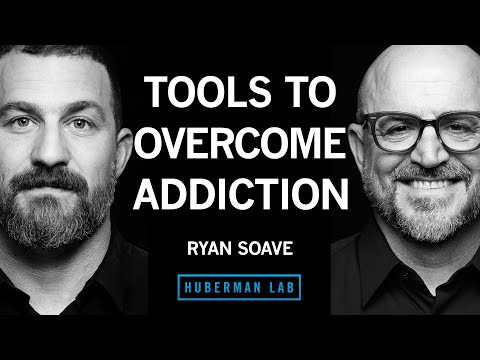
Tools for Overcoming Substance & Behavioral Addictions | Ryan Soave
Andrew Huberman (host), Ryan Soave (guest)
In this episode of Huberman Lab, featuring Andrew Huberman and Ryan Soave, Tools for Overcoming Substance & Behavioral Addictions | Ryan Soave explores rewiring Addiction: Trauma, Dopamine, and Daily Recovery Tools Explained Andrew Huberman and addiction/trauma specialist Ryan Soave unpack addiction as a maladaptive solution to underlying pain rather than the core problem itself. Soave explains how substances and behaviors like alcohol, gambling, porn, and social media function as “medicine” for unmanaged distress, then become new sources of trauma and chaos. They detail a practical framework for treatment: medical stabilization when needed, understanding the person’s biological/psychological/social context, building distress tolerance, and then constructing a meaningful life that makes relapse less likely. Throughout, they offer concrete, zero-cost tools—like an “emotional weather map,” Yoga Nidra/NSDR, breathwork, and 12-step communities—that anyone can use to better manage stress and compulsive behaviors.
Rewiring Addiction: Trauma, Dopamine, and Daily Recovery Tools Explained
Andrew Huberman and addiction/trauma specialist Ryan Soave unpack addiction as a maladaptive solution to underlying pain rather than the core problem itself. Soave explains how substances and behaviors like alcohol, gambling, porn, and social media function as “medicine” for unmanaged distress, then become new sources of trauma and chaos. They detail a practical framework for treatment: medical stabilization when needed, understanding the person’s biological/psychological/social context, building distress tolerance, and then constructing a meaningful life that makes relapse less likely. Throughout, they offer concrete, zero-cost tools—like an “emotional weather map,” Yoga Nidra/NSDR, breathwork, and 12-step communities—that anyone can use to better manage stress and compulsive behaviors.
The conversation also explores how childhood roles, family dynamics, and unprocessed trauma shape adult coping strategies, and why confusing discomfort with threat keeps people stuck in survival mode. Soave emphasizes that recovery is not just about stopping a behavior; it’s about learning to “feel bad” without self-destruction and repeatedly returning to balance amidst life’s inevitable storms.
Key Takeaways
Addiction is usually a solution to pain, not the root problem.
Soave frames addiction—whether to alcohol, drugs, porn, gambling, or work—as an attempt to relieve underlying distress, not the core issue itself. ...
Get the full analysis with uListen AI
Stabilization comes first; deeper work comes only after safety is restored.
For acute substance use (e. ...
Get the full analysis with uListen AI
Building distress tolerance is central: recovery is learning “how to feel bad.”
Soave repeatedly emphasizes that he helps clients “learn how to feel bad”—to face discomfort, pain, and difficult emotions without reaching for short-term relief that causes long-term damage. ...
Get the full analysis with uListen AI
Use an “emotional weather map” each morning to anticipate and manage triggers.
Soave recommends a daily written exercise: (1) list a few gratitudes, including one current challenge; (2) sketch the basic plan for the day; (3) name your current emotional state (e. ...
Get the full analysis with uListen AI
Yoga Nidra/NSDR and breathwork are powerful, zero-cost nervous system tools.
Daily Yoga Nidra or NSDR (20–35 minutes, ideally morning and late afternoon) trains the ability to relax the body while the mind stays aware, enhancing parasympathetic activation and making it easier to move from dysregulation to calm. ...
Get the full analysis with uListen AI
Behavioral addictions exploit dopamine and contrast effects, making real life feel dull.
Video games, social media, online porn, gambling, and even excessive online shopping produce rapid, high dopamine spikes and hyper-rich sensory input. ...
Get the full analysis with uListen AI
Community and 12-step programs are accessible, proven containers for long-term change.
Soave highlights 12-step fellowships (AA, NA, GA, SA, etc. ...
Get the full analysis with uListen AI
Notable Quotes
““I don’t really see addiction as the problem. Addiction is the solution to some underlying stressor.””
— Ryan Soave
““What I really do with them is help them learn how to feel bad.””
— Ryan Soave
““Beware the things that come easily and quickly.””
— Andrew Huberman
““Most of the time when people are doing drugs the first time, it doesn’t feel like that fried egg. It feels good. It feels great.””
— Ryan Soave
““A real secret to having a fulfilling life is being able to embrace all aspects of ourself, the light and the shadow.””
— Ryan Soave
Questions Answered in This Episode
You describe addiction as a solution that becomes the problem; can you walk through a concrete example of that cycle—from early trauma, to stress patterns, to the specific addiction, and then how you’d unwind it in treatment?
Andrew Huberman and addiction/trauma specialist Ryan Soave unpack addiction as a maladaptive solution to underlying pain rather than the core problem itself. ...
Get the full analysis with uListen AI
For a young man who feels trapped in compulsive pornography use but is paralyzed by shame, what exact first three steps would you recommend he take this week, including how to talk about it with someone in his real life?
The conversation also explores how childhood roles, family dynamics, and unprocessed trauma shape adult coping strategies, and why confusing discomfort with threat keeps people stuck in survival mode. ...
Get the full analysis with uListen AI
You emphasize an appetite for discomfort that, if unmet in healthy ways, gets channeled into unhealthy addictions—how would you help a high-performing ‘work addict’ or ultra-endurance athlete know when their chosen struggle is adaptive versus destructive?
Get the full analysis with uListen AI
Given your concerns about ethics and overuse of psychedelics in the personal development world, what screening criteria and guardrails would you put in place before allowing someone with a history of addiction to pursue psilocybin or ibogaine treatment?
Get the full analysis with uListen AI
You spoke about family roles and covert parentification as covert abuse; how should an adult who realizes they were ‘the emotional parent’ growing up confront their parents—if at all—and integrate that insight without simply blaming or cutting off contact?
Get the full analysis with uListen AI
Transcript Preview
(Upbeat music) Welcome to the Huberman Lab Podcast where we discuss science, and science-based tools for everyday life. I'm Andrew Huberman, and I'm a professor of neurobiology and ophthalmology at Stanford School of Medicine. My guest today is Ryan Swave. Ryan Swave is a renowned expert in addiction treatment and trauma recovery. Ryan has spent decades on the front lines helping people overcome addictions to substances like alcohol and various drugs, as well as behavioral addictions including gambling, video games, and pornography. His approach combines evidenced-based protocols tailored to each person's unique family history and needs. During today's episode we explore all aspects of addiction, including the relationship between addiction and trauma. Ryan shares insights from his extensive clinical work and provides clear zero-cost protocols for effective recovery that leverage neuroplasticity, which is your brain's ability to change with intention and experience. We discuss and compare residential treatment programs, 12-step programs, self-guided addiction recovery, and more. If you or someone you know suffers from addiction, the information and tools offered in this episode ought to be of tremendous benefit to initiate and maintain sobriety from that behavior or substance. Before we begin, I'd like to emphasize that this podcast is separate from my teaching and research roles at Stanford. It is however part of my desire and effort to bring zero-cost-to-consumer information about science and science-related tools to the general public. In keeping with that theme, this episode does include sponsors. And now for my discussion with Ryan Swave. Ryan Swave, welcome.
I'm glad to be here. Thank you for having me.
You're the guy that people call, reach out to, cry to when everything comes crashing down. That's kind of your thing.
Yeah.
And you have this incredible, uh, gift really to, uh, orient people in time and space when that sort of thing is happening, and you do this for men, women, teens, kids, adults, families. You've pretty much seen it all, although I'm sure there's more to come. I would love for you to just explain to people listening what addiction is, and how you see it show up in people's lives. I know that you tend to get things like a trauma surgeon would see the human body, hemorrhaging and in need of great support, but how do you think about addiction?
First thing, I'd like to make a little bit of a distinction, you know, we're gonna talk about addiction, um, when we look at the DSM, the diagnostic manual that we use for diagnosing psychological disorders, not really addiction as a diagnosis. That's not super important necessarily because we can talk about it in the, the term of addiction but, you know, we can look at people and have s- and, and look at biological, uh, psychological and social factors and make a diagnosis to see that they've got a substance use disorder, an alcohol use disorder, uh, whether it's moderate or severe or they're dependent on it, and not to give people an out but not all people that show up with an alcohol use disorder for a point and time are necessarily an addict. They may not be forever. It might have been a life circumstance that kind of, that brought them there. Um, that said, someone that at a point and time in their life could have an alcohol use disorder or substance use disorder, you know, they're probably prone to that and they probably shouldn't, uh, continued on that path or, or gambled with it. Um, so talking about addiction in general, I like to broaden that definition to really, you know, the question I'll ask people is does it have you or do you have it? Is it driving you and your behaviors, are you really leaning on it in a way that that's your, uh, your medicine? Because I, I don't really see addiction as the problem. You know, addiction is the solution, whatever they're addicted to is the solution to some underlying stressor. You know, I, I think as, as humans we, when we're dis- when we're uncomfortable, when we're experiencing pain, our kind of immediate reaction is to get out of that, and when that stress becomes really big we're going to look for the things that are gonna impact us a, a lot quicker, you know, taking a drink, using a drug. Now once people start doing that, depending on what it is, you know, if it's, uh, heroin or fentanyl, uh, they could become physically addicted to it very quickly, or alcohol over time, um, but I think the, the definition can be expanded to a lot of other things, maybe even things that seem mundane, you know? And we can have addictive behaviors at different points in our life and maybe work have the same behavior that sometimes is addictive and sometimes isn't. You know, this is very mundane but sometimes I'm binge watching Netflix because I'm on a plane and don't have anything to do or I'm sick and I can't get out of bed, and other times I might have a really stressful day or have something going on that I don't want to deal with and I end up watching TV too late and then I don't sleep and now is that a, a addiction that I need to get treatment for or be pulled away from my family for? Probably not, but it's I, I, I think in talking about addiction we want to understand, you know, what is it that people are using whether it's a substance or a behavior and why are they using it? You know, th- while I say it's addiction is not the problem, it's the solution, it's a solution that becomes very problematic for people, um, and, you know, you will know this better than, than I will or be able to explain it better than I would but, you know, they get a benefit in their brain and body for feeling this sense of relief that they'll feel when they use the substance, you know? One of the, uh, doctors who initially supported the people who founded Alcoholics Anonymous, his name was Dr. Silkworth and he wrote this opinion and he said, "Men and women drink essentially because they like the effect produced by alcohol."I believe that effect is relief. So people are looking for some sort of relief and the question has to be, I think when we're talking about addiction, what is it that they're looking for relief from?
Install uListen to search the full transcript and get AI-powered insights
Get Full TranscriptGet more from every podcast
AI summaries, searchable transcripts, and fact-checking. Free forever.
Add to Chrome