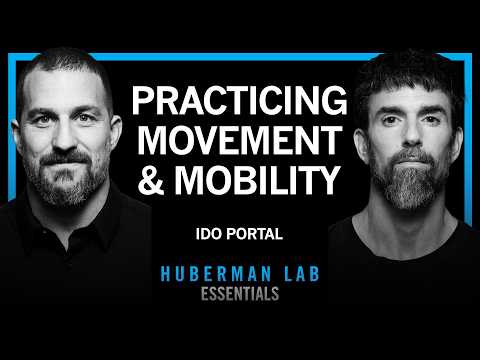
Essentials: The Science & Practice of Movement | Ido Portal
Andrew Huberman (host), Ido Portal (guest)
In this episode of Huberman Lab, featuring Andrew Huberman and Ido Portal, Essentials: The Science & Practice of Movement | Ido Portal explores ido Portal on movement as inquiry: awareness, play, and senses Ido Portal frames movement practice as an open, decentralized system that can be entered through many routes—body, playfulness, or focused training—but must include self-inquiry and awareness of constant “motion” (body, mind, emotions, environment).
Ido Portal on movement as inquiry: awareness, play, and senses
Ido Portal frames movement practice as an open, decentralized system that can be entered through many routes—body, playfulness, or focused training—but must include self-inquiry and awareness of constant “motion” (body, mind, emotions, environment).
He argues that many limitations come from habitual “postures” of body, thought, and emotion, and that advanced practice aims to work with these patterns while also learning to move beyond them toward freer, more adaptive expression (virtuosity).
A major practical theme is using sensory parameters—especially vision (focused vs panoramic) and hearing/head positioning—to shift attention, state, and movement organization.
Portal critiques overly linear, standardized fitness approaches (including modern yoga/typical gym training) and urges ongoing experimentation: change constraints, explore discomfort safely/consensually, and make practices personally meaningful rather than chasing one-size-fits-all ‘hacks.’
Key Takeaways
Start movement practice through awareness, not a fixed method.
Portal emphasizes movement as a way to notice motion across body, thoughts, emotions, and environment; the entry point can be play, walking, or formal training, but the core is attentive self-inquiry.
Get the full analysis with uListen AI
Train “wordlessness” as a skill for clarity and recovery.
Non-verbal attention to sensation and motion can become a ‘safe haven’ from cognitive overload and help unlock freshness, adaptability, and presence over time.
Get the full analysis with uListen AI
Identify your recurring “postures” to avoid lifelong repetition.
People often keep the same physical and mental-emotional patterns even as they learn new sports; progress requires recognizing these defaults and gradually expanding beyond them.
Get the full analysis with uListen AI
Use variability to move from mastery toward virtuosity.
Beyond competent technique, inviting chance and variation builds real freedom—more ways to solve the same problem without becoming trapped by one “correct” form.
Get the full analysis with uListen AI
Treat vision as a movement tool: toggle focus and panoramic awareness.
Portal argues modern life overtrains narrow focus (reading/screens); balancing with soft, panoramic viewing—especially in nature—can improve responsiveness and broaden attention-state control.
Get the full analysis with uListen AI
Let head/eyes organize the rest of the body.
In teaching movement (e. ...
Get the full analysis with uListen AI
Practice proximity and touch to reduce reactivity—consensually.
Exploring peripersonal space can reveal anxiety-driven anticipatory reactions; learning to sense more without reacting builds performance, clearer thinking, and more flexible social/physical interaction.
Get the full analysis with uListen AI
Linear exercise is useful but incomplete; the win is the examination.
Weight training, yoga, and machines can narrow movement options if done rigidly; the real upgrade is experimenting with stance, breath, head position, tempo, facial expression, and context—staying a ‘researcher’ rather than chasing hacks.
Get the full analysis with uListen AI
Notable Quotes
“It’s an open system. It has no center, it’s decentralized, and it can be approached from anywhere.”
— Ido Portal
“We do not move the eyes as well as we think we do.”
— Ido Portal
“The fact that you can sense more doesn’t mean you should react to it.”
— Ido Portal
“People want a hack. People want the icing. There is no cake.”
— Ido Portal
“If you don’t get the weird looks, you’re not moving in the right direction.”
— Ido Portal
Questions Answered in This Episode
Portal says movement is an “open system.” What are 3 concrete starting practices for different entry points (play, strength training, walking) that still preserve self-inquiry?
Ido Portal frames movement practice as an open, decentralized system that can be entered through many routes—body, playfulness, or focused training—but must include self-inquiry and awareness of constant “motion” (body, mind, emotions, environment).
Get the full analysis with uListen AI
How do you operationally identify a person’s repeating “postures” (physical/cognitive/emotional) in the first 10 minutes of observing them move?
He argues that many limitations come from habitual “postures” of body, thought, and emotion, and that advanced practice aims to work with these patterns while also learning to move beyond them toward freer, more adaptive expression (virtuosity).
Get the full analysis with uListen AI
What’s a simple weekly progression for training panoramic vision vs narrow focus, and how would you test whether it’s improving performance or state control?
A major practical theme is using sensory parameters—especially vision (focused vs panoramic) and hearing/head positioning—to shift attention, state, and movement organization.
Get the full analysis with uListen AI
You claim the head organizes the feet (e.g., in bobbing). What drills best demonstrate this for beginners without creating neck tension or compensation?
Portal critiques overly linear, standardized fitness approaches (including modern yoga/typical gym training) and urges ongoing experimentation: change constraints, explore discomfort safely/consensually, and make practices personally meaningful rather than chasing one-size-fits-all ‘hacks.’
Get the full analysis with uListen AI
On hearing: what does “cone of auditory attention” training look like in practice, and how does it transfer to movement skill?
Get the full analysis with uListen AI
Transcript Preview
[upbeat music] Welcome to Huberman Lab Essentials, where we revisit past episodes for the most potent and actionable science-based tools for mental health, physical health, and performance. I'm Andrew Huberman, and I'm a professor of neurobiology and ophthalmology at Stanford School of Medicine. And now for my discussion with Ido Portal Ido, thank you for coming here today. Over the years, we've been in communication, and I've come to realize that you're a true intellectual of the topic of movement. And I define an intellectual as somebody who can understand a topic at multiple levels of granularity. To start off, could you inform us how people should think about approaching a movement practice? What is the first layer of any good movement practice?
It's an open system. It has no center, it's decentralized, and it can be approached from anywhere, and, uh, that's its magic, and that's, that's the benefit of it. Some people, uh, find the body a good entry point, and then playfulness can be an entry point, an attribute or... And this is so open, so I, I don't want to limit, uh, people and limit their minds in the way that they engage with the practice. But I also want to encourage the self-inquiry. So when people enter movement practice, it is about education, bringing some awareness to the fact that they are living in a body, that they are living in motion, that their mind is a type of movement, that their life is a type of movement. Uh, bringing attention to the movement o- of the emotions as well, bringing just attention to the fact that things are in motion. Uh, and this, for me, is the movement practice, is, is this examination and bringing this awareness into things. As we sit now here, I'm also aware of my body. I'm also aware of the way that things make me feel, the way that your face is communicating to me, and, uh, and I'm not just i- in some limited, overly verbal state because it misses a lot of the beautiful flux.
Actually, in anticipation of you arriving here today, I noticed that as I was going up and down the stairs in this, in this house, um, that I was injecting a little bit of playfulness in the way that I might have many, many decades ago, but haven't for a very long time. And I asked myself whether or not that's what Ido is referring to, as opposed to, but of course not exclusive from just saying: "I have forty-five minutes. I'm going to do movement practice before I shower and have some dinner." Could you share with us just some ideas to get people thinking about or maybe even, uh, incorporating movement practice into their day, and maybe even, uh, touch on the, the potential role of play or playfulness?
One thing is this, what you call wordlessness. Uh, I, I have been recommending to people non-verbal experiences. The awareness of motion is a very good way to start to, to bring awareness to that layer, and that layer will start to get clarified more and more and more, the more you practice. And then it will enable, for most people, a safe haven, away from many states and difficulties, and will unlock a lot of potential, uh, attributes and strengths and, uh, freshness, and a lot of beautiful things. Really, uh, one of the pretty perspectives about who we are comes, uh, from a person who influenced my thinking a lot, Moshe Feldenkrais, the late Moshe Feldenkrais. And he talks about the body as the core three elements: the core nervous system, two is the mechanical system of muscle, skeleton, et cetera, and the third is the environment, which is a unique way to look at it. And he talks about how the nervous system is both get- receiving information from the outside and from the inside. And in the first years of life, you work a lot on differentiating those, what am I-- what is me and what is not me. And I think when you feel movement, you feel the movement of the outside that is, of course, arriving to you and receiving this, and also your own internal movement, and the same can be said for stillness. So bringing the attention into those layers, it's a tricky thing. It's one of those elusive things to look at, but it's definitely of huge benefit to start to train it, start to practice it, to feel not our thoughts, not necessarily our body, but to start to recognize the dynamic nature, the flux, the motion. And it occurs in all these layers. You will need to find it in multiple locations before you start to more and more m- make it your own, make it really yours. For example, uh, simple pragmatic things. I used to do this, uh, I spent some time in Hong Kong, uh, I would, uh, need to get my practice in, but n- I'm, I'm really turned off from commercial gyms, and th- there is not a lot of nature accessible there. So I would just strap on my bag, and I would walk the streets of Hong Kong, which are very crowded, and then I would try to avoid touching anyone. And it would be like two hours of, of just, like, moving, involved, fully involved, fully in my body and experiencing beautiful things and enjoying and developing myself as well. So this is an example of a, a way to, to practice. And then the way that we're sitting, like these chairs, for example, our chairs are not very dynamic, but there is rocking chairs, right? And this is something I recommend for a lot of kids. Uh, like in schools, I used to rock on the chair, uh, which is very common. I would make the chairs even more mobile, and, uh, I, I would support more motion, and then I, I would be able to bring attention there, but I would also be able to bring attention away from it into other things, and it keeps refreshing me.... so I don't become stale, the water doesn't stand. This is the beauty of, of movement. So you can focus for long periods of time and do incredible things with the mind, with focus, with awareness, attention, um, and it's with skin in the game. So that's how movement keeps me very honest and humble i- in the way that I view humility and, and, uh, in a way that protects me, um, and, and keeps me, yeah, it keeps me fresh.
Install uListen to search the full transcript and get AI-powered insights
Get Full TranscriptGet more from every podcast
AI summaries, searchable transcripts, and fact-checking. Free forever.
Add to Chrome