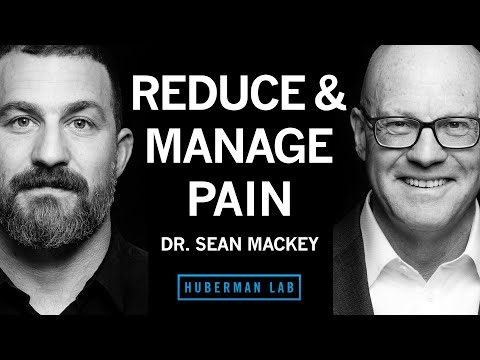
Tools to Reduce & Manage Pain | Dr. Sean Mackey
Andrew Huberman (host), Dr. Sean Mackey (guest)
In this episode of Huberman Lab, featuring Andrew Huberman and Dr. Sean Mackey, Tools to Reduce & Manage Pain | Dr. Sean Mackey explores science-Backed Strategies To Understand, Reduce, And Reframe Physical Pain Neurobiologist Andrew Huberman interviews Stanford pain specialist Dr. Sean Mackey about what pain is, how it arises in the nervous system, and why it is always both sensory and emotional. They distinguish nociception (raw danger signals from the body) from the brain’s constructed experience of pain, explaining why pain is so individual and context-dependent. The conversation covers acute versus chronic pain, hurt versus harm, and how factors like emotions, beliefs, early life experiences, and relationships amplify or reduce pain. They review evidence-based tools—from NSAIDs, opioids, and supplements to heat/cold, movement, mindfulness, cognitive therapy, acupuncture, and digital health—to help people manage and in some cases significantly reduce chronic pain.
Science-Backed Strategies To Understand, Reduce, And Reframe Physical Pain
Neurobiologist Andrew Huberman interviews Stanford pain specialist Dr. Sean Mackey about what pain is, how it arises in the nervous system, and why it is always both sensory and emotional. They distinguish nociception (raw danger signals from the body) from the brain’s constructed experience of pain, explaining why pain is so individual and context-dependent. The conversation covers acute versus chronic pain, hurt versus harm, and how factors like emotions, beliefs, early life experiences, and relationships amplify or reduce pain. They review evidence-based tools—from NSAIDs, opioids, and supplements to heat/cold, movement, mindfulness, cognitive therapy, acupuncture, and digital health—to help people manage and in some cases significantly reduce chronic pain.
Key Takeaways
Pain Is Created In The Brain, Not In The Tissue
Nociceptors in skin, muscle, and viscera detect heat, pressure, chemical changes, etc. ...
Get the full analysis with uListen AI
Learn To Distinguish ‘Hurt’ From ‘Harm’
A central clinical and self-management principle is separating painful sensations (hurt) from ongoing tissue damage (harm). ...
Get the full analysis with uListen AI
Use Medications Strategically: NSAIDs, Acetaminophen, Opioids, And Beyond
NSAIDs (ibuprofen, naproxen, aspirin) reduce inflammation and peripheral sensitization (anti-hyperalgesic) but are not classic analgesics; they act on COX/prostaglandin pathways in periphery, spinal cord, and brain. ...
Get the full analysis with uListen AI
Simple Physical Techniques Powerfully Modulate Pain
Melzack and Wall’s gate control theory plus descending inhibition explain why rubbing, shaking, or running water over an injury reduces pain: fast A-beta touch fibers and brainstem pathways inhibit nociceptive transmission in the spinal cord. ...
Get the full analysis with uListen AI
Movement, Pacing, And Physical Rehab Are Cornerstones For Chronic Pain
Chronic pain often leads to activity avoidance, deconditioning, and a boom-bust cycle: doing too much on good days, crashing on bad days, then developing fear of movement. ...
Get the full analysis with uListen AI
Psychological Factors Can Amplify Or Dampen Pain—and Are Treatable
Anxiety, depression, anger (especially “anger in”), and catastrophizing (repetitive, exaggerated negative thinking about pain) reliably worsen pain, disability, and treatment response. ...
Get the full analysis with uListen AI
Relationships, Love, And Social Connection Are Real Analgesics
In a study with newly-in-love college students, looking at photos of their romantic partner while receiving painful stimuli reduced pain as much as a demanding distraction task, but via different circuits. ...
Get the full analysis with uListen AI
Notable Quotes
“What goes on in your shoulder or your neck is not pain. That's nociception… once it hits the brain, it becomes the experience of pain.”
— Dr. Sean Mackey
“One of the key messages is understanding the distinction between hurt versus harm.”
— Dr. Sean Mackey
“I'm not pro-opioid. I'm not anti-opioid. I am pro-patient.”
— Dr. Sean Mackey
“Pain inhibits pain… when you engage a painful stimulus at a different site, it engages brainstem circuits that send descending inhibition to the spinal cord.”
— Dr. Sean Mackey
“I don't try to distinguish between psychological pain and physical pain. It's pain, end of.”
— Dr. Sean Mackey
Questions Answered in This Episode
For someone with long-standing back pain who’s been told their imaging is ‘normal,’ how can they practically apply your hurt-versus-harm framework to decide which activities to resume and how far to push themselves?
Neurobiologist Andrew Huberman interviews Stanford pain specialist Dr. ...
Get the full analysis with uListen AI
You mentioned that anger in and catastrophizing are major amplifiers of pain—what are the most concrete first steps a patient could take (on their own or with a therapist) to start reducing these patterns?
Get the full analysis with uListen AI
Given your caution about NSAIDs potentially delaying healing, how would you advise an athlete who wants to minimize long-term joint damage but also needs to manage pain enough to keep training and sleeping?
Get the full analysis with uListen AI
On kratom and cannabis: if you were designing the ideal clinical trials to determine whether and how these should be used for pain, what doses, formulations, and patient populations would you prioritize?
Get the full analysis with uListen AI
Your work on ‘love analgesia’ suggests social connection is biologically potent—what can people without a romantic partner practically do to leverage social and emotional factors (friendship, community, touch) as part of their pain management plan?
Get the full analysis with uListen AI
Transcript Preview
(uptempo music) Welcome to the Huberman Lab Podcast, where we discuss science and science-based tools for everyday life. I'm Andrew Huberman, and I'm a professor of neurobiology and ophthalmology at Stanford School of Medicine. My guest today is Dr. Sean Mackey. Dr. Sean Mackey is a medical doctor, that is, he treats patients, as well as a PhD, meaning he runs a laboratory. He is the chief of the division of pain medicine and a professor of both anesthesiology and neurology at Stanford University School of Medicine. Today, we discuss, what is pain? Most of us are familiar with the notion of pain from having a physical injury or some sort of chronic pain or a headache. Today, Dr. Mackey makes clear what the origins of pain are, both in the nervous system and outside the nervous system. That is, the interactions between the brain and the body that give rise to this thing that we call pain. Indeed, we discuss the critical link between physical pain and emotional pain, and how altering one's perception of emotional or physical pain can often change the other. We also discuss some of the changes in the nervous system that occur when we experience pain, and how that can give rise to chronic pain.If you'd like to try BetterHelp, go to betterhelp.com/huberman to get 10% off your first month. Again, that's betterhelp.com/huberman. And now for my discussion with Dr. Sean Mackey. Dr. Mackey, welcome.
Oh, it's a pleasure to be here. Thank you.
Yeah, this is a long time coming. We're colleagues at Stanford, and I'm familiar-
Yeah.
... with your work, but today, we're going to take a pretty broad and deep survey of this thing called pain. So I'll just start off very simply and ask, what is pain?
Pain is this complex and subjective experience that serves a crucial role for all of us to keep us away from injury or harm. It is both a sensory and an emotional experience, and I think that gets lost on people that includes this emotional component to it, and it is incredibly individual. And we'll get more into that hopefully as time goes by that, you know, your pain is different from my pain and is different from everybody else's. It takes an incredible toll on society when it goes chronic, when it becomes persistent to the tune of about 100 million Americans, and at last count, about a half a trillion dollars a year in medical expenses, uh, so an astounding problem we're facing in society and one that's only getting worse. And I'm hoping during the course of this discussion that we can kind of break down a little bit of the foundation of pain and kind of build it back up because unfortunately, uh, in society, there's a lot of misunderstanding about what pain is. And I think, uh, hopefully we can build that foundation and then layer on some, some useful treatments and useful options for people.
Install uListen to search the full transcript and get AI-powered insights
Get Full TranscriptGet more from every podcast
AI summaries, searchable transcripts, and fact-checking. Free forever.
Add to Chrome