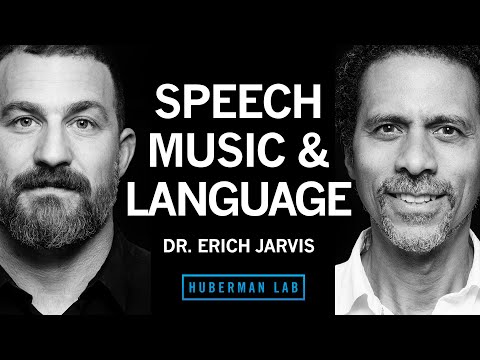
The Neuroscience of Speech, Language & Music | Dr. Erich Jarvis
Andrew Huberman (host), Erich Jarvis (guest), Narrator, Narrator
In this episode of Huberman Lab, featuring Andrew Huberman and Erich Jarvis, The Neuroscience of Speech, Language & Music | Dr. Erich Jarvis explores how Brains Turn Sound Into Speech, Song, Dance, and Writing Neurobiologist Erich Jarvis explains how speech, language, music, and dance all emerge from overlapping motor and sensory circuits rather than a separate “language module” in the brain. Humans, parrots, songbirds, and hummingbirds share specialized forebrain pathways that enable vocal learning—the rare ability to imitate sounds—built on more ancient motor systems for body movement.
How Brains Turn Sound Into Speech, Song, Dance, and Writing
Neurobiologist Erich Jarvis explains how speech, language, music, and dance all emerge from overlapping motor and sensory circuits rather than a separate “language module” in the brain. Humans, parrots, songbirds, and hummingbirds share specialized forebrain pathways that enable vocal learning—the rare ability to imitate sounds—built on more ancient motor systems for body movement.
Jarvis details how reading, writing, and even silent thinking covertly recruit our speech muscles, why critical periods make childhood language learning easier, and how genes shape both the wiring and metabolic demands of speech circuits. He also describes the surprising link between vocal learning and the capacity to dance in time with music.
The conversation spans from animal models and convergent evolution to stuttering, texting, brain–computer interfaces, and global efforts to sequence the genomes of all vertebrates and endangered species. Throughout, Jarvis argues that movement—of the larynx, hands, face, or whole body—is central to how the brain generates and understands communication.
Key Takeaways
Speech and language are embedded in motor and sensory circuits, not a separate ‘language module’.
Jarvis argues that what we call “language” is implemented inside specialized speech-production and auditory-perception pathways, rather than in an abstract, standalone language center. ...
Get the full analysis with uListen AI
Vocal learning is rare and defines spoken language; most animals vocalize innately.
Nearly all vertebrates produce innate calls (e. ...
Get the full analysis with uListen AI
Critical periods make childhood the optimal window for learning languages and phonemes.
Like songbirds, humans have a developmental window when speech and language are learned most efficiently. ...
Get the full analysis with uListen AI
Reading and writing covertly recruit your speech and auditory systems.
When you read, visual input is routed to speech motor areas; you silently “speak” the words, often generating detectable low-level activity in laryngeal muscles. ...
Get the full analysis with uListen AI
Dance and rhythmic movement are tightly linked to vocal learning circuits.
Jarvis and others have found that only vocal learning species reliably learn to dance in time with a beat. ...
Get the full analysis with uListen AI
Specific genes remodel speech circuits for connectivity, speed, and plasticity.
Comparative transcriptomics reveal that speech-related regions in humans, songbirds, and parrots share specialized patterns of gene expression. ...
Get the full analysis with uListen AI
Large-scale genome projects will illuminate brain evolution and aid conservation.
Jarvis leads efforts like the Vertebrate Genomes Project and contributes to the broader Earth BioGenome Project, aiming for error-free, telomere-to-telomere genomes across tens of thousands of species. ...
Get the full analysis with uListen AI
Notable Quotes
“There really isn’t such a sharp distinction between speech and language in the brain.”
— Erich Jarvis
“Dogs can understand several hundred human speech words… but they can’t say a word.”
— Erich Jarvis
“Hummingbirds hum with their wings and sing with their syrinx… in a coordinated way.”
— Erich Jarvis
“When you read, you are silently speaking what you read in your brain.”
— Erich Jarvis
“If you want to stay cognitively intact into your old age, you better be moving.”
— Erich Jarvis
Questions Answered in This Episode
You argue that there is no separate ‘language module’ in the brain; what specific experiments (e.g., lesion, stimulation, high-resolution imaging) would most conclusively test this idea against classical language-localization models?
Neurobiologist Erich Jarvis explains how speech, language, music, and dance all emerge from overlapping motor and sensory circuits rather than a separate “language module” in the brain. ...
Get the full analysis with uListen AI
In your motor theory of vocal learning origin, what do you see as the key genetic or developmental changes that allowed motor circuits to ‘duplicate’ and specialize for controlling the larynx rather than limbs?
Jarvis details how reading, writing, and even silent thinking covertly recruit our speech muscles, why critical periods make childhood language learning easier, and how genes shape both the wiring and metabolic demands of speech circuits. ...
Get the full analysis with uListen AI
Given that only vocal-learning species reliably dance to a beat, have you identified any candidate genes or circuit motifs that might jointly support both vocal learning and rhythmic entrainment?
The conversation spans from animal models and convergent evolution to stuttering, texting, brain–computer interfaces, and global efforts to sequence the genomes of all vertebrates and endangered species. ...
Get the full analysis with uListen AI
Your bird model of stuttering implicates basal ganglia and adult neurogenesis; do you envision future therapies for human stuttering that go beyond behavioral approaches, perhaps targeting specific circuit dynamics or plasticity pharmacologically?
Get the full analysis with uListen AI
With the Genome Ark and de-extinction efforts, how do you think we should prioritize which species to resurrect or heavily invest in, and what ethical framework should guide decisions about reintroducing genetically ‘revived’ animals into modern ecosystems?
Get the full analysis with uListen AI
Transcript Preview
(peaceful music) Welcome to the Huberman Lab Podcast, where we discuss science and science-based tools for everyday life. I'm Andrew Huberman, and I'm a professor of neurobiology and ophthalmology at Stanford School of Medicine. Today, my guest is Dr. Erich Jarvis. Dr. Jarvis is a professor at the Rockefeller University in New York City, and his laboratory studies the neurobiology of vocal learning, language, speech disorders, and remarkably, the relationship between language, music, and movement, in particular, dance. His work spans from genomics, so the very genes that make up our genome and the genomes of other species that speak and have language, such as songbirds and parrots, all the way up to neural circuits, that is the connections in the brain and body that govern our ability to learn and generate specific sounds and movements coordinated with those sounds, including hand movements, and all the way up to cognition, that is our ability to think in specific ways based on what we are saying and the way that we comprehend what other people are saying, singing, and doing. As you'll soon see, I was immediately transfixed and absolutely enchanted by Dr. Jarvis's description of his work and the ways that it impacts all the various aspects of our lives. For instance, I learned from Dr. Jarvis that as we read, we are generating very low levels of motor activity in our throat. That is, we are speaking the words that we are reading at a level below the perception of sound or our own perception of those words. But if one were to put an amplifier to measure the firing of those muscles in our vocal cords, we'd find that as we're reading information, we are actually speaking that information. And as I learned and you'll soon learn, there's a direct link between those species in the world that have song and movement, which many of us would associate with dance, and our ability to learn and generate complex language. So, for people with speech disorders, like stutter, or for people who are interested in multiple language learning, bilingual, trilingual, et cetera, and frankly, for anyone who is interested in how we communicate through words, written or spoken, I'm certain today's episode is going to be an especially interesting and important one for you. Dr. Jarvis's work is so pioneering that he has been awarded truly countless awards. I'm not going to take our time to list off all of the various important awards that he's received. But I should point out that in addition to being a decorated professor at the Rockefeller University, he is also an investigator with the Howard Hughes Medical Institute, the so-called HHMI. And for those of you that don't know, HHMI investigators are selected on an extremely competitive basis that they have to re-up, that is they have to re-compete every five years. They actually receive a grade every five years that dictates whether or not they are no longer a Howard Hughes investigator, or whether or not they can advance to another five years of funding for their important research. And indeed, Howard Hughes investigators are selected not just for the rigor of their work, but for their pioneering spirit and their ability to take on high-risk, high-benefit work, which is exactly the kind of work that Dr. Jarvis has been providing for decades now. Again, I think today's episode is one of the more unique and special episodes that we've had on the Huberman Lab Podcast. I single it out because it really spans from the basic to the applied. And Dr. Jarvis's story is an especially unique one in terms of how he arrived at becoming a neurobiologist. So, for those of you that are interested in personal journey and personal story, Dr. Jarvis's is truly a special and important one. I'm pleased to announce that the Huberman Lab Podcast is now partnered with Momentous supplements. We partnered with Momentous for several important reasons. First of all, they ship internationally, because, uh, we know that many of you are located outside of the United States. Second of all, and perhaps most important, the quality of their supplements is second to none, both in terms of purity and precision of the amounts of the ingredients. Third, we've really emphasized supplements that are single ingredient supplements and that are supplied in dosages that allow you to build a supplementation protocol that's optimized for cost, that's optimized for effectiveness, and that you can add things and remove things from your protocol in a way that's really systematic and scientific. If you'd like to see the supplements that we partner with Momentous on, you can go to livemomentous.com/huberman. There, you'll see those supplements, and just keep in mind that we are constantly expanding the library of supplements available through Momentous on a regular basis. Again, that's livemomentous.com/huberman. Before we begin, I'd like to emphasize that this podcast is separate from my teaching and research roles at Stanford. It is, however, part of my desire and effort to bring zero-cost-to-consumer information about science and science-related tools to the general public. In keeping with that theme, I'd like to thank the sponsors of today's podcast. Our first sponsor is InsideTracker. InsideTracker is a personalized nutrition platform that analyzes data from your blood and DNA to help you better meet your immediate and long-term health goals. I've long been a believer in getting regular blood work done, for the simple reason that many of the factors that impact your immediate and long-term health can only be a- analyzed from a quality blood test. And nowadays, with the advent of modern DNA tests, you can also get insight into, for example, what your biological age is and compare that to your chronological age. The problem with a lot of DNA tests and blood tests, however, is you get information back about metabolic factors, lipids, and hormones and so forth, but you don't know what to do with or about that information. InsideTracker solves that problem with a simple platform that allows you to click on any specific factor, learn more about it and what it does in your brain and body, and also, the various nutritional supplementation and other types of interventions you can take to bring the levels of that factor into the ranges that are optimal for you and your health. If you'd like to try InsideTracker, you can go to insidetracker.com/huberman to get 20% off any of s- InsideTracker's plans. That's insidetracker.com/huberman to get 20% off. Today's episode is also brought to us by Roka.ROKA makes eyeglasses and sunglasses that are of the absolute highest quality. They also have some really unique features that make them especially attractive from the standpoint of aesthetics and performance. The company was founded by two all-American swimmers from Stanford, and everything about their eyeglasses and sunglasses were designed with performance in mind. Initially, the eyeglasses and sunglasses were designed for sport, that is for running and for cycling, et cetera, and indeed, still their eyeglasses and sunglasses are very lightweight and they won't slip off your face if you get sweaty. But they also have a terrific aesthetic. You can wear them to work, you can wear them out to eat. I wear readers at night when I work or if I drive, and I wear sunglasses sometimes during the middle of the day if it's too bright and I need sunglasses in order to see. If you'd like to try ROKA eyeglasses or sunglasses, you can go to ROKA, that's ROKA.com and enter the code Huberman to save 20% off your first order. Again, that's ROKA.com and enter the code Huberman at checkout. Today's episode is also brought to us by LMNT. LMNT is an electrolyte drink that has everything you need and nothing you don't, meaning no sugar, but plenty of the correct ratios of sodium, magnesium, and potassium, and those three electrolytes, sodium, magnesium, and potassium, are critical for your neuron, your nerve cell function, and for the function of all the cells in your brain and body. I've mentioned this before on the podcast, but I'm a fan of salt. Not taking too much salt, but certainly not getting too little salt. LMNT has 1,000 milligrams, that is one gram of salt, which might sound like a lot of salt, but for many people, especially people who are following low carbohydrate diets or who are exercising or sweating a lot or both, that level of salt can actually help you in many circumstances. Getting the appropriate level of salt and certainly the appropriate levels of electrolytes will improve your cognitive function and will improve your physical performance. If you'd like to try LMNT, you can go to DrinkLMNT, that's LMNT.com/Huberman, and you'll get a free sample pack with your order. That's DrinkLMNT.com/Huberman. And now for my discussion with Dr. Erich Jarvis. Eric, so great to have you here.
Install uListen to search the full transcript and get AI-powered insights
Get Full TranscriptGet more from every podcast
AI summaries, searchable transcripts, and fact-checking. Free forever.
Add to Chrome