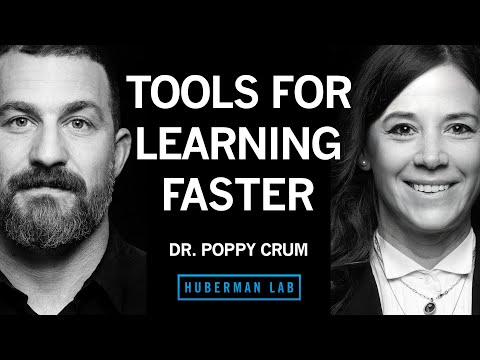
Enhance Your Learning Speed & Health Using Neuroscience Based Protocols | Dr. Poppy Crum
Andrew Huberman (host), Poppy Crum (guest)
In this episode of Huberman Lab, featuring Andrew Huberman and Poppy Crum, Enhance Your Learning Speed & Health Using Neuroscience Based Protocols | Dr. Poppy Crum explores future-Brain: AI Tools To Supercharge Learning, Health, And Environments Dr. Andrew Huberman and neuroscientist/technologist Dr. Poppy Crum explore how technology and AI can be used to drive neuroplasticity, accelerate learning, and optimize health and performance across daily life.
Future-Brain: AI Tools To Supercharge Learning, Health, And Environments
Dr. Andrew Huberman and neuroscientist/technologist Dr. Poppy Crum explore how technology and AI can be used to drive neuroplasticity, accelerate learning, and optimize health and performance across daily life.
They discuss how every technology we use reshapes our brain, from smartphones and video games to emerging AI agents and sensor-rich environments, and why intent and design determine whether these tools make us smarter or more dependent.
Crum explains digital twins (data-based representations of systems like our body, home, car, or even a reef tank), and how integrating multi-modal data with AI can personalize sleep, focus, training, and even medical detection in real time.
She also shares her own path—from absolute pitch and violin to Knudsen’s owl plasticity work and industrial R&D—and provides a zero-cost, no-coding protocol for anyone to build AI tools that train specific skills and behaviors.
Key Takeaways
Use AI To Amplify Your Learning, Not Replace It
Crum distinguishes between using AI as a cognitive amplifier versus a cognitive replacement. ...
Get the full analysis with uListen AI
Design Closed-Loop Training Systems Around Data And Feedback
Powerful neuroplasticity comes from closed loops: clear goals, measurable performance, and real-time feedback. ...
Get the full analysis with uListen AI
Start Building Simple AI + Computer Vision Protocols Now
You don’t need to code to build useful AI tools. ...
Get the full analysis with uListen AI
Think Beyond Wearables: Your Environment Can Be The Sensor
Crum argues we won’t need to cover ourselves in sensors. ...
Get the full analysis with uListen AI
Be Strategic About Where You Let AI Take Over
Crum proposes a simple lens for tools and AI agents: are you using them to (1) give you *more* cognitive skill and insight, or (2) to replace skills just to go faster? ...
Get the full analysis with uListen AI
Exploit Task-Relevant Gaming And Training For Real-World Gains
Video game work shows that about 40 hours of fast-paced gaming (e. ...
Get the full analysis with uListen AI
Leverage Multi-Modal Signals For Early Health Detection
AI can pick up disease signatures long before humans or standard exams, by analyzing patterns in voice (prosody, micro-fluctuations), eye metrics (pupil size, saccades), breathing (CO₂, VOCs), and movement. ...
Get the full analysis with uListen AI
Notable Quotes
“Everything we engage with in our daily lives, especially technology, is architecting our brains as we move forward.”
— Dr. Poppy Crum
“The quick things that make us faster can also make us dumber, and take away our cognitive capabilities.”
— Dr. Poppy Crum
“We aren’t developing new resources; it’s how those cells are getting allocated to the different ways my brain has to interpret a text message.”
— Dr. Poppy Crum
“Without germane cognitive load, you don't have learning, really.”
— Dr. Poppy Crum
“Our success as humans is partly dependent on how we use technology to optimize each of us with the different variables we need.”
— Dr. Poppy Crum
Questions Answered in This Episode
How would you design a simple, no-code digital twin for your own focused work—what signals would you capture, and what feedback would you want it to give you in real time?
Dr. ...
Get the full analysis with uListen AI
Where do you personally draw the line between using AI as a ‘GPS’ that replaces cognitive skills and using it as an amplifier, especially in domains like writing, clinical reasoning, or scientific research?
They discuss how every technology we use reshapes our brain, from smartphones and video games to emerging AI agents and sensor-rich environments, and why intent and design determine whether these tools make us smarter or more dependent.
Get the full analysis with uListen AI
Given that acronyms and texting are a form of lossy compression, what nuances of in-person conversation or long-form writing do you think are truly irreplaceable—and which might younger generations genuinely not need?
Crum explains digital twins (data-based representations of systems like our body, home, car, or even a reef tank), and how integrating multi-modal data with AI can personalize sleep, focus, training, and even medical detection in real time.
Get the full analysis with uListen AI
What are the most realistic near-term examples of ambient sensing (CO₂, sound, thermals, eye-tracking) that could and *should* be deployed in homes or cars, and what privacy constraints would you insist on to make them acceptable?
She also shares her own path—from absolute pitch and violin to Knudsen’s owl plasticity work and industrial R&D—and provides a zero-cost, no-coding protocol for anyone to build AI tools that train specific skills and behaviors.
Get the full analysis with uListen AI
If a future AI system could reliably detect early Alzheimer’s or suicidality from your speech or online behavior, who should have access to that information—only you, your doctor, your family, or perhaps no one without explicit, revocable consent?
Get the full analysis with uListen AI
Transcript Preview
Welcome to the Huberman Lab Podcast, where we discuss science and science-based tools for everyday life. (instrumental music plays) I'm Andrew Huberman, and I'm a professor of neurobiology and ophthalmology at Stanford School of Medicine. My guest today is Dr. Poppy Crum. Dr. Poppy Crum is a neuroscientist, a professor at Stanford, and the former chief scientist at Dolby Laboratories. Her work focuses on how technology can accelerate neuroplasticity and learning and generally enrich our life experience. You've no doubt heard about and perhaps use wearables and sleep technologies that can monitor your sleep, tell you how much slow wave sleep you're getting, how much REM sleep, and technologies that can control the temperature of your sleep environment and your room environment. Well, you can soon expect wearables and hearable technologies to be part of your life. Hearable technologies are, as the name suggests, technologies that can hear your voice and the voice of other people and deduce what is going to be best for your immediate health and your states of mind. Believe it or not, these technologies will understand your brain states, your goals, and it will make changes to your home and working and other environments so that you can focus better, relax more thoroughly, and connect with other people on a deeper level. As Poppy explains, all of this might seem kind of space age and maybe even a little aversive or scary now, but she explains how it will vastly improve life for both kids and adults, and indeed increase human-human empathy. During today's episode, you'll realize that Poppy is a true out of the box thinker and scientist. She has a really unique story. She discovered she has perfect pitch at a young age. She explains what that is and how that shaped her worldview and her work. Poppy also graciously built a zero-cost step-by-step protocol for all of you. It allows you to build a custom AI tool to improve at any skill you want and to build better health protocols and routines. I should point out that you don't need to know how to program in order to use this tool that she's built. Anyone can use it, and as you'll see, it's extremely useful. We provide a link to it in the show note captions. Today's conversation is unlike any that we've previously had on the podcast. It's a true glimpse into the future, and it also points you to new tools that you can use now to improve your life. Before we begin, I'd like to emphasize that this podcast is separate from my teaching and research roles at Stanford. It is however part of my desire and effort to bring zero-cost-to-consumer information about science and science-related tools to the general public. In keeping with that theme, today's episode does include sponsors. And now for my conversation with Dr. Poppy Crum. Dr. Poppy Crum, welcome.
Thanks, Andy. It's great to be here.
Great to see you again. We should let people know now, we were graduate students together. But that's not why you're here. You're here because you do incredibly original work, you've worked in so many different domains of technology, neuroscience, et cetera. Today, I want to talk about a lot of things, but I want to start off by talking about neuroplasticity, this incredible ability of our nervous systems to change in response to experience. I know how I think about neuroplasticity, but I want to know how you think about neuroplasticity. In particular, I want to know, do you think our brains are much more plastic than most of us believe? Like, can we change much more than we think and we just haven't accessed the ways to do that? Or do you think that our brains are pretty fixed, and in order to make progress as a species, we're going to have to, I don't know, create robots or something to- to do the work that we're not able to do because our brains are fixed? Let's start off by just getting your take on what neuroplasticity is and what you think the limits on it are.
Install uListen to search the full transcript and get AI-powered insights
Get Full TranscriptGet more from every podcast
AI summaries, searchable transcripts, and fact-checking. Free forever.
Add to Chrome