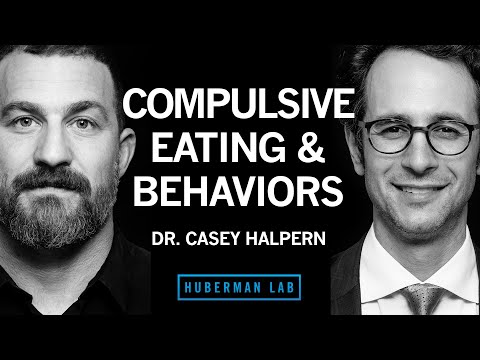
Biology & Treatments for Compulsive Eating & Behaviors | Dr. Casey Halpern
Andrew Huberman (host), Casey Halpern (guest)
In this episode of Huberman Lab, featuring Andrew Huberman and Casey Halpern, Biology & Treatments for Compulsive Eating & Behaviors | Dr. Casey Halpern explores rewiring Cravings: Deep Brain Stimulation for Compulsive Eating Behaviors Andrew Huberman interviews neurosurgeon and researcher Dr. Casey Halpern about using deep brain stimulation (DBS) and other brain–circuit based tools to treat compulsive eating, OCD, addiction, and movement disorders.
Rewiring Cravings: Deep Brain Stimulation for Compulsive Eating Behaviors
Andrew Huberman interviews neurosurgeon and researcher Dr. Casey Halpern about using deep brain stimulation (DBS) and other brain–circuit based tools to treat compulsive eating, OCD, addiction, and movement disorders.
Halpern explains how specific brain circuits, particularly the nucleus accumbens and connected frontal areas, drive loss-of-control behaviors such as binge eating, drug seeking, and compulsive checking.
His lab translates rodent findings into first-in-human trials where implanted devices detect craving-related brain signals in real time and deliver brief, targeted electrical stimulation to interrupt binges.
They also discuss emerging noninvasive approaches like focused ultrasound and TMS, the limits of current pharmacologic and behavioral treatments, and how understanding brain circuitry could inform future therapies for anorexia, depression, and other psychiatric conditions.
Key Takeaways
Compulsive Disorders Share a Core 'Loss-of-Control' Circuit
Halpern emphasizes that OCD, binge eating disorder, certain forms of obesity, and addictions share a common feature: pursuing an urge despite clear risk or negative consequences. ...
Get the full analysis with uListen AI
Nucleus Accumbens is a Hub for Craving, Not Just 'Reward'
The nucleus accumbens integrates inputs from cortical control areas and is crucial for gating reward-seeking and compulsive behavior. ...
Get the full analysis with uListen AI
Responsive, Episodic DBS May Work Better Than Continuous Stimulation
Traditional DBS often delivers constant stimulation, which can lead to tolerance and loss of benefit, as seen in some depression and OCD cases. ...
Get the full analysis with uListen AI
Binge Eating is Episodic; 'Loss-of-Control Eating' is the More Frequent Target
Clinically defined binge episodes (very large amount of food in a short time with loss of control) typically occur once daily in severe binge eating disorder, a constraint of stomach capacity and diagnostic criteria. ...
Get the full analysis with uListen AI
Obesity is a Phenotype; Only a Subset is Driven by Compulsion
Halpern stresses that not all obesity is due to compulsive overeating. ...
Get the full analysis with uListen AI
Noninvasive Tools Show Promise but Need Circuit-Level Precision
Transcranial magnetic stimulation (TMS) is already FDA-approved for depression, OCD, and nicotine addiction, and MR-guided focused ultrasound can create noninvasive lesions for tremor. ...
Get the full analysis with uListen AI
Awareness Helps Many, But Severe Patients Need Direct Circuit Modulation
Behavioral therapies like exposure-response prevention and CBT largely work by improving patients’ awareness of triggers and teaching cognitive control strategies; they can be very effective for mild to moderate OCD and eating disorders. ...
Get the full analysis with uListen AI
Notable Quotes
“The issue is if you have an urge for a reward that either puts you or somebody else at risk, it's probably a reward we shouldn't have.”
— Dr. Casey Halpern
“You have to get into the brain before you get out of it.”
— Dr. Casey Halpern
“We see laughter in the clinic sometimes… that's because we're stimulating parts of the brain that are not just involved in motor circuits, but also in what we call limbic circuits, or parts of the brain involved in emotion.”
— Dr. Casey Halpern
“In a mouse, if you deliver stimulation intermittently, and only when a craving signal is detected, that effect will be the most robust and durable. But if you deliver it continuously, actually the benefit goes away over time.”
— Dr. Casey Halpern
“Obesity is a phenotype… not everybody is obese because of the same thing.”
— Dr. Casey Halpern
Questions Answered in This Episode
In your responsive DBS trials, what specific neural signal features (frequency bands, patterns, or spatial combinations) have proven most predictive of imminent loss-of-control eating in humans?
Andrew Huberman interviews neurosurgeon and researcher Dr. ...
Get the full analysis with uListen AI
Given that continuous stimulation in mice leads to tolerance, have you observed any analogous 'tolerance' or homeostatic compensation so far in your human binge-eating or OCD DBS patients using episodic stimulation?
Halpern explains how specific brain circuits, particularly the nucleus accumbens and connected frontal areas, drive loss-of-control behaviors such as binge eating, drug seeking, and compulsive checking.
Get the full analysis with uListen AI
How would you clinically distinguish between an individual with obesity who is an appropriate candidate for nucleus accumbens DBS (due to true loss-of-control eating) versus someone whose obesity is primarily metabolic or environmental?
His lab translates rodent findings into first-in-human trials where implanted devices detect craving-related brain signals in real time and deliver brief, targeted electrical stimulation to interrupt binges.
Get the full analysis with uListen AI
In your view, could certain popular diets or intermittent fasting protocols inadvertently reinforce maladaptive reward circuitry in vulnerable individuals, similar to your high-fat food findings in mice?
They also discuss emerging noninvasive approaches like focused ultrasound and TMS, the limits of current pharmacologic and behavioral treatments, and how understanding brain circuitry could inform future therapies for anorexia, depression, and other psychiatric conditions.
Get the full analysis with uListen AI
What ethical and regulatory guardrails do you believe are essential as we move toward more precise circuit-based neuromodulation, especially if future technologies allow noninvasive modulation of mood, motivation, or risk-taking in otherwise 'healthy' individuals?
Get the full analysis with uListen AI
Transcript Preview
(uptempo music) Welcome to the Huberman Lab Podcast, where we discuss science and science-based tools for everyday life. I'm Andrew Huberman, and I'm a professor of neurobiology and ophthalmology at Stanford School of Medicine. Today my guest is Dr. Casey Halpern. Dr. Halpern is the Chief of Neurosurgery at the University of Pennsylvania School of Medicine. His laboratory focuses on bulimia, binge eating disorder, and other forms of obsessive-compulsive behaviors. Normally, when we hear about eating disorders or obsessive-compulsive disorders of other kinds, the conversation quickly migrates to pharmacologic interventions, and serotonin, or dopamine, or talk therapy interventions, many of which can be effective. The Halpern Laboratory, however, takes an entirely different approach. While they embrace pharmacologic and behavioral and talk therapy interventions, their main focus is the development and application of engineered devices to go directly into the brain and stimulate the neurons, the nerve cells, that generate compulsions, that cause people to want to eat more even when their stomach is full. In other words, they do brain surgery of various kinds, sometimes removing small bits of brain, sometimes stimulating small bits of brain with electrical current, and even stimulating the brain through the intact skull, that is, without having to drill down beneath the skull, in order to alleviate and indeed sometimes cure these conditions. Today's discussion with Dr. Halpern was an absolutely fascinating one for me because it represents the leading edge of what's happening in modification of brain circuits and the treatment of neurologic and psychiatric disease. For instance, they just recently published a paper in Nature Medicine, one of the premier journals out there, entitled Pilot study of responsive nucleus accumbens deep brain stimulation for loss-of-control eating. The nucleus accumbens is an area of our brains that we all have, in fact, we have two of them, one on each side of the brain, that is intimately involved in the release of dopamine for particular motivated behaviors. And while most often we think about dopamine for the release of behaviors that we want to engage in, in this context, they are using stimulation and control of neuronal activity in nucleus accumbens to control loss-of-control eating, something that when people suffer from it, despite knowing they shouldn't eat, despite not even wanting to eat, they find themselves eating. So again, this represents really the leading edge of where neuroscience is going and certainly is going to be an area of neuroscience that's going to expand in the years to come. And Dr. Halpern and the members of his laboratory are among a very small group of scientists in the world that are using the types of approaches that I described a minute ago and that you're going to hear more about in today's episode in order to resolve some of the most difficult and debilitating human conditions. During today's discussion, you will also learn about the use of deep brain stimulation and other approaches for the treatment of movement disorders such as essential tremor, Parkinson's disease, and various types of dystonias, which are challenges in generating particular types of movement. So whether or not you or somebody that you know suffers from an eating disorder, from obsessive-compulsive disorder, or from a movement disorder, today's episode is sure to teach you not only about what's happening in those arenas but also in the arenas of neuroscience generally. In fact, I would say today's episode is especially important for anyone that wants to understand how the brain works and what the future of brain modification really looks like for all of us. Before we begin, I'd like to emphasize that this podcast is separate from my teaching and research roles at Stanford. It is, however, part of my desire and effort to bring zero cost to consumer information about science and science-related tools to the general public. In keeping with that theme, I'd like to thank the sponsors of today's podcast. Our first sponsor is ROKA. ROKA makes eyeglasses and sunglasses that are of the absolute highest quality. The company was founded by two All-American swimmers from Stanford, and everything about ROKA eyeglasses and sunglasses were created with performance in mind. Now I've spent a lifetime working on the biology of the visual system, and I can tell you that your visual system has to contend with a number of very important challenges in order for you to be able to see clearly, for instance, when you go from a sunny area to a more shaded area and then back out again. It's a very complex process. ROKA eyeglasses and sunglasses were built, that is engineered, with that sort of biology in mind. And as a consequence, no matter where you are wearing them and where you happen to be, you always see through them with crystal clarity. The aesthetic of ROKA eyeglasses and sunglasses is also worth mentioning. Unlike a lot of performance eyeglasses out there which only come in the kind of cyborg variety, ROKA eyeglasses and sunglasses come in those varieties but they also come in varieties that you would feel very comfortable wearing out to dinner or to work or to school, really anywhere that you go. If you'd like to try ROKA eyeglasses you can go to ROKA, that's ROKA.com, and enter the code Huberman to save 20% off on your first order. Again, that's ROKA, ROKA.com, and enter the code Huberman at checkout. Today's episode is also brought to us by Eight Sleep. Eight Sleep makes mattress covers with cooling, heating, and sleep tracking ability. I've talked many times before on this podcast about the close relationship between temperature and your ability to stay asleep and emerge from sleep. The way Eight Sleep mattress covers work is that they allow you to program the temperature of your mattress so that you can fall asleep quickly, get into deep sleep, stay in deep sleep, and emerge from that sleep feeling especially rested by dropping the temperature of that surface by one to three degrees at the beginning of the night-... dropping a little bit further into the night, and then raising the temperature towards morning, because waking up requires that one to three degree re-increase in body temperature. I've been sleeping on an Eight Sleep mattress cover for the last six months or so now and I can assert that it is the absolute biggest game changer in the quality and duration of my sleep. In fact, I don't really like traveling as much as I used to, because the Eight Sleep doesn't go with me and they don't seem to have them yet in Airbnbs and hotels. So, this is also a call to action. Airbnbs and hotels, please put Eight Sleep mattresses on your beds, and I'll be more apt to stay in those hotels and Airbnbs. With that said, if you'd like to try an Eight Sleep mattress cover, you can go to eightsleep.com/huberman. Check out the Pod 3 cover to save $150 at checkout. Again, that's eightsleep.com/huberman, and please note that Eight Sleep currently ships in the USA, Canada, UK, select countries in the EU, and Australia. Again, eightsleep.com/huberman to save $150 at checkout. Today's episode is also brought to us by InsideTracker. InsideTracker is a personalized nutrition platform that analyzes data from your blood and DNA to help you better understand your body and help you reach your health goals. Now, I've long been a believer in getting regular blood work done, for the simple reason that many of the factors that impact your immediate and long-term health can only be assessed with a quality blood test. One of the major issues with the various blood tests out there is that you get information back about lipids and hormones and metabolic factors, et cetera, but you don't know what to do with that information. With InsideTracker, they make knowing what to do with the information you get about your biological health extremely easy. They have this very easy to use dashboard, and that dashboard tells you, for instance, what to change in your nutrition, what supplements you may want or may not want to take, as well as other behavioral and other types of interventions that can allow you to move those numbers related to metabolic, hormone, and other factors into the precise range that's optimal for your immediate and long term health. If you'd like to try InsideTracker, you can go to insidetracker.com/huberman to get 20% off any of InsideTracker's plans. Again, that's insidetracker.com/huberman to get 20% off. On many episodes of the Huberman Lab Podcast, we talk about supplements. While supplements aren't necessary for everybody, many people derive tremendous benefit from them. Things like enhancing sleep and the depth of sleep, or for enhancing focus and cognitive ability, or for enhancing e- energy or adjusting hormone levels to optimal range for you. The Huberman Lab Podcast is now partnered with Momentous Supplements. We partnered with Momentous for a number of important reasons. First of all, the quality of their ingredients is exceptional. It's really second to none. Second of all, they ship internationally, and that was important to us because a number of you reside outside of the United States. Third, we've worked with Momentous very closely to develop single ingredient formulations. Now, this turns out to be very important, because if you're going to take supplements, you want to know what's working for you and what isn't. And of course, you want to optimize the cost efficiency and the biological efficiency of those supplements. To find the supplements we discuss on the Huberman Lab Podcast, you can go to Live Momentous, spelled O-U-S, livemomentous.com/huberman, and I should just mention that the library of those supplements is constantly expanding. Again, that's livemomentous.com/huberman. And now, for my discussion with Dr. Casey Halpern. Casey, I should say Dr. Halpern for those listening, welcome.
Install uListen to search the full transcript and get AI-powered insights
Get Full TranscriptGet more from every podcast
AI summaries, searchable transcripts, and fact-checking. Free forever.
Add to Chrome